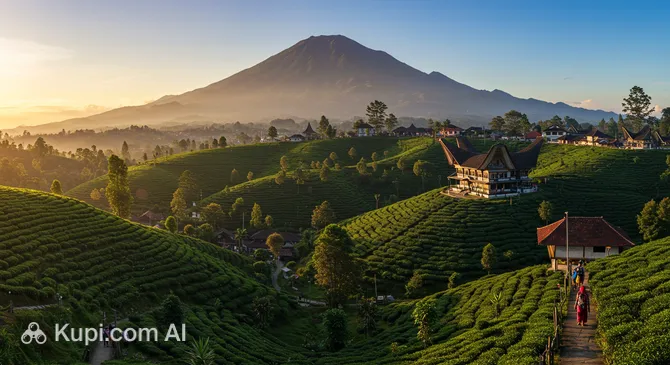
Sumedang is a charming city in the West Java province that has preserved the spirit of traditional Sundanese culture. Located in the picturesque hilly terrain of the Parahyangan region, it serves as an important administrative and cultural center. Visiting this corner of Indonesia allows travelers to get in touch with the authentic islander lifestyle, far from the hustle and bustle of giant megacities, while maintaining convenient proximity to major transport hubs.
The city is situated approximately 45 kilometers from Bandung at an altitude that provides a milder tropical climate than on the coast. The population of the city itself is about 184,000 people, though the entire regency of the same name is home to more than 1.2 million residents. Surrounded by farmland and mountains, Sumedang attracts tourists with its natural views and rich heritage.
Sumedang. Illustration.
Source: Kupi.com AI
The city's rich historical heritage is closely linked to the local royal dynasty, whose relics are still kept in local museums. The city is also world-famous for its gastronomic symbol—a special kind of fried tofu that foodies from all over the country come here to enjoy. Sumedang is ideal for those seeking a peaceful vacation, interested in ethnography, and fond of mountain walks.
If you are planning a journey through West Java, be sure to stop by this city to enjoy its hospitality, taste its famous delicacies, and see the monuments that preserve the memory of ancient rulers and the colonial past.
Weather Overview
In Sumedang, a humid tropical climate typical of inland Java prevails; however, thanks to the elevated terrain, it is somewhat cooler and fresher here than on the coast. The average annual temperature stays within a comfortable range of +24…+26 °C, making the city pleasant to visit at any time of year. You can study a more detailed forecast and the weather in Sumedang by month before your trip.
The year is clearly divided into two periods: the rainy season and the dry season. The heaviest precipitation falls from November to April, with December and January being the wettest months (up to 440 mm of rain). During this time, rains usually take the form of short but intense downpours in the afternoon.
The most favorable time for active travel and nature excursions is considered to be from May to September. During these months, the number of sunny days is at its maximum, and humidity is lower. September and October can be the hottest months, with daytime temperatures rising to +30 °C, though the proximity of the mountains ensures a pleasant nighttime coolness around +20 °C.
Average monthly temperature
Average monthly precipitation
Interesting Facts
Sumedang is the culinary capital of tofu in Indonesia. The famous Tahu Sumedang was first prepared here by a Chinese immigrant in the early 20th century, and since then, the recipe for this crispy fried tofu has become a true brand for the city.
In colonial times, the city's name was spelled in the Dutch style as Soemedang, and it served as an important administrative outpost for the Dutch East Indies in the mountainous region.
The official slogan of the region calls it Paradisj Van Java (Paradise of Java), highlighting the harmonious blend of fertile lands, mountain peaks, and the rich cultural heritage of the Sundanese people.
The local Prabu Geusan Ulun Museum is considered one of the most significant in West Java, as it houses the crown of the kings of the Pajajaran Kingdom—a symbol of ancient power on the island.
How to Get There
The transport accessibility of Sumedang is largely determined by its position on a major highway connecting Bandung and the eastern regions of Java. The city does not have its own airport or railway station, so the main flow of travelers arrives here by road. You can find more details on how to get to Sumedang from various points on the island, including the capital and the nearest major hubs.
The nearest large airports are located in the Bandung area. From there, Sumedang can be reached by taxi, intercity buses, or the popular regional shuttle vans known as "travel." The trip from Bandung usually takes between 1.5 to 2 hours, though you should account for possible traffic jams that often occur at the entrances to major cities during rush hour.
If you prefer rail transport, the nearest station for a transfer will also be the station in Bandung, which serves high-speed trains from Jakarta. There is no direct rail connection to the city center, so the final leg of the journey will be by road in any case. Traveling by bus from Jakarta is also possible, but it will require more time due to heavy highway congestion.
Main Attractions
The main attractions of Sumedang reflect its status as the cultural heart of the region. A must-visit is the central public space—Sumedang City Square (Alun-Alun). This place is the center of urban life, where festivals are held and locals meet. Adjacent to the square is the majestic Great Mosque of Sumedang, which impresses with its architecture and peaceful atmosphere.
For those interested in the history of West Java's ruling dynasties, the Prabu Geusan Ulun Museum is a key site. Its halls house unique artifacts, weapons, and royal regalia that tell the story of the region's glorious past. Within the city, you can also see the Binokasih Monument, which serves as an important symbol of the continuity of power and the identity of the local people.
Nature lovers and seekers of panoramic views are recommended to head to the Jatigede Dam. This colossal hydraulic structure has formed a massive reservoir, whose shores have become a popular spot for relaxation and photos against the backdrop of submerged valleys and surrounding hills. Also located in the city's outskirts is the picturesque Curug Cinulang waterfall, attracting visitors with its cool air and the beauty of its cascading water.
Local Cuisine
The culinary identity of Sumedang is inextricably linked to its main gastronomic symbol—Tahu Sumedang. This fried tofu has a unique crispy crust and a delicate texture inside. It is traditionally eaten hot, accompanied by fresh green bird's eye chilies or dipped in sambal sauce. Stalls selling this treat can be found on almost every street in the city.
In addition to tofu, traditional Sundanese cuisine is widely represented here. The diet is based on rice dishes (nasi), fresh vegetables with spicy sauces (lalapan), and various types of fish, either grilled or cooked in banana leaves. A characteristic feature is the use of many aromatic herbs and soy products, such as tempeh and oncom.
Modern gastronomy is also actively developing in the city. For example, Mie Gacoan offers popular variations of spicy noodles, and fans of Japanese flavors can check out KUMI Ramen. However, to feel the true spirit of the city, be sure to visit local warungs—small family-run cafes where food is prepared according to home recipes and the atmosphere is exceptionally friendly.
Travel Tips
A trip to Sumedang promises to be rich and authentic, and to ensure your visit is as comfortable as possible, we have prepared several practical recommendations.
Clothing and Essentials: Choose light clothing made from natural fabrics, but be sure to bring a sweatshirt or light jacket, as evenings in the hilly terrain can be cool. When visiting mosques and temples, observe the dress code: shoulders and knees should be covered.
Transport: The primary way to get around is by "angkot" microbuses. For comfort and predictable pricing, it is better to use the Gojek or Grab apps to call a motorcycle taxi or a car.
Finance: The official currency is the Indonesian Rupiah. Cards are accepted in shopping centers, but for markets and street food, always keep small denomination cash with you. ATMs are easy to find in the city center.
Communication: English is not widely spoken here. Learn a few basic phrases in Indonesian ("Terima kasih" — thank you, "Berapa?" — how much?) or use an offline translator.
Local Etiquette: Greet people with a smile. Try not to pass items or eat with your left hand, as this is considered impolite.
Health: Drink only bottled water and avoid ice at street stalls if you are unsure of its origin. Pharmacies ("Apotek") are open until late evening.
What to Avoid: Do not express strong emotions publicly or show impatience in lines—calmness and politeness are valued in the local culture.
Top Tip: Be sure to try tofu straight from a street vendor—it is the most authentic gastronomic experience in Sumedang.
By following these simple rules, you will be able to fully immerse yourself in the atmosphere of West Java and enjoy every moment of your stay in this hospitable region.
Entertainment & Nightlife
Leisure in Sumedang is predominantly calm and family-oriented. You won't find a vast number of noisy nightclubs typical of Jakarta; instead, the city offers a cozy atmosphere for evening walks and social gatherings. The main activity after sunset is concentrated around the central square and local markets, where numerous street food stalls open up.
One of the popular forms of evening entertainment among locals and tourists is karaoke. The Arosa Resto & Family Karaoke establishment offers an excellent opportunity to spend time with friends, combining singing with dinner. Such places serve as centers of the city's social life during the evening hours.
For those seeking larger-scale entertainment, cinemas featuring world premieres, or exclusive bars, a trip to neighboring Bandung is a great option. The journey takes about an hour and a half, allowing guests of Sumedang to easily combine the tranquility of a provincial town with the rich entertainment industry of a major metropolis.
Parks & Museums
A cultural program in Sumedang is incomplete without a visit to its main historical center—the Prabu Geusan Ulun Museum. This complex of buildings is an architectural monument in itself, and its exhibitions allow you to trace the development of local kingdoms and see unique Sundanese artifacts. The museum is of interest not only to historians but to anyone who wants to understand the soul of this region.
Within the city itself, you can find interesting monuments that have become part of the urban landscape. Among them are the Horse Statue and the Tugu Paseh Serasi Monument, which serve as landmarks and important photo spots. These sites emphasize the citizens' respect for their history and symbolism.
While there aren't many huge parks within the dense urban area, the natural lack of greenery is more than compensated for by the recreational zone at the Jatigede reservoir. This place serves as a vast natural park where residents of Sumedang go for picnics and walks to enjoy the cool water and open spaces that are so scarce in noisy cities.
Getting Around
The public transport system in Sumedang is based on the traditional Indonesian microbuses—angkots. This is the cheapest and most common way to get around the city and its surroundings. Angkots do not have a fixed schedule; they depart as they fill up, and the route is usually indicated on the windshield or determined by the color of the vehicle.
Since the city has no metro or trams, the main alternative to public buses is motorcycle taxis (ojek). You can use the services of private drivers at intersections or book a ride through popular mobile apps like Gojek or Grab. This significantly speeds up travel, especially on narrow streets or in traffic congestion.
Minivans and medium-sized buses are used for intercity travel. Main transport hubs are concentrated along major roads, where you can transfer to transport heading to Bandung or other regencies. Tourists are recommended to plan their trips in advance and keep in mind that public transport activity decreases significantly in the evening.
Accommodation
Accommodation options in Sumedang are primarily geared toward domestic tourists and business travelers, creating a market for affordable and functional housing. You won't find massive skyscrapers of international chains here, but you can choose from many cozy local hotels, guesthouses, and villas located in the scenic foothills.
The most convenient area to stay is the city center near Alun-Alun, where the main shops, cafes, and administrative buildings are concentrated. If you are looking for seclusion and beautiful views, it's worth considering guesthouses on the outskirts, closer to the mountain ranges. Most properties offer standard amenities at very reasonable prices.
For those accustomed to luxury vacations in five-star complexes, the optimal solution might be staying in Bandung, from where it is easy to make day trips to Sumedang. Nevertheless, booking local hotels in advance is recommended during holidays and weekends, when the flow of vacationers from neighboring cities increases significantly.
Nearby Cities
Sumedang is an excellent starting point for exploring the central part of West Java, offering travelers access to the diverse cultural and natural landscapes of neighboring areas. Thanks to a developed road network, many interesting cities are within a couple of hours' drive.
The most popular destination for a trip is Bandung, located just 35 kilometers away. This metropolis is famous for its Art Deco architecture, endless shopping opportunities, and cool highland climate. It's also worth paying attention to the city of Majalengka, which attracts visitors with its natural parks and the region's new transport capabilities.
For those who want to see the authentic life of the Javanese province, trips to Subang or Tarogong will be of interest. Exploring the surroundings will allow you to see the endless rice terraces and tea plantations that make this region one of the most beautiful on the entire island.
Shopping & Souvenirs
Shopping in Sumedang is primarily about getting to know local markets and traditional goods. The city is not a center for high fashion, but it offers an excellent selection of folk crafts and gastronomic souvenirs. The main item that almost every guest takes home is the famous fried tofu, which is sold in special gift boxes.
For those who prefer a modern shopping format, there are large shopping centers in the city. Plaza Asia Sumedang is the city's largest mall, where you can find clothing, electronics, a supermarket, and entertainment zones. Another popular spot is Griya Plaza Sumedang, offering a wide range of goods for the whole family in a convenient format.
The city's traditional markets (pasar) are places where you can buy the freshest exotic fruits, spices, and fabrics. Most shops are open from 9:00 AM to 9:00 PM. Card payments are accepted in large shopping centers, but for purchases at markets and small stalls, be sure to have cash Rupiah on hand, as it remains the most common method of payment.