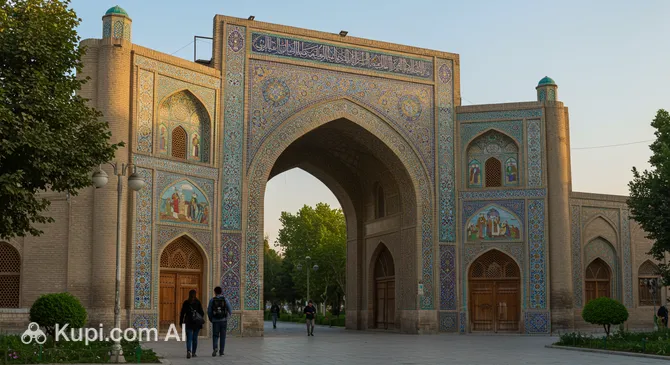
Imagine a majestic portal that serves as a living reminder of the former greatness of the Qajar era. The Bagh Melli Gate (or Sardar-e Bagh-e Melli) is not just an entrance to a former military parade ground, but a true symbol adorning Tehran. The structure is located on Imam Khomeini Street and is considered one of the city's most recognizable architectural landmarks.
Bagh Melli Gate. Illustration.
Source: Kupi.com AI
Traveler photos:
This historical site in Iran impresses with its monumentality: three massive entrance archways are decorated with cast-iron gates of incredible craftsmanship by Master Mohammad Ali Kermani. At the top of the structure, there was once an observation post and a platform for kettledrummers who announced important events with the sound of music.
Although the beautiful "National Garden" that gave the gate its name eventually gave way to austere administrative buildings, the arch itself remains a magnificent example of the Tehran architectural style. Today, it is a must-visit point on the itinerary for anyone who wants to touch history and see the mastery of Iranian architects of the past century.
Contacts
To plan your visit to this architectural gem, it is helpful to know its exact location. The gates are a standing landmark and are open for exterior viewing by the general public.
When you arrive at the gate, your first priority should be taking the time to study its unique decor. Every detail here—from the massive cast-iron doors to the finest tile mosaics—deserves careful inspection. This is an ideal spot for a photo shoot: the play of light on the ancient masonry and the vibrant colors of the tiles make for impressive shots at any time of day.
History buffs will find it interesting to search the design for motifs dedicated to important events of the past. Exploring the arch, you can clearly trace the influence of both European and traditional Persian traditions in Tehran's architecture. Walking through these gates offers a rare opportunity to feel like a resident of the capital at the beginning of the 20th century.
Thanks to its central location, a visit to the gate is easily combined with a cultural program. The Post and Telegraph Museum and the National Museum of Iran are located right nearby, allowing for a rich walking route. After exploring the gate, it is pleasant to walk through the historical quarters, viewing neighboring government buildings which are architectural monuments in their own right.
Getting There
Finding the Bagh Melli Gate is easy, as it is located in the heart of the capital, in District 12 on the busy Imam Khomeini Street. This site is well-integrated into the urban environment and is within walking distance of many government offices.
The most convenient way to reach the attraction is by using the Tehran Metro. The nearest stations on the central lines allow you to quickly reach the historical quarter. Additionally, city buses run regularly along Imam Khomeini Street, with stops located near the arch.
If you prefer comfort, you can order a taxi from any part of the city. Drivers know this iconic location well; you can simply provide the address or the name of the gate. In the central part of town, it is also pleasant to explore on foot, viewing other historical facades and government buildings along the way.
Nearest city: Tehran
History & Facts
The history of this majestic structure began by the decree of Reza Shah. Construction was carried out under the careful guidance of the prominent architect Jafar Khan Kashani with technical support from German specialists. Interestingly, the current gate replaced an older structure of the same type, completely replicating its scale and appearance, after which its predecessor was demolished.
The name, which translates as "National Garden Gate," was given due to an ambitious project to create Tehran's first public park on the former parade ground. Although the garden itself did not last long in its original form and eventually gave way to administrative buildings (such as the Ministry of Foreign Affairs), the beautiful name has remained associated with the gate forever.
When looking at the facade, pay attention to the skillful tile work. These are not merely decorative: they capture important historical stories, including images of victory angels and battle scenes. Despite restoration in the mid-1940s and subsequent attempts to change some design elements after the revolution, the gate has retained its unique Qajar character.
Time Needed
For a quick look at the architecture and to take a few memorable photos, 30–60 minutes is quite sufficient. The gate is located on a busy street, making it easy to include in a walking route through the city center.
However, if you are a true connoisseur of detail and plan to carefully study the tile mosaics, or visit the nearby Post Museum or the National Museum of Iran, it is better to set aside about 2–3 hours for this area. This will allow you to enjoy the historical atmosphere of old Tehran without rushing.
Working Hours
You can visit this historical location throughout the daylight hours. The Bagh Melli Gate is accessible for viewing daily from 07:30 to 16:30. This schedule applies to both weekdays and weekends.
Since the gate is located in an open urban street space, exterior viewing is possible at almost any time; however, for the best lighting and a detailed study of the tiles, it is recommended to visit during official working hours. Before visiting, tourists should still check for the most current information on-site or at Tehran's information centers.
07:30–16:30
Nearby
A stroll around the Bagh Melli Gate is just the beginning of a discovery of multifaceted Tehran. District 12 is rich with interesting locations that allow for a deeper immersion into the atmosphere of the metropolis and its history.
Exploring the surroundings can enrich your experience, as within a few kilometers and slightly beyond, you will find various amusement parks and cultural sites suitable for family leisure.