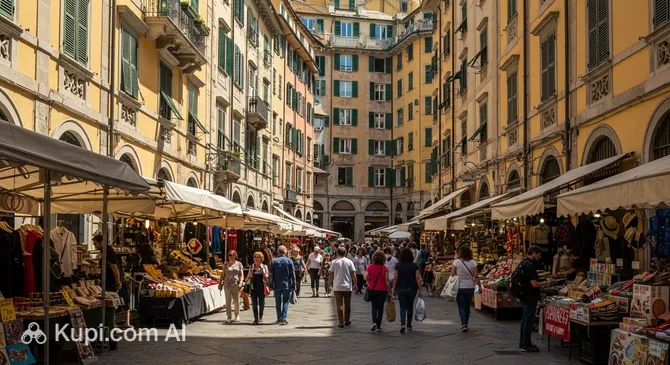
Genoa, a city with a centuries-old trading history, has long been famous for its markets and commercial spirit. Back in the Middle Ages, as a powerful maritime republic, Genoa was one of the key trading hubs of the Mediterranean. Its Old Port welcomed ships with goods from all over the then-known world, laying the foundation for a vibrant market culture, echoes of which can still be found today in the atmosphere of places like the Corso Sardegna Market.
The heyday of Genoese trade occurred in the 16th century, when the city experienced a renaissance thanks to its alliance with the Spanish crown. It was during this time that many luxurious basilicas and palazzos were built, testifying to the city's wealth. However, by the mid-17th century, the republic began to lose its influence and colonies. Later, in 1797, the Most Serene Republic of Genoa ceased to exist after being captured by Napoleon's troops, and in 1805, Genoa, as part of the Ligurian Republic, was annexed by France. At the beginning of the 19th century, the city and all the towns of the Italian Riviera became part of Piedmont. These historical shifts undoubtedly influenced the nature of trade and urban life.
Despite historical changes, the trading spirit of Genoa never faded. The city continued to develop, and after World War I, an ambitious plan was implemented to develop the Albaro district, which included the construction of the Corso Italia promenade. Although there is no direct historical data regarding the exact founding date of the Corso Sardegna Market in the provided records, its existence on the street of the same name (Corso Sardegna) fits perfectly into the overall picture of urban infrastructure development and the preservation of long-standing trading traditions. Markets like this continue to play an important role in the daily life of Genoese people, offering fresh produce and local goods.
Thus, the Corso Sardegna Market, as an important commercial space in the city, carries a piece of Genoa's rich commercial heritage. It serves as a reminder of the times when the city was a significant maritime center and a hub for international trade, continuing the tradition of lively city markets so characteristic of Italy.