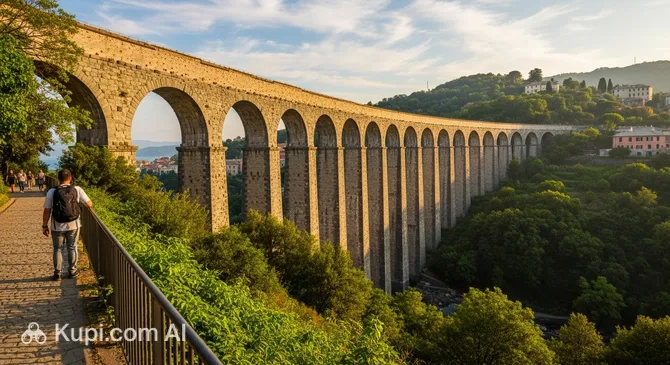
Imagine a majestic stone structure cutting through green hills, serving as the "circulatory system" of a maritime power for centuries. The Historical Aqueduct of Genoa is an outstanding monument of medieval engineering, erected back in the 13th century to supply the city with fresh water. Today, it has become one of the most atmospheric attractions hidden from the typical tourist in Genoa.
Historic Aqueduct of Genoa. Illustration.
Source: Kupi.com AI
Traveler photos:
While visiting Italy, travelers often seek authentic spots, and the aqueduct in the Via Lodi area is a perfect fit. Its impressive arches and preserved channels clearly demonstrate the skill of ancient builders who managed to master the complex Ligurian terrain for their purposes. This is not just an open-air museum, but a harmonious blend of architecture and nature.
A walk here allows you to see the city from an unusual perspective while enjoying the silence and panoramic views. The high rating of the structure among visitors confirms that even a purely practical building of the past can become a source of inspiration and romance for the modern traveler.
Contacts
For those planning a visit to this engineering monument, it is useful to know the exact coordinates and contact information for Genoa's municipal services. For additional information about the current state of the hiking routes, it is recommended to contact the city's tourist offices.
The main reason to visit the aqueduct is the opportunity to take a walking tour along the ancient channels and arches. The route passes through picturesque green zones where the rugged stonework contrasts with the soft landscape. Photography enthusiasts will find many great angles here: the massive arches set against the backdrop of the Ligurian Sea look truly monumental.
For those interested in history and technology, exploring the aqueduct turns into a fascinating quest. You can study in detail how the water supply system was designed and find information boards explaining the construction stages. This is a great place for educational recreation with children, who will be interested to learn how people solved everyday challenges long before modern plumbing.
Many visitors prefer to have small picnics in the shade of the centuries-old structures, enjoying the solitude. During the summer, this spot becomes a pleasant refuge from the city heat. If you enjoy hiking, be sure to combine your visit to the aqueduct with a walk along Genoa's mountain trails—this way you can fully experience the spirit of the region.
Getting There
Getting to this unique site is easy using the well-developed urban transport network. From the very center, starting at the famous Piazza De Ferrari, it is most convenient to take bus No. 36 or 39. You should get off in the Via Lodi area; the entire journey takes about 20–30 minutes on average, offering interesting views of the city's residential neighborhoods along the way.
If you prefer active walks, you can set off on foot from the Genova Piazza Principe station. The walk takes about 40 minutes and goes through picturesque hills via Via Andrea Doria. Keep in mind that roads in Liguria are often steep, so comfortable shoes will be your best ally. For precise navigation, it is best to use the site's GPS coordinates.
Travelers arriving at Genoa Airport (GOA) can first reach the central station by train or the special VOLABUS shuttle, and then transfer to local transport. A taxi ride from the center to the entrance of the aqueduct territory will cost approximately 15–20 euros and take no more than 15 minutes, depending on traffic.
Nearest city: Genoa
History & Facts
The history of this grand structure dates back to the beginning of the 13th century, when the Republic of Genoa was experiencing its "Golden Age." Rapid population growth and the development of the port required a steady supply of clean fresh water. It was then that construction began on the system of channels that became a true triumph of medieval engineering.
Over the centuries, the aqueduct was constantly modernized and expanded. Until the middle of the 17th century, new powerful arches and deep reservoirs were added to quench the thirst of the growing city. This work took place alongside the flourish of the Genoese economy: while the Bank of Saint George managed the finances of half of Europe, the aqueduct ensured the life and health of thousands of citizens.
Interestingly, the construction was so reliable that it functioned for centuries until it was eventually replaced by modern water supply systems. Today, the massive stone walls and spans serve as a reminder of a time when fresh water was valued in Liguria no less than the gold brought by merchant ships from distant voyages.
Time Needed
A full visit to this historical monument usually takes between 1 and 2 hours. This is quite enough time to take a leisurely stroll along the preserved arches, study the channel system, and take impressive photos against the backdrop of the ancient masonry and city panoramas.
If you plan to include the aqueduct in a larger hiking route through the hills of Genoa, it is worth allowing about 3 hours. In this case, you can not only inspect the structure itself but also enjoy the peace away from the noisy center, taking a short break at one of the viewing platforms.
Working Hours
Access to this historical location is open to everyone 24 hours a day. Since the aqueduct is part of the urban landscape and an open-air monument, there are no turnstiles or ticket offices, allowing you to plan a visit for early morning to catch the sunrise or in the evening when the arches are beautifully lit by the setting sun.
Visiting the site is completely free on any day of the week, including holidays. Nevertheless, before your trip, it is recommended to check the city's official tourism portals to ensure there are no temporary restrictions on certain sections of the walking trails due to restoration work.
Open 24 hours
Nearby
The aqueduct's location on the hills allows tourists to combine exploring ancient arches with visiting other interesting locations in the northern part of the city. The surrounding areas offer opportunities for both active recreation and cozy park zones where you can spend time with the whole family.
Below are the sites located relatively nearby that will help complement your travel itinerary in the capital of Liguria.