Support

Monumental Cemetery of Staglieno

About

Imagine a grandiose open-air museum where time seems frozen in marble. The Monumental Cemetery of Staglieno, located in the picturesque city of Genoa, is rightfully considered one of the most beautiful and impressive necropolises in Italy and all of Europe. Covering an area of 33 hectares on a hillside, it impresses with its combination of austere neoclassical architecture and lush vegetation.
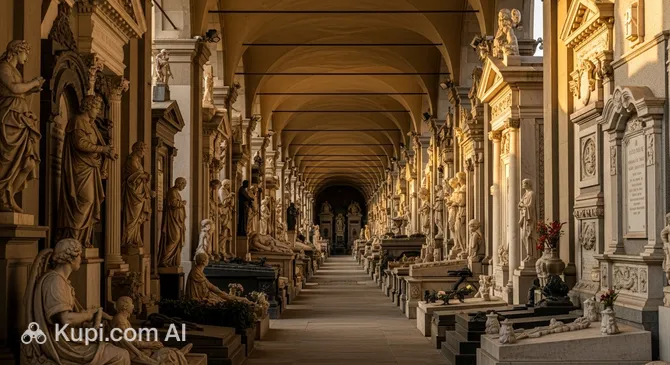
Monumental Cemetery of Staglieno
Monumental Cemetery of Staglieno. Иллюстрация. Источник: Kupi.com AI

This site is world-famous for its highly artistic gravestones and family vaults, which reflect shifting styles from Realism to Art Nouveau and Symbolism. Strolling through its galleries, you can encounter incredibly realistic sculptures depicting deep human emotions, making Staglieno an important cultural and historical site rather than just a place of burial.

The centerpiece of the necropolis is the majestic Pantheon—a domed building with a Doric portico inspired by its famous namesake in Rome. The entire complex is divided into several sectors with arcades and colonnades where prominent figures are buried, turning a visit to the cemetery into a fascinating journey through the history of Italian art and society in the 19th and 20th centuries.

Contacts

To clarify details of your visit or inquire about special events, you can use the official contact information of the administration. Please note that most information is typically provided in Italian.

How to contactContact
AddressPiazzale Giovanni Battista Resasco, 2, 16137 Genova GE, Италия
Phone+39 010 557 6400
Websitewww.staglieno.comune.genova.it

What to Do

The main activity at Staglieno is leisurely contemplation. Visitors are recommended to start their journey from the main entrance and ascend the monumental staircase to the Pantheon, examining the lower and upper arcades (Porticati Inferiori and Porticati Superiori) along the way. The most famous sculptural compositions, executed with striking anatomical precision, are concentrated here.

Be sure to find the famous "Sleeping Beauty" statue and the stunning figures of "weeping angels" that have become the hallmarks of the necropolis. Architecture enthusiasts should visit the Montino Gallery, which features exquisite Art Deco works, and look into Sector D to appreciate the grandeur of the Pantheon from the inside.

Do not miss the unique Paggio Chapel, often called a miniature "Milan Duomo" for its Gothic style and white Carrara marble finish. It is also worth walking to the graves of the Risorgimento heroes, including the Giuseppe Mazzini memorial. Thanks to the play of light and shadow in the galleries, the cemetery is an ideal location for artistic photography.

Getting There

Reaching this majestic necropolis from the center of Genoa is quite simple. The most convenient way is to use public transport: buses No. 34, 36, 39, and 40 run regularly from Piazza De Ferrari. The journey to the Cimitero Staglieno stop takes approximately 15–20 minutes.

For those arriving from the airport, take bus No. 100 to Piazza Verdi, where you can transfer to city transport heading north toward the cemetery. The entire journey in this case will take about 40 minutes. You can also always use a taxi, which will quickly take you to the Piazzale Giovanni Battista Resasco entrance.

If you prefer traveling by car, follow the A10 or A7 highways. There is a parking area near the main entrance, making the visit convenient for those exploring the region independently. For walking enthusiasts, the route from the city center is about 4–5 km through picturesque, though occasionally hilly, terrain.

Ближайший город: Genoa

History & Facts

The history of this unique site dates back to the early 19th century. Following Napoleon's famous Edict of Saint-Cloud in 1804 and a subsequent decree by King Carlo Alberto in 1832, burials within city limits were prohibited for sanitary reasons. This led to the necessity of building a large-scale necropolis outside residential areas.

The design of the project was entrusted in 1835 to the prominent Genoese architect Carlo Barabino, creator of the famous Teatro Carlo Felice. Unfortunately, the master passed away that same year during a cholera epidemic, and his ideas were carried out by his pupil, Giovanni Battista Resasca. The cemetery officially opened in 1851, although construction work continued until 1880.

Resasca managed to achieve the impossible: he harmoniously combined the strict neoclassical style characteristic of Mediterranean tradition with an "Anglo-Saxon" approach that incorporates abundant greenery and natural landscapes. Thanks to this, Staglieno was transformed into a true garden city where architecture and nature complement each other.

Over the years of its existence, the cemetery has become the final resting place not only for noble Genoese families but also for national heroes. It is here that the grave of Giuseppe Mazzini is located—a key figure of the Italian Risorgimento—which has turned the necropolis into an important symbol of national identity for the entire country.

Time Needed

The scale of the territory and the incredible detail of the sculptures require a certain amount of time from the visitor. For a first introduction and to view the main monuments, such as the Pantheon and the central arcades, it is recommended to allocate at least 2–3 hours. This will allow you to appreciate the skill of the Italian sculptors and soak in the atmosphere of the place without rushing.

If you are an art lover, a photography enthusiast, or plan to walk along the remote terraces and park paths, you should set aside half a day for the visit. Walking through all seven sectors requires physical stamina, as the cemetery is located on a hillside, but the views and the crypts hidden in the shade of the trees are definitely worth the effort.

Working Hours

Staglieno Cemetery is usually open to visitors daily from 07:30 to 17:00. This allows you to choose either the early morning hours, when the soft light beautifully emphasizes the texture of the marble, or the late afternoon for your visit.

As the operating schedule may change depending on the season or public holidays, it is highly recommended to check the latest information on the official Genoa city website before planning your trip.

07:30–17:00

Nearby

After finishing your walk through the necropolis, you can continue exploring the surroundings of Genoa. Discovering this part of the city allows you to see it from different angles—from sports facilities to picturesque parks and recreation areas.

Below are some interesting places located relatively close to the attraction that will help diversify your tourist itinerary:

NameDistance
Righi Adventure Park1.2 km
Historic Aqueduct of Genoa1.4 km
Corso Sardegna Market2.2 km
Sciorba Sports Complex2.3 km
Le Baron Blanc Lounge Shisha Club2.3 km
D'Albertis Castle2.4 km
Palazzo Doria Tursi2.4 km

Reached the end of the page?

That means the route is fully explored