Support

Giants' grave of Su Mont'e s'Abe

About

The mysterious Giants' Grave of Su Mont'e s'Abe is one of the most impressive archaeological monuments of the Nuragic civilization in Sardinia. Located near the city of Olbia in sunny Italy, it is a colossal collective burial site dating back thousands of years. This megalithic site is striking in its scale: its length reaches 28 meters, making it one of the largest structures of its kind on the island.
Giants
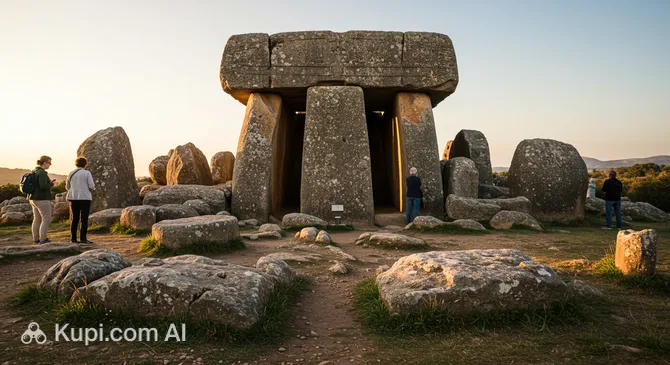
Giants' Tomb of Su Mont'e s'Abe. Иллюстрация. Источник: Kupi.com AI

The main architectural feature of the monument is its unusual shape, which from above resembles a bull's head, an ancient symbol of fertility and life force. At the front is a semicircular area — an exedra — where sacred rituals were performed in ancient times. In the center of this space once stood a massive granite stele, opening the way to a ten-meter burial corridor hidden under stone slabs and an earthen mound.

This place is literally steeped in the spirit of antiquity and mystery. Unlike many single graves of that era, the Su Mont'e s'Abe Grave served as a resting place for an entire community, emphasizing the unity and importance of ancestral bonds. Today, the monument is recognized as an important cultural heritage site, attracting travelers with its rugged beauty and the opportunity to touch the roots of Gallura's history.

Contacts

For those planning a visit to this ancient monument, current information about its location will be useful. The site is freely accessible; however, it is worth checking the route in advance as it is located in a rural area.

How to contactContact
AddressVia Caterina Longa, 07026 Olbia Provincia della Gallura Nord-Est Sardegna, Италия

What to Do

Once at this ancient megalith, be sure to take the time to study its structure. You can examine the exedra in detail — the semicircular area in front of the entrance where mysterious rituals were once performed. Walk along the long burial corridor to appreciate the engineering skill of the Nuragic culture, which managed to erect such a grand structure from massive granite slabs without the use of modern equipment.

Since the site is unmanaged, visitors have a rare opportunity to explore the territory freely without strict restrictions. This allows you to fully enjoy the silence and wild nature of the Gallura region, surrounded by granite boulders and low hills. Be sure to climb to the nearby Pedres Castle: such a combined walk will give you not only historical knowledge but also magnificent panoramic views of the Olbia surroundings and the sea bay.

For those who want to dive deeper into the context of what they've seen, visiting the Archaeological Museum in Olbia after the trip to the grave is a great idea. There you can see artifacts found during excavations of similar sites, which will help recreate a full picture of the life and beliefs of the Nuragic civilization.

Getting There

The easiest way to reach this unique archaeological monument is by private or rented car. The attraction is located just a few kilometers south of the center of Olbia, towards the commune of Loiri. Pedres Castle, clearly visible on the hill, will serve as your landmark — the grave is located on the plateau right at its foot.

If you prefer to use a taxi, the ride from the city center or Olbia airport will take about 15–20 minutes. This is a convenient option, considering that public transport does not go directly to the site itself. The road to the monument passes through the picturesque landscapes of Gallura, making the trip a pleasant addition to the excursion.

For travelers by car, parking is provided near the archaeological zone. From there, a short walking trail leads to the grave itself. The entire route from the city's main tourist hubs is intuitive thanks to road signs for Tomba dei Giganti.

Ближайший город: Olbia

History & Facts

Research shows that the Giants' Grave of Su Mont'e s'Abe was built in two main stages. The first dates back to the Bonnanaro culture (circa 1800–1600 BC), when a long dolmen — a gallery grave — was built. Later, during the era of the Nuragic civilization (circa 1600 BC), the structure acquired its monumental appearance with the characteristic exedra and central stele.

Archaeological excavations were carried out here in 1968 under the direction of Editta Castaldi. Although many ritual objects have not survived to this day, the structure of the monument itself has provided scientists with invaluable information about the burial rites of the ancient inhabitants of Italy. Interestingly, unlike the individual graves of the Bronze Age, the giants' graves in Sardinia were always intended for collective burials.

The name "Giants' Grave" is a tribute to local legends. The island's ancient inhabitants, finding huge stone slabs in the ground, believed that such impressive structures could only belong to beings of gigantic stature. In reality, the monumentality of the building emphasized the social significance of the clan and served as a sacred place for connecting with ancestors.

In the 1960s, the monument underwent careful restoration, which allowed the appearance of the burial corridor and exedra to be restored. Today, this site is considered one of the most important testimonies to the evolution of megalithic architecture in the Gallura region, demonstrating the transition from simple dolmens to complex cult structures.

Time Needed

For a brief acquaintance with the grave itself and its architectural features, you will need about 30–60 minutes. This time is quite enough to slowly inspect the megaliths, walk along the burial corridor, and take memorable photos against the backdrop of the majestic exedra.

However, we recommend setting aside at least 1.5–2 hours for a visit to this location. Most tourists combine a tour of the grave with a climb to the neighboring Pedres Castle. Given the time for climbing and resting with a panoramic view of the surroundings of Olbia, such a walk will be a complete and effortless adventure.

Working Hours

As an open-air archaeological monument, the Giants' Grave of Su Mont'e s'Abe is open for visits 24 hours a day, daily. There are no gates or ticket offices, allowing tourists to plan a visit at any convenient time, whether it's early morning for sunrise or a quiet evening hour.

Despite free access, it is recommended to visit the site during daylight hours, as the territory has no artificial lighting. Before your trip, it is also worth checking the official tourist portals of the region to ensure there are no temporary restrictions on access to the hiking trails.

Круглосуточно

Nearby

The location of the monument allows you to combine its visit with other interesting places, creating a full-day itinerary. Just a few steps from the grave, a medieval fortress awaits history buffs, offering a breathtaking view of the entire valley from its height.

The surroundings of Olbia are rich in archaeological and natural sites: from ancient Roman aqueducts to sacred wells of the Nuragic era. Exploring these locations will help you gain a deeper understanding of Sardinia's multi-layered history.

NameDistance
Pedres Castle0.3 km
Olbia Seafront Promenade4.9 km
Olbia Mare Shopping Center5 km
Mere Restaurant Olbia5.3 km
My Soul Irish Pub5.5 km
Ristorante Piperita5.6 km
Parish Church of Saint Paul the Apostle5.6 km

Reached the end of the page?

That means the route is fully explored