Support

Piazza San Carlo

About

Piazza San Carlo is one of the most elegant and significant squares in Turin, which locals affectionately call the city's "drawing room" or "salon." Located in the historic center of Italy, this square is a magnificent example of Baroque architecture designed in the 17th century. Its austere and harmonious appearance makes it one of the key attractions and the true heart of city life.

The square has an elongated rectangular shape and is surrounded on all sides by buildings with graceful porticos, creating a unified and complete ensemble. A stroll under these arcades allows you to fully experience the majestic atmosphere of old Turin. In the center of the square stands the equestrian monument to Duke Emmanuel Philibert of Savoy, who moved the capital of his duchy to Turin in the 16th century—a turning point in the city's history.
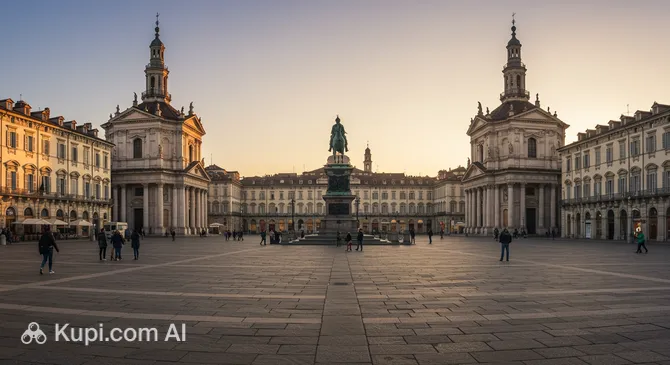
Piazza San Carlo. Illustration.
Source: Kupi.com AI

Traveller photos:

One of the main architectural features of Piazza San Carlo is the two twin churches—Santa Cristina and San Carlo—located on the southern side. Their symmetrical facades give the square a special expressiveness and recognizability. Today, it is not only a historical monument but also a popular venue for concerts, city events, and gatherings, where tourists and residents alike enjoy relaxing in numerous historical cafes.

Contacts

Since Piazza San Carlo is a public space in the heart of the city, it does not have a single point of contact, such as a phone number or official website. Reaching the square is very easy, as it is located in the center of Turin and is a fully pedestrianized zone. It can be reached on foot from many key attractions or by public transport—numerous bus, tram, and metro routes serve the area.

How to contactContact
AddressP.za S. Carlo, 10123 Torino TO, Italy

What to Do

Upon entering Piazza San Carlo, you immediately feel its special atmosphere—it is not for nothing that it is called the "salon" of Turin. The main activity here is a leisurely stroll and contemplation. Enjoy the magnificent Baroque architecture and take a close look at the graceful facades of the historic buildings framing the square. After your walk, you can relax in one of the many historical cafes or restaurants located under the arcades. A cup of coffee in one of them is a wonderful opportunity to feel the rhythm of the city and observe its daily life.

The central element of the square that draws the eye is the equestrian monument to Emmanuel Philibert of Savoy, known locally as "Caval ëd Brons." Be sure to walk around it to appreciate the sculptor's skill and the composition's dynamics. Equal attention should be paid to the two famous twin churches, which give the square its complete and symmetrical look. These are the churches of San Carlo and Santa Cristina, true gems of the architectural ensemble.

Be sure to step inside these temples. The Church of San Carlo was built in 1619, although its current facade appeared later, in 1834. Its "sister," the Church of Santa Cristina, was founded in 1639, and its facade was masterfully rebuilt by the famous architect Filippo Juvarra between 1715 and 1718. The facade of Santa Cristina is adorned with expressive sculptures, including images of Saints Christina and Teresa.

Getting There

Getting to Piazza San Carlo is very simple, as it is located in the very heart of Turin's historic center. The most pleasant way to reach the square is on foot. It is situated on the city's main pedestrian artery, Via Roma, which connects the central Porta Nuova railway station with Palace Square (Piazza Castello). A walk from the station takes no more than 10–15 minutes and allows you to enjoy the views of elegant shop windows and architecture. Since the square is a pedestrian zone, direct access by car is not possible.

For those who prefer public transport, there are many convenient options. Turin has a well-developed network of buses and trams, many of which stop in the immediate vicinity of the square. The nearest stops, such as Arcivescovado and Bertola, are just a couple of minutes' walk away. You can also use the metro: the nearest stations are Porta Nuova and Re Umberto (line M1), from which the square can be reached on foot in 5–10 minutes. This is especially convenient if you are traveling from outlying areas of the city.

If you decide to take a taxi, the driver can drop you off as close as possible to the pedestrian zone surrounding the square. Driving a private car into the city center is not recommended due to the Limited Traffic Zone (ZTL) in effect on weekdays. The best solution is to leave your car in one of the many underground parking lots located around the perimeter of the center—for example, right under Piazza San Carlo itself—and continue on foot.

Nearest city: Turin

History & Facts

The history of the square dates back to the early 17th century when it was decided to expand Turin to the south. The design of this grand space was entrusted to the architect Carlo di Castellamonte, who in 1617 began work on creating not only a new street (the current Via Roma) but also a majestic square intended to symbolize the power of the Savoy dynasty. Interestingly, until that point, the territory of the future square lay outside the ancient Roman walls that served as the original core of the fortress city.

Construction work began in 1618 and was completed twenty years later, in 1638. The ceremonial opening of the square was held by Christine of France, the widow of Duke Vittorio Amedeo I. Initially, the site was named "Piazza Reale" (Royal Square) or "Piazza d'Armi" (Weapons Square), highlighting its high status. However, the square's history is full of changes: during the French occupation, it was renamed in honor of Napoleon Bonaparte.

The square received its current, world-famous name—Piazza San Carlo—later, in honor of Saint Carlo Borromeo, the influential Archbishop of Milan. This choice was not accidental and reflected the deep religious and cultural ties of the time. Thus, passing through various eras and changing several names, Piazza San Carlo transformed from an outskirts area into Turin's elegant "salon," all while retaining its historical significance.

Time Needed

The time needed to explore Piazza San Carlo can be estimated in different ways depending on your interests. For a quick overview—to simply walk across the square, take photos with the equestrian monument and the twin churches, and soak in its majestic atmosphere—30-40 minutes will be sufficient. This is enough time to appreciate the architectural ensemble and feel the spirit of Turin's "drawing room."

If you want a deeper immersion, it is worth setting aside 1.5–2 hours or even more. During this time, you can not only take a leisurely stroll under the elegant arcades but also step inside the churches of Santa Cristina and San Carlo to view their Baroque interiors. Additionally, an essential part of a visit to the square is stopping at one of the historical cafes, such as Caffè Torino or Caffè San Carlo. A cup of coffee or the famous Turin dessert, bicerin, will allow you to relax and fully enjoy the life of this iconic location.

Working Hours

Piazza San Carlo is a public city space, so it is open to visitors 24 hours a day, year-round. Entry to the square itself is completely free, and no tickets or advance reservations are required. You can come here at any time of the day or night to enjoy its majestic architecture and special atmosphere.

However, it is worth remembering that the attractions and establishments located on the square have their own operating schedules. The twin churches, Santa Cristina and San Carlo, are only open for visits during certain hours, usually during the day, and may be closed in the mid-afternoon. The same applies to the numerous historical cafes and shops under the arcades. Before visiting a specific location on the square, it is recommended to check the current opening hours on Turin's official tourist portals or directly on-site.

Open 24/7

Nearby

A visit to Piazza San Carlo is just the starting point for exploring the heart of Turin. The area surrounding the square is as steeped in history and culture as the square itself. Thanks to the compact layout of the city center, many other iconic sites are literally just a few steps away, and a walk through them will allow you to form a more complete and vivid impression of the Piedmontese capital.

Exploring the nearby streets and squares will enrich your experience, revealing new architectural masterpieces, world-class museums, and cozy corners hidden from most tourists' eyes. Every attraction near Piazza San Carlo is a piece of the large mosaic that makes up the unique character of this elegant Italian city.

NameDistance
Galleria San Federico0.1 km
Egyptian Museum0.2 km
Palazzo Madama0.4 km
Victoria Hotel Bar0.4 km
Royal Palace of Turin0.6 km
Chapel of the Holy Shroud0.6 km
LAO0.6 km

Reached the bottom of the page?

Looks like you know this route inside out