Support

Sanno Shrine one-legged Torii Gate

About

The One-Legged Torii Gate of Sannō Shrine is one of the most poignant and symbolic landmarks in Nagasaki. This unique stone arch serves as the entrance to a Shinto shrine and stands as a silent witness to the events of August 1945, when Japan underwent immense upheaval. Located just 800 meters from the hypocenter of the explosion, the gate miraculously remained standing, though it lost one of its pillars.

Made of sturdy granite, the structure now stands on a single pillar. The other half of the torii was destroyed by a powerful shockwave, while the surviving part rotated approximately 30 degrees from its original position but maintained its balance. Today, this site is considered a powerful symbol of resilience and rebirth, drawing travelers from all over the world with its unusual form and profound historical significance.
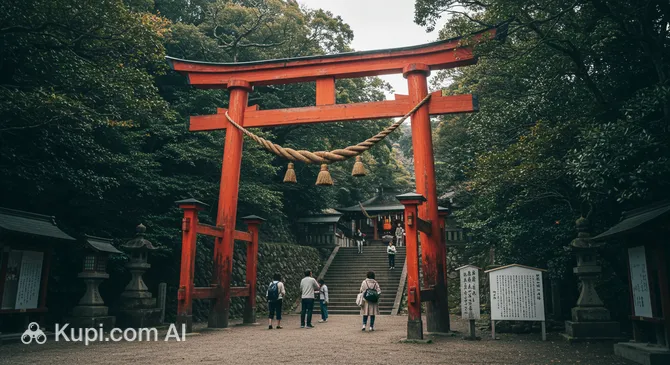
Sanno Shrine One-Legged Torii Gate
Sanno Shrine One-Legged Torii Gate. Иллюстрация. Источник: Kupi.com AI

A visit here allows you to touch history and see an incredible example of how architectural elements can withstand devastating forces. Sannō Shrine and its famous gate have become an integral part of the city's cultural landscape, serving as a reminder of the importance of peace and the indomitable human spirit.

Contacts

For those planning a visit to this historical location, it is helpful to have current contact details on hand. The shrine is located in a quiet residential area and is easy to find using its official address.

How to contactContact
Address1 Chome-5 Sakamoto, Nagasaki, 852-8102, Япония
Phone+81 95-844-1415
Websitesannou-jinjya.jp

What to Do

A walk to the shrine begins with a climb up a long stone staircase, which leads visitors through quiet residential neighborhoods directly to the sanctuary. The first thing that catches the eye is the one-legged torii. Be sure to stop here to examine the texture of the stone and marvel at how the massive upper beam is held up by just a single support.

Next to the shrine entrance grow two majestic camphor trees. These giants are true living monuments: despite their trunks being completely scorched during the catastrophe, they survived and eventually sprouted new branches. Today, their lush green canopies symbolize the triumph of life over destruction.

Inside the sanctuary, which has been fully restored, an atmosphere of tranquility prevails. Here, you can perform a traditional ritual: offer a prayer, toss a coin into the offering box, clap your hands, and ring the bell. Additionally, the shrine grounds offer pleasant walks along well-kept paths lined with stone lanterns, providing views of the city landscape.

Getting There

Reaching the Sannō Gate is easy, as it is located within the city limits near the Nagasaki University Hospital. If you start from Nagasaki Station, the distance is about 2 kilometers, which can be quickly covered by taxi.

The most convenient and popular method is to use the city's famous tram. You should get off at the Kawaguchimachi or Iwakawamachi (Urakamiekimae) stops. From there, a short walk will lead you directly to the foot of the stairs leading to the shrine. This route is also easy to combine with a visit to Hypocenter Park, which is just a 10–15 minute walk from the gate.

Ближайший город: Nagasaki

History & Facts

The history of Sannō Shrine began long before the events of the 20th century. The sanctuary was founded in 1638 by the feudal lord Matsudaira Nobutsuna. Upon arriving in the area to suppress the Shimabara Rebellion, he was captivated by the local landscape, which reminded him of the sacred Mount Hiei near Kyoto.

Under Matsudaira's orders, the local governor built the shrine, which was named Sannō Jinja, meaning "Shrine of the Mountain King." For centuries, it served as a place of spiritual solace for the region's residents and remains an important religious center.

Interestingly, until the middle of the last century, there were four consecutive torii gates on the path to the main shrine building. It was the second gate that became the "one-legged" torii we see today. The other structures were either completely destroyed or severely damaged by the blast wave, making the surviving pillar a unique historical witness.

Time Needed

When planning your itinerary, set aside about 1–1.5 hours to see this landmark. This is enough time to leisurely climb to the sanctuary, take commemorative photos, and feel the special energy of the site.

The bulk of your time will be spent examining the details of the famous arch and walking around the ancient camphor trees. If you decide to stay at the shrine for prayer or simply want to admire the panoramic views of the city streets, your visit might last a bit longer.

Working Hours

The grounds of Sannō Shrine and access to the one-legged gate are open to visitors 24/7. This allows travelers to visit early in the morning for peace and quiet, or in the evening as the city sinks into twilight.

However, if you plan to purchase amulets or speak with the shrine staff, it is best to visit during standard daylight hours. For details on holidays or festivals, it is recommended to check the official website in advance.

Круглосуточно

Nearby

Exploring the area around Sannō Shrine will help you delve deeper into the city's atmosphere and see other landmark sites related to its rich and multifaceted history. Many interesting places are within walking distance or a short tram ride away.

Below are some attractions worth including in your itinerary:

NameDistance
Nagasaki National Peace Memorial Hall for the Atomic Bomb Victims0.6 km
Nagasaki Cinema Complex0.6 km
Nagasaki Atomic Bomb Museum0.7 km
Atomic Bomb Hypocenter0.8 km
Nagasaki Hypocenter Park0.8 km
Urakami Cathedral1 km
Nagasaki Peace Park1.1 km

Reached the end of the page?

That means the route is fully explored