Support

Jōmon Sugi

Nearby attractions

About

Hidden in the heart of the misty forests on Yakushima Island, the Jōmon Sugi tree is one of the most majestic natural wonders that Japan takes pride in. It is not just a plant, but a living historical monument belonging to the Cryptomeria japonica (Japanese cedar) species. Its impressive dimensions—a trunk circumference of over 16 meters and a height exceeding 25 meters—make every visitor feel the true grandeur of nature.
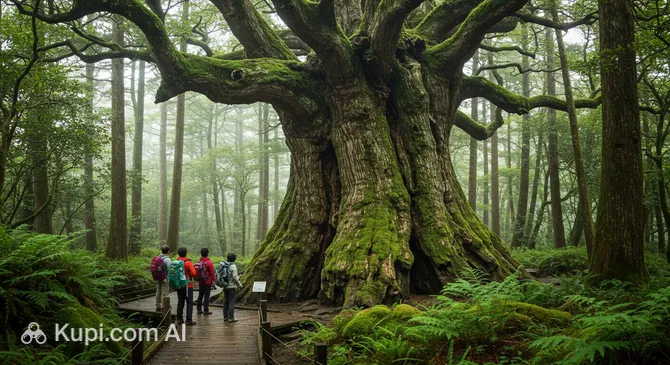
Jomon Sugi
Jomon Sugi. Иллюстрация. Источник: Kupi.com AI

This sacred tree is located in the Kumage district and is the crowning jewel of the UNESCO World Heritage National Park. The name Jōmon Sugi refers to the earliest period of Japanese history, emphasizing its incredible age, which is estimated to be between two and seven thousand years. The tree has become a symbol of longevity and resilience, surviving for millennia in high humidity and a changing climate.

For the Japanese, Jōmon Sugi is the spiritual center of the island, a "place of power" steeped in legend. The ancient cryptomeria, with its whimsically twisted trunk and thick canopy, looks like it stepped out of the pages of fairy tales. A trip to this giant is considered a true pilgrimage for nature lovers and those seeking solitude amidst primeval forests that have remained unchanged for tens of thousands of years.

Contacts

To clarify current information regarding the condition of hiking trails or to organize excursions to the ancient tree, visitors can contact the local information center.

How to contactContact
AddressMiyanoura, Yakushima, Kumage District, Kagoshima 891-4205, Japan
Phone+81 997-49-4010

What to Do

The main adventure that draws travelers to Jōmon Sugi is an hours-long hike through the scenic trails of the national park. The entire route passes through dense, primeval forests where every trunk is covered in emerald moss and the air is filled with the scent of pine needles. It is the perfect place for those who want to challenge themselves and enjoy ecotourism in its purest form, conquering climbs and admiring mountain streams.

Along the way to the goal, you can encounter other impressive trees, such as Tenku Sugi, which reaches a height of 45 meters. Photographing these forest giants is a mandatory part of the experience; however, it is worth remembering that Jōmon Sugi itself is surrounded by a special observation deck. This was built to protect the ancient cedar's root system from damage while allowing tourists to view the majestic bark and powerful branches from a safe distance.

For many, visiting this site becomes a form of meditation. The silence of the forest, broken only by birdsong and the sound of the wind in the treetops, encourages reflection on eternity. To ensure a comfortable hike, it is recommended to prepare high-quality trekking shoes and a raincoat in advance, as the weather on Yakushima is extremely changeable. Contemplating the sacred tree in the rays of the morning sun or through a shroud of mist gives an unforgettable sense of connection to the mysteries of the planet.

Getting There

The journey to Jōmon Sugi begins with a trip to Yakushima Island. You can get here by plane from Kagoshima Airport (about 45 minutes in the air) or by high-speed ferry from the same city's port (approximately 4 hours). Upon arrival on the island at Miyanoura Port or the airport, you must take a bus, which will take you to the start of the hiking trails, such as Shiratani Unsuikyo or Arakawa Trailhead, in 30–40 minutes.

It is important to remember that the tree itself is in a remote forest area inaccessible by vehicle. A challenging hike begins from the entrance to the national park, taking an average of 10–11 hours. The route, approximately 22 kilometers round trip, requires good physical fitness as it includes steep climbs and crossing forest streams.

For the convenience of tourists, regular buses run from the city center and main ports to the starting points of the route. You can also use a taxi, though this will be significantly more expensive. Experienced travelers recommend renting a car in Kumage to reach the parking lot at the trailhead as early as possible, before the main influx of tourists.

Ближайший город: Kumage

History & Facts

The history of the modern world's discovery of Jōmon Sugi began relatively recently—in 1968. It was then, during a scientific expedition to study the virgin forests of Yakushima, that scientists came across this colossal specimen of cryptomeria. The name "Jōmon" was not chosen by chance: it refers to the Jōmon period (roughly 14,000–1,000 BC), highlighting the incredible longevity of a tree that could have been growing back in those ancient times.

Determining the exact age of this giant became a real challenge for dendrochronologists. Since the core of the trunk has rotted over time, classic ring counting is impossible. Nevertheless, based on various studies and radiocarbon analysis, the tree's age is estimated to be in the range of 2,170 to 7,200 years. One of the most widely accepted methods points to a figure of 3,640 years, making it one of the oldest living things on the planet.

In Japanese culture, Cryptomeria japonica has always been considered sacred. For centuries, its wood was valued for its strength and fragrance, used to build grand temples and palaces. However, Jōmon Sugi escaped the logger's axe due to its unusual, gnarled trunk, which in past centuries was considered unsuitable for construction. Today, this tree symbolizes the unwavering power of nature and its ability to survive millennia of climatic upheaval.

Time Needed

Visiting Jōmon Sugi is not just a walk, but a full-scale expedition for which you should set aside one or two full days. The main hiking route to the tree and back is about 22 kilometers over rough terrain. An average traveler needs at least 10–12 hours of continuous walking to complete this hike in one day, so it is necessary to start before dawn, around 5 am.

For those who want to enjoy the silence of the ancient forest without rushing, the ideal option is a two-day hike with an overnight stay in specially equipped mountain huts or tents on the trail. This allows you not only to save energy but also to spend more time by the tree itself once the bulk of tourists has left. Given the unpredictable weather on the island, a buffer of extra time is never a bad idea.

Working Hours

Access to the natural landmark itself is technically possible around the clock, as it is located within a national park. However, for the convenience and safety of tourists, official operating hours have been established for the information centers and park services, which regulate visitor flow and transport to the trailheads.

Park facility operating hours:

  • Monday: 09:00 – 18:00
  • Tuesday: 09:00 – 18:00
  • Wednesday: 09:00 – 18:00
  • Thursday: 09:00 – 18:00
  • Friday: 09:00 – 18:00
  • Saturday: 09:00 – 18:00
  • Sunday: 09:00 – 18:00

Despite the stated hours, experienced tourists are strongly advised to set out on the route well before the visitor center opens (around 4–5 am) to ensure they return from the forest before dark.

9:00 – 18:00

Nearby

Exploring the surroundings of Jōmon Sugi allows for a deeper immersion into the atmosphere of the mystical forest that has inspired great artists and animators. The path to the island's main giant passes through places of incredible natural beauty, where every tree seems like a living being.

A walk through the national park offers the chance to see other unique natural features that often undeservedly remain in the shadow of their famous neighbor. Below are the attractions located within walking distance of the route to the ancient cryptomeria:

NameDistance
Wilson Stump1.1 km

Reached the end of the page?

That means the route is fully explored