Support

Hypocenter Park

About

Hypocenter Park is an iconic memorial space in the city of Nagasaki, Japan, located at the exact spot where the epicenter of the atomic blast was in August 1945. It is a quiet and solemn place, created to preserve the memory of the past and offer prayers for a peaceful future for the entire planet.

The central element of the park is a simple black column marking the point above which the explosion occurred. It is surrounded by a well-kept square where an atmosphere of tranquility and respect prevails. Fragments of the surviving wall of the Urakami Cathedral are also installed here, serving as a living testimony to the destructive power and the subsequent rebirth of the city.
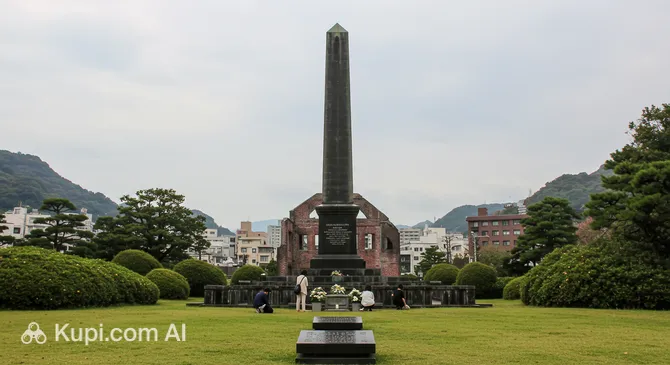
Nagasaki Hypocenter Park
Nagasaki Hypocenter Park. Иллюстрация. Источник: Kupi.com AI

Today, this historical site is a must-see for those who want to understand the soul of the modern city. The park is part of a larger memorial complex that combines Peace Park and a thematic museum, turning this location into a global center for the ideas of unity and humanism.

Contacts

To clarify information about visiting the memorial complex, you can use the city's official resources.

How to contactContact
Address5 Matsuyamamachi, Nagasaki, 852-8118, Japan
Websitenagasakipeace.jp

What to Do

A visit to the park evokes a contemplative mood and provides an opportunity to touch history through visual imagery. The most important thing to do is to approach the monolith marking the hypocenter and examine the nearby display of soil layers preserved from 1945. This literally allows you to see the boundary between the past and the present.

Be sure to notice the fragment of the Urakami Cathedral wall. Looking at the scorched stones, one can feel the scale of the events that occurred here decades ago. Many visitors come here simply to sit on the benches in the shade of the trees, enjoying the silence, which seems especially precious here.

A stroll through the Hypocenter is easy to combine with a visit to the neighboring Peace Park. There, you can see the majestic 10-meter Peace Statue and the Fountain of Peace, as well as view numerous monuments donated to the city by various countries around the world. The park territory is open to everyone and admission is free, making it accessible for a thoughtful individual or family visit.

Getting There

Getting to this memorial site in Nagasaki is quite easy thanks to the well-developed public transport system. The most convenient way is to use the famous city trams (Lines 1 or 3). You should get off at the “Heiwa Koen” (Peace Park) stop, which is only about 500 meters away from the park entrance on foot.

If you are departing from Nagasaki Station or the port area, you can take bus No. 10. A public transport trip from the central part of the city usually takes about 20–30 minutes. For those who prefer comfort, a taxi ride will be fast and convenient, as drivers know this destination well.

For travelers by car, there are parking zones nearby. GPS coordinates: 32.7732113, 129.8631168. Many tourists include a visit to the park in a walking route, combining it with a tour of Glover Garden or an ascent to Mount Inasa.

Ближайший город: Nagasaki

History & Facts

The history of this place changed forever on August 9, 1945, at 11:02 AM, when an atomic explosion occurred directly above this point. Before this tragic moment, ordinary residential neighborhoods and the Urakami branch of the Nagasaki Prison were located here. Today, the scale of the events is marked by a poignant black monolithic column, placed exactly at the epicenter of the blast.

Near the column, you can see a fragment of the Urakami Cathedral wall. At that time, it was the largest Catholic church in the East, located only 500 meters from the hypocenter. The remains of the wall were moved here as a symbol of resilience and an eternal reminder of what was lost. The memorial complex in its current form began to take shape in 1955, ten years after the end of the hostilities.

Over the years, the park has evolved into an international symbol of the desire for harmony. In 1978, a "zone of peace symbols" was established here, featuring monuments gifted by various countries. For example, a monument donated by the former USSR was placed here in 1985, highlighting the global nature of the call for unity and the rejection of conflict.

Time Needed

For a thoughtful exploration of Hypocenter Park itself, 30–60 minutes is usually sufficient. This time is enough to approach the memorial column, examine the preserved cathedral wall, and spend a few minutes in silence, soaking in the atmosphere of the place.

However, we recommend allocating at least 2–3 hours for the entire area. Hypocenter Park is part of a unified complex that includes the Atomic Bomb Museum and the extensive Peace Park with the famous Peace Statue. Such a comprehensive visit will provide the most complete understanding of the city's cultural and historical heritage.

Working Hours

Hypocenter Park is open to visitors 24/7. This allows you to choose any convenient time for a visit — from early morning, when it is particularly quiet, to late evening, when the memorial objects are illuminated, creating a special atmosphere for reflection.

Keep in mind that the nearby Atomic Bomb Museum operates on its own schedule, so if you are planning a comprehensive tour, it is better to aim for daytime hours.

Круглосуточно

Nearby

Exploring the surroundings of the hypocenter allows guests of the city to feel the historical context more deeply and see how Nagasaki rose from the ruins. A walk through the adjacent areas provides access to many significant cultural and religious sites.

Most interesting places are within walking distance, allowing for a rich walking route of several hours.

NameDistance
Atomic Bomb Hypocenter0.1 km
Nagasaki Atomic Bomb Museum0.1 km
Nagasaki National Peace Memorial Hall for the Atomic Bomb Victims0.2 km
Nagasaki Peace Park0.4 km
Nagasaki Peace Statue0.4 km
Urakami Cathedral0.6 km
Sanno Shrine One-Legged Torii Gate0.8 km

Reached the end of the page?

That means the route is fully explored