Hyogo Park of the Oriental White Stork (Konotorinosato Park)
About
If you are looking for a place where nature and humans coexist in perfect harmony, a visit to the Hyogo Park of the Oriental White Stork is a must. This unique facility in the city of Toyooka is part zoo, part rehabilitation center, and part sanctuary. Here, in the heart of Japan, efforts are underway to save one of the world's rarest birds—the Oriental White Stork—from extinction.
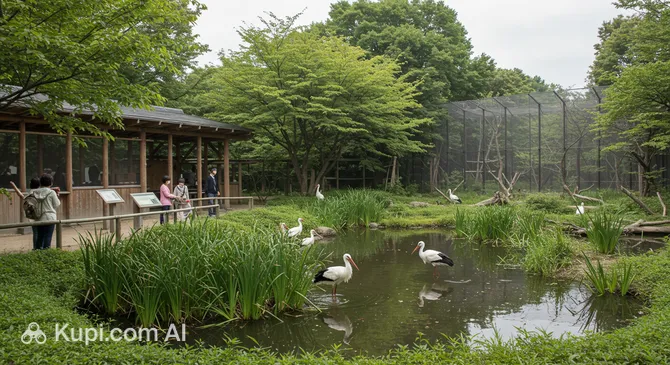
Hyogo Park of the Oriental White Stork. Illustration.
Source: Kupi.com AI
Traveler photos:
The park is famous not only for its residents but also for its role in global ecology. It has become a home for Ciconia boyciana, which once disappeared from the Japanese islands. Today, visitors can see these birds soaring freely over rice fields, nesting on special platforms, and raising their chicks in conditions that closely mimic the wild.
The atmosphere here is filled with tranquility and creativity. Besides birdwatching, guests can learn about the organic farming methods that helped restore the natural habitat. The park is ideal for family vacations and educational walks in the fresh air amidst the picturesque landscapes of Hyogo Prefecture.
Contacts
To ensure your trip goes smoothly, we recommend saving the park's contact details in advance. The administration is always ready to provide up-to-date information regarding special events or seasonal changes in the center's operation.
Below are the main ways to get in touch and the exact address of the attraction:
The main activity at the park is, without a doubt, stork watching. You can see these majestic birds in spacious aviaries and open areas where they hunt for small fish in ponds or build their massive nests. For the best views, we recommend bringing binoculars to see the details of their plumage and the behavior of the chicks without disturbing the inhabitants.
Be sure to take a stroll along the surrounding rice paddies. These are not just part of the landscape but an important ecological experiment: rice here is grown without pesticides specifically so that the storks can safely find food. Photos of the birds against the emerald green fields will be a true highlight of your trip's photo collection.
Inside the information center, interactive exhibits and educational programs await guests, telling the story of the storks' lives and their return to the wild. During the spring and summer nesting season, the park is filled with a special energy, and visitors have a chance to see the feeding of young birds—a sight that leaves no one indifferent.
Getting There
Getting to this unique sanctuary is quite simple. If you are traveling from major metropolitan areas like Tokyo or Osaka, the most convenient option is to take the JR Limited Express Kounotori train to Toyooka Station. The journey from Osaka takes approximately 2.5–3 hours, offering scenic views of the Japanese countryside along the way.
From Toyooka Station itself, you can reach the park by bus or taxi in just 10–15 minutes. For those who prefer active travel, bicycle rentals are available in the city center—the ride to the address 128 Shōunji is about 3–4 kilometers along convenient paths. If you are traveling by rental car, parking for visitors is provided on-site.
Nearest city: Toyooka
History & Facts
The history of this place is inextricably linked to the struggle for biodiversity conservation. Once, Oriental White Storks were common inhabitants of the Japanese islands, but by 1971, they had completely disappeared from the wild due to the heavy use of pesticides in agriculture. It is symbolic that the last birds were seen right here, in the vicinity of Toyooka, which determined the choice of location for the future sanctuary.
The turning point came in 1985 when a large-scale population restoration program was launched. An important role in this process was played by the Soviet Union, which gifted several storks to Japan. Thanks to the joint efforts of specialists, the first birds were successfully released into their natural habitat in 1989 after a period of rehabilitation.
Today, the park is a global benchmark for sustainable development. For the storks to survive, local farmers had to completely change their approach to agriculture, abandoning chemicals in favor of organic rice cultivation. This project proved that the harmonious coexistence of humans and rare animal species is possible with the right approach to ecology.
Time Needed
To leisurely enjoy the sanctuary's atmosphere and watch the graceful birds, a typical tourist will need about 2–3 hours. This is enough time to walk all the open trails, see the aviaries, and take memorable photos against the backdrop of picturesque landscapes.
If you plan to visit the educational exhibits or attend information lectures about ecosystem restoration, it's worth setting aside an extra hour. We recommend choosing morning or afternoon hours for your visit when the birds are most active and the lighting is perfect for photography.
Working Hours
The park is warmly open to visitors from Tuesday to Sunday. Working hours are set from 09:00 to 17:00; however, please note that the last entry to the grounds is allowed no later than 16:30. The sanctuary is closed on Mondays, except for cases when national holidays fall on that day.
Since the schedule may change slightly depending on the season or special ecological events, we strongly recommend checking the park's official website before your trip for the most up-to-date information.
Day
Working hours
Monday
Закрыто
Tuesday
09:00–17:00
Wednesday
09:00–17:00
Thursday
09:00–17:00
Friday
09:00–17:00
Saturday
09:00–17:00
Sunday
09:00–17:00
Nearby
A visit to the stork park can be complemented by exploring other interesting sites nearby. The city is rich in small historical monuments and memorials that allow for a deeper dive into the local culture and history of the Hyogo region.
Exploring these locations will help you better understand the heritage of samurai families and get acquainted with the biographies of prominent figures from the past. Here is a list of nearby attractions located within a short drive: