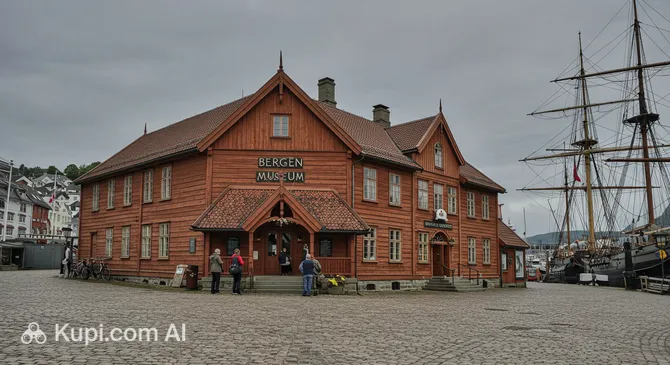
Imagine a place where legends of rugged seafarers and great maritime discoveries come to life. The Bergen Maritime Museum is a unique venue in the city of Bergen, entirely dedicated to the rich maritime heritage Norway has accumulated over many centuries.
Bergen Maritime Museum. Illustration.
Source: Kupi.com AI
Traveler photos:
Located in a picturesque district, the museum serves as a guardian of history from ancient times to the present day. Here, you can see detailed models of Viking ships, learn about the lives of medieval Hanseatic League merchants, and trace the transformation of a small fishing settlement into one of Northern Europe's most significant ports.
The exhibits capture the interest of both professional historians and casual tourists with their meticulous attention to detail. Bergens Sjøfartsmuseum offers more than just dry facts; it provides a true immersion into maritime culture, showcasing authentic artifacts, antique maps, and navigational instruments that once guided sailors through storms.
Contacts
To find out the latest information about special exhibitions or to plan a group visit, you can use the official communication channels. Museum staff are always ready to assist visitors with organizational questions by phone or through digital resources.
Below are the main contact details for reaching the museum administration:
In the museum's halls, a fascinating journey through the centuries awaits: from inspecting detailed reconstructions of Viking ships to studying the powerful engines of modern liners. Visitors can get a close look at the merchant ships that once brought goods to the Hanseatic quarter and learn the secrets of Norwegian shipbuilders' craftsmanship.
Interactive exhibits allow you to literally touch history: you will see items from the daily lives of sailors, ancient navigational tools, and maps used to chart courses to uncharted lands. Special attention should be given to the photo exhibitions dedicated to famous explorers and captains whose names are forever written in the annals of seafaring.
For families with children, the museum offers educational programs that turn history into an exciting game. After exploring the main exhibition, you can enjoy panoramic views of the bay from the surrounding grounds and capture great photos against the backdrop of Bergen's maritime landscapes.
Getting There
Located in the heart of the city, the Bergen Maritime Museum is situated at Haakon Sheteligs plass 15. Thanks to its central location, it is easily accessible on foot from the famous Fish Market or the lower station of the Fløibanen funicular. A walk from the Bryggen wharf takes no more than 10–15 minutes and allows you to enjoy the atmosphere of the historic streets.
If you prefer public transport, you can use the buses or light rail that stop near the University of Bergen or the central port. For those arriving from the airport, the most convenient option is the Flybussen express bus or the light rail (Bybanen) to the city center, from where the museum is just a few blocks away.
Those traveling by car should keep in mind that streets in the city center are quite narrow and parking spaces are limited. It is recommended to leave your vehicle in one of the large city parking garages and continue on foot, which is always a pleasant alternative to a taxi in the compact city of Bergen.
Nearest city: Bergen
History & Facts
The history of this site is inextricably linked to the development of seafaring in northern latitudes, starting from the rugged times of the Viking Age. Bergen, founded in 1070 by King Olav III, quickly became Norway's largest trading hub. Museum exhibits vividly demonstrate how sea routes allowed the city to become a "gateway to the world" for all of Scandinavia.
A special chapter in the city's history is the 14th century, when it became a key member of the Hanseatic League. German merchants established a powerful trade monopoly here, exporting stockfish and importing grain. The museum houses documents and artifacts from that era that help explain how the region's unique architectural and cultural identity was shaped by maritime trade.
Despite numerous fires that repeatedly devastated the city over the centuries, Bergen was consistently rebuilt, maintaining its status as the country's main port. The museum's displays carefully preserve the memory of how shipbuilding technology changed: from maneuverable longships to powerful steamers and the modern vessels that drive the economy of today's Norway.
Time Needed
To leisurely explore all the main halls and delve into the details of the exhibits, most visitors need between 1.5 and 2 hours. This is plenty of time to get acquainted with the collection of ship models and explore the interactive displays, which are particularly popular with children.
If you are a true maritime history enthusiast and plan to study the archival documents or temporary photo exhibitions in detail, it's worth setting aside a bit more time. The museum is laid out very logically, allowing you to move comfortably between eras without feeling overwhelmed by the abundance of information.
Working Hours
The museum is open to visitors daily, making it easy to include in your travel itinerary. On weekdays (Monday to Friday), the doors are open from 10:00 AM to 4:00 PM, while on weekends—Saturday and Sunday—the opening hours are extended until 5:00 PM, so everyone can enjoy the exhibition at their own pace.
Day
Working hours
Monday
10:00 – 16:00
Tuesday
10:00 – 16:00
Wednesday
10:00 – 16:00
Thursday
10:00 – 16:00
Friday
10:00 – 16:00
Saturday
10:00 – 17:00
Sunday
10:00 – 17:00
Nearby
Exploring the surroundings of the Bergen Maritime Museum will allow you to immerse yourself deeper into the atmosphere of this port city and see its many facets. Nearby locations offer both historical landmarks and modern places for leisure and sports.