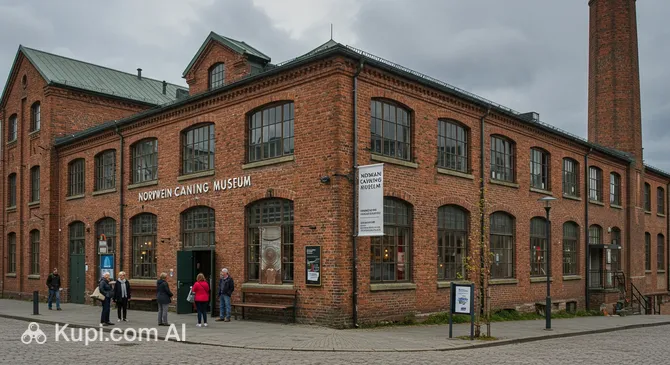
Imagine a place where time seems to have stood still during the height of the industrial era. The Norwegian Canning Museum is a unique space in the heart of the historic district that Stavanger is so proud of. Housed in a former factory building, it transports visitors back to the days when Norway was a world leader in the production of fish delicacies.
Norwegian Canning Museum. Illustration.
Source: Kupi.com AI
Traveler photos:
The museum is dedicated to the "golden age" of local industry, when the city was famous for its sprats and "Norwegian sardines." This is not just a static exhibition, but living history: here you can see fully restored fish processing lines, authentic smoking ovens, and antique machinery preserved in working order.
As part of the Museum Stavanger (MUST) association, this site offers an authentic cultural immersion. Visitors can not only learn the secrets of canning but also experience the atmosphere of a factory that was once the heart of the city's economy.
Contacts
For up-to-date information on events or to book group tours, you can use the following contact details:
In this museum, visitors are invited to do more than just look at exhibits; they can literally immerse themselves in the working process of an early 20th-century factory. You can put on a work apron and try your hand at being a packer or a fish cleaner using original equipment from those years. Such interactive elements make the visit particularly engaging for children.
One of the main highlights is the demonstration of the full cycle of sprat processing. Guests can see how fish is prepared and smoked in real ovens, and then packed into tin cans. In the museum's souvenir shop, you can purchase fresh canned goods made according to traditional recipes and take a tasty piece of Stavanger's history home with you.
Informative brochures are available in various languages for the convenience of international guests. After touring the production line, be sure to check out the section dedicated to label design—it is a true art form that once helped Norwegian sardines conquer world markets.
Getting There
The attraction is located in the picturesque Old Town district, just a few minutes' walk from the center of Stavanger. The most pleasant way to get here is a leisurely walk from the harbor or the central railway station, which takes about 10–15 minutes.
If you prefer public transport, take bus No. 1, No. 2, or No. 18 to the Vågen or Kirkegata stops, from where it is no more than a 5–10 minute walk to the museum entrance. Express buses and taxis run regularly from Sola Airport to the city center, with the journey taking approximately 20–30 minutes. It is worth noting that parking in the Old Town is very limited, making a walking route the most convenient option.
Nearest city: Stavanger
History & Facts
In the late 19th century, Stavanger experienced a true economic boom thanks to the return of massive schools of herring to its shores. The first canning factory opened here in 1873, marking the beginning of an entire industry that sustained the city for decades. The local factories' products were famous far beyond the country: it is known that in 1902, Norwegian delicacies even received an Imperial Certificate in Russia.
The peak of production occurred between the 1880s and the 1960s. During that time, dozens of factories operated in Stavanger, where the primary workforce consisted of women. The building that houses the museum today has fully preserved the machinery and the spirit of that era. The industry remained the mainstay of the region's economy until 1965, when the last major factory closed its doors.
Time Needed
For a detailed tour of the exhibition and participation in interactive workshops, most tourists find 1–2 hours sufficient. This time is enough to inspect the vintage machinery, try your hand at the improvised production line, and browse the souvenir shop.
If you plan to combine your visit with a thorough stroll through the streets of the Old Town or a break at a local cafe, set aside about half a day for this area. The museum is very compact but packed with details that you'll want to examine leisurely.
Working Hours
The museum's doors are open to visitors daily from 10:00 AM to 4:00 PM. This schedule applies to all days of the week, including Saturday and Sunday, making it easy to include a visit in your weekend plans.
10:00 – 16:00
Nearby
Exploring the museum's surroundings will allow you to dive deeper into the atmosphere of this port city and see how Norwegians lived in past centuries. Right outside the factory doors begin the cobbled streets lined with white wooden houses, which are attractions in their own right.