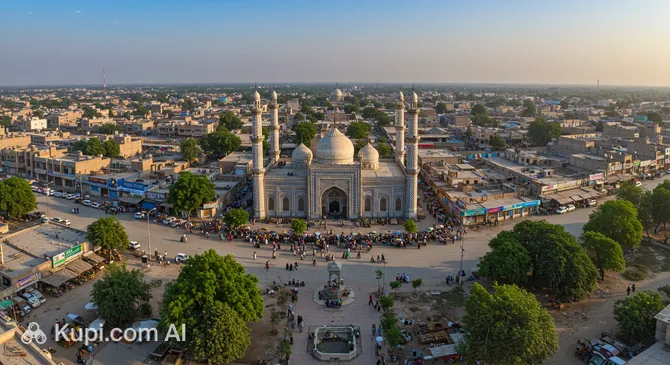
Khanewal is a dynamic administrative and transport hub located in the heart of the Punjab province, Pakistan. While not a typical tourist resort, the city possesses a unique energy as a vital link where the country's key highways and railways intersect. With a population of over 220,000, Khanewal serves as a strategic junction connecting major metropolises like Lahore, Multan, and Faisalabad.
Geographically, the city stretches across fertile plains near the Ravi River. The climate here is typical of the region: hot summers followed by mild winters, with the surrounding agricultural lands accounting for a significant portion of national exports. The history of Khanewal is closely intertwined with its development as a key communication node, which is reflected in its functional architecture and the busy rhythm of everyday life.
Khanewal. Illustration.
Source: Kupi.com AI
For the traveler, Khanewal is primarily interesting as an authentic slice of life in provincial Pakistan. There are no grand sights here, but you will find colorful markets and a monumental railway station building that has become the city's symbol. A visit to Khanewal is an opportunity to see the real, non-touristic Pakistan, experience its hospitality, and appreciate the scale of its internal logistics.
Weather Overview
The climate in Khanewal is distinctly continental, with extremely hot summers and cool, comfortable winters. The summer months, especially May and June, are characterized by sweltering heat, with temperatures often rising to +40°C and above. During this time, the city is often shrouded in a dusty haze due to active agricultural work and highway traffic.
The winter period, lasting from November to February, is considered the most favorable for visiting. Average temperatures during this time range from +13°C to +20°C, though nights can be quite chilly (down to +6°C). Precipitation is rare, except during the monsoon period in July and August, when intense but brief rains occur. The current city's climate should be taken into account when planning trips to avoid peak temperatures.
Average monthly temperature
Average monthly precipitation
Interesting Facts
The city's name translates from Persian as "Abode of the Khan," highlighting its historical connection to the Mughal era and the significance of local landowners.
Khanewal ranks 34th in population among all Pakistani cities and is one of the most important railway junctions in the national network.
The city is located in one of the most fertile regions in the world; agriculture in the Khanewal district contributes enormously to the country's cotton and wheat exports.
The city's railway station was designed as a strategic point back in colonial times to ensure seamless communication between the northern and southern regions of the Indian subcontinent.
Despite its industrial and transport focus, Khanewal is only an hour's drive from ancient Multan, which is known as the "City of Saints."
How to Get There
Khanewal is one of the most accessible cities in Pakistan in terms of transport logistics. Thanks to its unique location at the crossroads of vital communication routes, reaching it is easy from any part of the country. Detailed information on routes is available in the section on how to get to Khanewal.
The primary air gateway for travelers is Multan International Airport (MUX), located approximately 60 kilometers from the city. This is the nearest major airport, handling domestic flights from Islamabad and Karachi as well as international destinations. From the airport, you can reach the center of Khanewal by taxi or intercity bus; the journey takes about 1–1.5 hours depending on the traffic on the M-4 and Khanewal Road.
Railway transport is the city's pride. Khanewal Junction railway station is a powerful hub through which almost all trains heading south from Lahore (a 4-5 hour journey) and Faisalabad pass. Rail travel is considered the most convenient and reliable way to move around, although station congestion should be taken into account during peak hours.
Station
Passenger traffic
Distance
Multan Cantonment railway station
5
48 km
Bahawalpur railway station
4
102 km
Dera Ghazi Khan railway station
3
129 km
Bahawalnagar Junction railway station
5
131 km
Dera Nawab Sahib railway station
5
142 km
For those who prefer traveling by car, Khanewal is connected to major cities by modern motorways. The M-3 and M-4 provide fast access from Lahore, making the trip comfortable and predictable in terms of time, despite the heavy transit traffic in the Ravi River area.
Main Attractions
Khanewal is primarily a functional city, so there are few classic tourist attractions. The main landmark and heart of the city is its railway station. It is one of the most important transport hubs in the country, through which thousands of passengers pass daily. Observing the organized chaos of arriving and departing trains provides an excellent insight into the scale of movement within Pakistan.
The central markets of Khanewal are also worth visiting. These are not just places for shopping but true centers of social life. Walking through the narrow aisles, you can see the trade in fabrics, spices, and agricultural products for which the district is famous. The atmosphere of traditional Punjab prevails here, and locals always show genuine curiosity toward rare foreign visitors.
For those interested in historical traces, mentions of Tomb Shah can be found outside the main center—a place locals associate with the region's spiritual heritage. Although Khanewal is geared toward transit, its proximity to ancient Multan allows the city to be used as a base for exploring more famous cultural monuments while enjoying the tranquility of a provincial center.
Local Cuisine
The gastronomy of Khanewal is a true feast for lovers of the rich flavors and aromatic spices characteristic of the Punjab province. The local diet is based on rice and wheat dishes. Be sure to try the classic biryani and various types of chicken or mutton curry, which are prepared here with special care and an abundance of local seasonings.
Street food plays a key role in the city's food culture. In the markets and near the station, you will find stalls selling pani puri (crispy balls with a spicy filling) and freshly prepared kebabs. Locals often spend time in dhabas—roadside cafes serving hearty dal (lentil stew) with fluffy naan or roti straight from the tandoor.
Among drinks, the absolute favorite is lassi—a refreshing yogurt drink that can be either salty or sweet. It is also impossible to imagine life in Khanewal without masala chai (tea with milk and spices), which is drunk everywhere at any time of day. It should be noted that alcohol is virtually non-existent in the city's establishments due to local traditions and laws.
Travel Tips
Visiting Khanewal is a unique experience of immersing yourself in the life of Pakistani Punjab. To ensure your trip is comfortable and safe, we have prepared some practical tips.
Clothing and Essentials: Choose light, modest clothing made of natural fabrics (cotton, linen) to protect yourself from the heat and respect the local dress code. Modesty in dress is a sign of respect for local traditions. Don't forget comfortable closed shoes for walking on dusty streets.
Transport:Auto-rickshaws are best for moving around the city. Always confirm the price of the trip before getting in. For trips to other cities, use trains or licensed bus companies.
Finances: Be sure to carry a sufficient supply of cash in Rupees. ATMs are available in the center, but international cards are not accepted everywhere, and in small shops and rickshaws, it's cash only.
Health and Safety: Due to air pollution and dust from traffic during the dry wind season, a protective mask may come in handy. Drink only bottled water and avoid ice in street drinks.
Communication: The main languages are Punjabi and Urdu. English is understood by railway staff and educated youth. Learn a couple of greeting phrases—it always wins over the locals.
Local Etiquette: Greet people with your right hand. It is customary to remove your shoes before entering a private home or religious site. Residents of Khanewal are very friendly, but always ask permission before taking a photo of someone.
What to Avoid: It is not recommended to visit the outskirts of the city alone or at night. Also, avoid discussing political topics and exercise caution in crowded places.
Connectivity: It is best to purchase a SIM card at official operator offices in the city center; a passport is required for registration. Wi-Fi is available in some hotels, but the speed may be unstable.
Khanewal will reveal its true charm to you if you are open to communication and ready for the rhythm of a real Pakistani city. Enjoy your journey!
Entertainment & Nightlife
The entertainment scene in Khanewal is distinctly local. You won't find modern nightclubs or loud discos here; the city's evening life is centered around traditional tea houses (dhabas) and street food courts. After sunset, when the heat subsides, residents gather at the main markets and near the railway station to discuss the news over a cup of hot milk tea.
For daytime leisure, you can walk through the shopping districts or visit small local fairs that are periodically organized in the city's administrative areas. This is a great chance to see performances by folk musicians or traditional competitions. If you are looking for larger-scale cultural entertainment, such as cinemas or theaters, most locals prefer to make short trips to neighboring Multan.
Safety in the city is maintained at a good level, though for night walks, it is better to choose well-lit central streets and use official taxis or rickshaws. Overall, a stay in Khanewal is an immersion into the steady and traditional rhythm of Punjabi life, where the main entertainment is the interaction with the friendly locals themselves.
Parks & Museums
The urban environment of Khanewal reflects its status as an industrial and transport hub, so there are currently no classic museums with rich collections of artifacts in the city. The main focus here is on administrative and commercial infrastructure. The city's cultural life is more often expressed through street events and traditional festivals rather than through indoor exhibitions.
Green zones in the city are represented by small squares and parks, located mainly near government buildings and in the administrative district (Civil Lines). These areas serve as recreation spots for citizens in the evening. The greening of Khanewal is gradually developing, although dust from busy highways and agricultural activities around the city leave their mark on the landscape.
For those looking for a full recreational holiday or large-scale landscape parks, the best option would be to head to the suburbs, where you can enjoy views of the endless plains of Punjab. City residents often use the open spaces by the Ravi River for picnics and short breaks in nature, away from the noise of the railway tracks.
Getting Around
The public transport system in Khanewal is typical for medium-sized Pakistani cities and is focused on practicality. The primary means of getting around within the city limits are auto-rickshaws. They are maneuverable, affordable, and can take you anywhere, including the narrow alleys of the markets. It is always best to agree on the fare in advance, as rickshaws usually do not have meters.
Intercity communication is provided by a developed network of buses and minibuses. Khanewal's bus stations provide regular services to Multan, Lahore, and other neighboring districts. Buses come in different classes, ranging from basic non-air-conditioned ones to more comfortable expresses. This is a convenient option for those planning trips to the surrounding areas.
Railway transport holds a special place. For the residents of Khanewal, the train is not only a way to reach distant cities but also an important part of everyday logistics. When using any form of transport, tourists should take into account high road congestion during morning and evening hours, as well as the general dustiness of the air characteristic of this transport hub.
Accommodation
The accommodation options in Khanewal are primarily geared toward business travelers and transit passengers. Budget hotels and guest houses dominate the scene, with most concentrated in the immediate vicinity of the railway station and central markets. This is an ideal choice for those needing a convenient stopover on their journey.
The price range for staying in local guest houses varies between 10–30 USD per night. Conditions in such establishments are usually simple and functional: a clean room, basic amenities, and often traditional Pakistani hospitality. There are no luxury five-star hotels in the city itself, so for high-level service, travelers usually head to neighboring Multan.
When planning a visit, it is recommended to book accommodation in advance, especially if your arrival coincides with major holidays or agricultural exhibitions. To find suitable options, it is best to use local booking services or arrange on-site, as not all small hotels are represented on global international platforms.
Nearby Cities
Thanks to its location, Khanewal serves as an excellent starting point for exploring the cultural and historical treasures of central Pakistan. Just an hour's drive away is the majestic Multan, one of the oldest cities on the subcontinent, famous for its magnificent blue-tiled mausoleums and bustling traditional bazaars.
For those who want to get acquainted with the rhythm of life in smaller Punjabi towns, Kabirwala or Mian Channu are worth a visit. These destinations are ideal for day trips, allowing you to see endless agricultural fields, ancient mosques, and feel the peaceful atmosphere of the countryside. Abdul Hakeem, located near the river, may also be of interest.
Exploring the surroundings of Khanewal is an opportunity to step off the beaten path and see the real Pakistan. The region is rich in small but colorful settlements where traditions have been preserved for centuries, and the hospitality of the locals will make every trip unforgettable.
Shopping & Souvenirs
Shopping in Khanewal is primarily an immersion into the atmosphere of traditional bazaars. The city does not have large Western-style shopping malls, but its central markets, located near the railway station, offer a huge selection of goods that are hard to find elsewhere.
First and foremost, it is worth paying attention to local textiles and cotton products. As the center of an agricultural region, Khanewal is famous for high-quality fabrics. Hand-embroidered Punjabi scarves or traditional clothing make great gifts for loved ones. The markets also feature a rich selection of fresh spices, tea, and local sweets, which serve as excellent gastronomic souvenirs.
Shops usually operate from morning until late evening, with a short break during the hottest part of the day. It is important to remember that most retail outlets only accept cash (Pakistani rupees), and the ability to haggle is considered part of the communication culture here. A walk through the markets of Khanewal is not just for shopping, but for the unique experience of interacting with local traders.