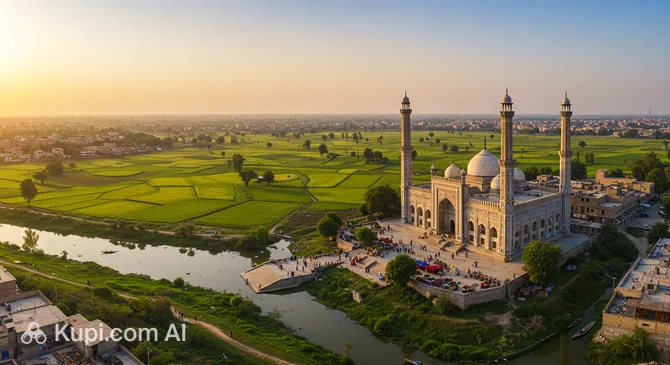
Jhang is a colorful and authentic city located in the heart of the Punjab province in Pakistan. Sprawling along the eastern bank of the majestic Chenab River, it serves as an important agricultural and administrative hub for the region. Life here moves at a relaxed pace, and the atmosphere is steeped in rural cultural traditions and the hospitality of the locals.
Jhang. Illustration.
Source: Kupi.com AI
The city is the eighteenth largest in the country, with a population of approximately 414,000 people. Jhang's rich historical roots date back to the Indus Valley Civilization and the Mughal era, when it served as an important military and trade center. Today, it is a flourishing agricultural hub surrounded by endless fields of wheat, cotton, and sugarcane.
While Jhang is not a classic tourist metropolis, it attracts travelers with its sincerity and unique monuments of the past, such as its old fort and shrines. A visit to this city is an opportunity to see the real Pakistan, free from urban glitz, and to immerse yourself in the living history of Punjab.
Weather Overview
Jhang is characterized by a subtropical continental climate, which dictates the conditions for planning a trip. The weather in Jhang features distinct seasonality: extremely hot summers and fairly mild, pleasant winters.
Summer months, especially May and June, can be harsh—temperatures often rise to +40°C and above. The monsoon season arrives in July and August, bringing heavy rains and high humidity, which lowers the heat slightly but makes the air feel heavy. Winter in the city is dry and cool: in January, the average temperature is around +12°C, though at night the thermometer can drop to +6°C.
Expect sunny and very hot summers with rare but intense downpours during the rainy season, and clear, invigorating winter days. The best time to visit the city is between November and March, when the weather is most comfortable for walking and exploring open-air attractions.
Average monthly temperature
Average monthly precipitation
Interesting Facts
Ancient Name: Historically, the city was known by the double name Jhang Maghiana, uniting two settlements on either side of the river.
River Confluence: The city occupies a unique geographical position near the point where the waters of two of Punjab's great rivers—the Chenab and the Ravi—meet.
Agricultural Gold: The surroundings of Jhang are considered some of the most fertile lands in the country, making the region a leader in cotton and sugarcane production.
Engineering Rarity: The bridge at Chund Bharwana, located nearby, is considered one of the longest and oldest railway-road bridges surviving from the British colonial era.
How to Get There
Accessibility to Jhang is primarily provided through a developed network of roads and railways connecting it to Punjab's largest cities. If you are planning a visit, it is useful to find out in advance how best to reach the city, considering the local traffic conditions.
There is no dedicated airport in Jhang itself. Travelers are recommended to fly into the nearest major aviation hubs. One of the most convenient options is Faisalabad International Airport (LYP), located about 100 kilometers away. From there, you can reach Jhang's center by taxi or intercity bus in about an hour and a half to two hours. Flying into Multan or Lahore is also a viable option.
Rail travel is another popular way to get around. Daily trains connect Jhang with Lahore and other cities in the province. The journey from Lahore usually takes about 4-5 hours. It is worth noting that trains may experience delays, but this mode of transport allows you to enjoy picturesque views of the Pakistani countryside. By car, the journey from Islamabad takes about 5-6 hours via modern highways.
Station
Passenger traffic
Distance
Faisalabad Railway Station
6
74 km
Okara Cantonment railway station
5
112 km
Multan Cantonment railway station
5
148 km
Bahawalnagar Junction railway station
5
167 km
Lahore Junction Railway Station
12
193 km
Main Attractions
Even though Jhang is not typically on popular tourist itineraries, it is home to several interesting sites that reflect its centuries-old heritage. One of the most significant monuments is the Jhang Fort, built during the Mughal era. This historical site stands as a silent witness to the city's former greatness and strategic importance during the Middle Ages.
For those who appreciate the engineering feats of the past, the old bridge at Chund Bharwana, located about 14 kilometers from the city, is a must-visit. Built in 1905, this impressive bridge—roughly 750 meters long—is still striking in its architecture and remains one of the oldest crossings in the region.
Shrines are a vital part of the city's cultural and spiritual life. One of the most revered is Darbar Sultan Bahu, a religious center on the outskirts of Jhang that attracts thousands of pilgrims from across the country. It is also worth visiting the city's central markets, which are attractions in their own right, showcasing the traditional lifestyle and crafts of the local people.
Local Cuisine
The cuisine of Jhang is the quintessence of Punjabi culinary traditions, where spices, meat, and fresh local produce play the lead roles. The diet is based on various rice dishes and flatbreads like naan and chapati, served with thick and aromatic curries. Mutton and chicken kebabs cooked over an open fire are particularly popular.
As a center for sugarcane cultivation, the city is famous for its sweets and desserts. Be sure to try fresh sugarcane juice, sold on almost every corner. Another iconic drink of the region is lassi—a refreshing yogurt-based drink that can be either salty or sweet, perfect for coping with the summer heat.
The city's gastronomic life is focused on the markets and small street stalls. Locals appreciate simple but hearty food. Among the signature dishes, saag (spiced spinach) is worth highlighting, traditionally served with corn flatbreads (makki di roti). The atmosphere in dining establishments is very welcoming, and portions are usually generous, making a meal in Jhang a true feast of flavor.
Travel Tips
A trip to Jhang offers a unique experience of exploring the heart of Pakistan. To make your journey comfortable and safe, we have prepared a few practical tips.
Clothing and Dress Code: Choose modest clothing made of natural fabrics. Women are advised to wear loose outfits that cover the shoulders and knees, and to always carry a light scarf (dupatta). Men should avoid short shorts. Comfortable closed shoes are essential due to the dusty streets.
Transport: Use rickshaws to get around the city, but always negotiate the fare beforehand. If you plan trips out of town, it is better to rent a car with a local driver.
Finance: The official currency is the Pakistani Rupee. Cards are rarely accepted, so always carry an adequate supply of cash. ATMs can be found in the city center, but international cards do not always work.
Health: Drink only bottled water and avoid ice in drinks. It is recommended to carry a basic first-aid kit and sunscreen.
Communication: The main languages are Punjabi and Urdu. Hotel staff and young people understand English, but it is useful to learn a few basic Urdu phrases for shopping in the markets.
Local Etiquette: Always remove your shoes when entering mosques or private homes. Do not take photos of people, especially women, without their prior consent.
What to Avoid: You should not plan long walks alone after dark, especially on the outskirts of the city or in sparsely populated areas.
Connectivity: Purchase a local SIM card (such as Jazz or Telenor) in Lahore or Faisalabad before arriving in Jhang, as the registration process here may take longer.
By following these simple rules, you will be able to fully enjoy Jhang's hospitality and bring home only warm memories!
Entertainment & Nightlife
The entertainment infrastructure in Jhang is traditional and understated, as the city follows the conservative norms of provincial Pakistan. You won't find loud nightclubs or bars here; the evening life of the locals centers around cozy tea houses and family gatherings. The main places for evening strolls are the central markets and squares, where life hums until late at night.
The main cultural event of the year is the Mela Chiran (Festival of Lights), held in honor of Syed Ahmed. This vibrant and large-scale event draws thousands of people, offering guests traditional music, dancing, and local treats. For those seeking more modern entertainment formats, such as cinemas or large entertainment centers, residents often recommend heading to Lahore, which is a few hours' drive away.
Daytime leisure in the city often involves visiting the scenic banks of the Chenab River, where you can have a small picnic or simply enjoy the views. Security in the city is generally good; however, tourists are advised to stick to central areas after dark and use official taxis or rickshaws for transportation.
Parks & Museums
The park areas in Jhang consist of small green squares and recreational spots along the banks of the Chenab River. In a densely populated agricultural hub, these places serve as important "lungs" for the city. While there are no large-scale botanical gardens, locals enjoy spending time in the shade of trees near the water to escape the heat.
As for museum exhibitions, there are no specialized museums in the city yet. However, the historical districts of Jhang and ancient fortifications serve as a living museum. To learn about the region's culture, tourists are encouraged to visit local shrines and Darbars, which are not only religious sites but also repositories of traditional art, architecture, and calligraphy.
The lack of formal parks is compensated for by the vast agricultural fields beyond the city limits. Walking through the countryside allows you to see the traditional way of life of Punjab's farmers and enjoy natural landscapes that have remained unchanged for many decades.
Getting Around
The transport system in Jhang is typical of provincial Pakistani cities, characterized by high dynamism and a degree of chaos. The main mode of transport for short distances is the rickshaw and its motorized versions—the qingqi. This is the most affordable and fastest way to navigate the city's narrow streets, though the fare should always be agreed upon in advance.
For trips between districts and to the suburbs, locals actively use buses and small vans known as "Hiaces." They run quite frequently but can be very crowded during peak hours. Most routes do not have a strict schedule, so it can be difficult for tourists to navigate without local help. Fares in these vehicles are paid in cash to the conductor.
Taxi services are an alternative to public transport, though international apps like Uber or Careem can be unstable here. The best option is to order a car through your hotel's reception. Keep in mind that due to the terrain and road conditions in the dry season, the city can be quite dusty, so it is recommended to use protective masks or scarves when traveling in open rickshaws.
Accommodation
The choice of accommodation in Jhang is somewhat limited and mainly caters to business travelers and locals. Luxury five-star hotels are practically non-existent, but you can find decent mid-range options and budget guesthouses.
The city center, adjacent to the main markets and administrative buildings, is considered the most convenient area to stay. Small 2-3 star hotels are concentrated here, offering basic amenities such as air conditioning, Wi-Fi, and breakfast. For those planning a longer stay, renting private apartments is a popular alternative.
If you plan to visit during major holidays or festivals like Mela Chiran, it is highly recommended to book your accommodation in advance. The cost of living in the city is very affordable, and payment is most often made in cash in the local currency, though some modern hotels are beginning to accept international cards.
Nearby Cities
Jhang serves as a convenient starting point for exploring the central part of Punjab, offering travelers the chance to visit interesting neighboring towns as part of day trips. The surrounding region is rich in agricultural land and small settlements, each with its own charm.
Just 36 kilometers away is the city of Gojra, known for its trading traditions and textile industry. Slightly further, about 37 kilometers away, lies Toba Tek Singh—a city with an interesting history and a calm atmosphere. For those who want to see larger centers, a trip to industrial Faisalabad or historic Multan, famous for its mosques and tombs, is an excellent option.
Exploring the outskirts of Jhang will give you a better understanding of the diversity of life in Pakistan, showing the contrast between quiet agricultural towns and bustling industrial centers. Most of these destinations are easily accessible by bus or taxi via regional roads.
Shopping & Souvenirs
Shopping in Jhang is, above all, an immersion into the atmosphere of an Oriental bazaar, where trade follows old rules. The city is famous for its cotton and high-quality fabrics, so buying textiles here is an excellent choice. In the central markets, you can find both modern clothing and traditional handmade Pakistani outfits.
The main shopping activities are concentrated in the old quarters, where narrow streets are lined with stalls selling spices, jewelry, and leather goods. Traditional markets (bazaars) offer a huge selection of agricultural products, including the famous local rice and brown sugar (jaggery), which makes for an unusual and tasty gift.
There are no large Western-style shopping and entertainment centers in the city, which only adds to its authenticity. Shops usually operate from morning until late evening, with a lunch break during the hottest part of the day. Most outlets only accept cash, so it is wise to carry small bills. Remember that polite haggling is appropriate and even encouraged in the local markets.