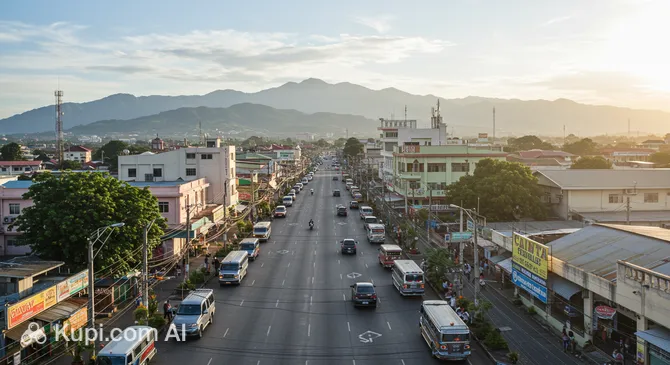
Cainta is more than just one of the oldest municipalities on the island of Luzon; it is the vibrant "gateway" to the Rizal province. Located right on the border with Metro Manila, it offers a unique blend of a highly urbanized suburb and a historical settlement founded back in 1571. Despite its small size, Cainta is one of the most densely populated and economically prosperous places in the Philippines, attracting visitors with its proximity to the capital and its active pace of life.
Geographically, the town occupies a flat plain along the banks of the Pasig River, which historically made it an important trading and strategic hub. Today, it is home to over 376,000 people, and the territory itself has transformed into a wealthy commercial center. If you are interested in the authentic history of Cainta, it is worth exploring its old quarters, where the spirit of the colonial past and legends of generous founders can still be felt.
Cainta. Illustration.
Source: Kupi.com AI
The town is famous for its unique cultural diversity, including the heritage of the Sepoys—descendants of Indian soldiers who settled here centuries ago. This is reflected not only in the physical features of the locals but also in unique gastronomic traditions. Cainta is an ideal destination for those who want to see the everyday life of a Philippine metropolis without the frills, enjoy local hospitality, and feel the pulse of the modern Rizal region.
A visit to this municipality is an excellent addition to a trip across the Philippines for those seeking an authentic experience off the usual tourist paths. The town invites you to explore its bustling markets, try its famous sweets, and immerse yourself in the atmosphere of one of the country's wealthiest and most dynamic communities.
Weather Overview
The town of Cainta is located in a typical tropical monsoon climate zone, characterized by high air temperatures throughout the year. Average figures usually fluctuate between 26–32°C. There are two distinct seasons here: the dry season, lasting from December to May, and the rainy season, which covers the period from June to November. Humidity remains high almost constantly, which should be considered when planning long walks.
The hottest months are April and May, when the thermometer can rise to 34°C, while the "coolest" and most comfortable months for visiting are January and February, with average temperatures around 26°C. If you want to find more precise data, check the current weather in Cainta. It's worth remembering that from July to September, the region is often affected by monsoons, which bring heavy, though sometimes brief, downpours.
Travelers are recommended to bring light cotton clothing and always carry a supply of drinking water. Due to dense urbanization and a lack of large open spaces, central districts of Cainta may experience the "heat island effect," where buildings trap heat even after sunset. Plan your visits to open markets and attractions for the morning hours to avoid the midday heat.
Average monthly temperature
Average monthly precipitation
Interesting Facts
Cainta is a place with a fascinating history and hidden features that make this municipality unique on the country's map.
A Legendary Name: According to local folklore, the town was named after a wealthy and merciful woman named Jacinta, whom locals affectionately called "Ka Inta." She was known for her kindness and for helping the poor and the sick.
Indian Roots: Barrio Dayap is home to descendants of the Sepoys—Indian soldiers who deserted the British army during the occupation of Manila in 1762–1764. Even today, many Cainta residents have distinct Indian features that set them apart from typical Malay Filipinos.
Wealthiest Municipality: Despite Cainta occupying one of the smallest territories in the Rizal province, it is officially recognized as the wealthiest municipality in the Philippines in terms of total assets, which exceed several billion pesos.
City of Sweet Rice: Cainta is considered the unofficial "capital of biko and suman"—traditional Filipino desserts made from glutinous rice. Local recipes for these sweets are considered among the best in the country.
Military Past: In 1571, Cainta was a well-fortified settlement surrounded by bamboo stockades and moats. It put up fierce resistance against the Spanish conquistadors led by Juan de Salcedo.
How to Get There
The transport accessibility of Cainta is due to its strategic position at the junction of Metro Manila and Rizal province. The town serves as an important transit hub through which the main arteries connecting the capital with the eastern regions pass. Although the municipality itself does not have its own airport, getting here from the country's main air gateways is easy. To plan your route, you can check out detailed information on how to get to Cainta.
The nearest and most significant airport is Ninoy Aquino International Airport (MNL). It is located approximately 20 kilometers from the town. Depending on traffic, a trip by taxi or via the Grab service will take between 45 and 90 minutes. Travelers are advised to choose routes via the C-5 highway or Ortigas Avenue. For a budget-friendly trip, you can take the LRT-2 light rail to Santolan Station and then transfer to a jeepney heading straight to the town center.
There is currently no direct rail service within Cainta, but the town benefits significantly from its proximity to the LRT-2 light rail stations in the neighboring Marikina and Pasig areas. These stations provide quick links to the business centers of Cubao and Recto. The main flow of passengers within the municipality and to nearby suburbs is handled by an extensive network of buses and traditional Filipino jeepneys.
Station
Passenger traffic
Distance
Marikina–Pasig Station
5
4 km
Antipolo Station
6
4 km
Santolan Station
7
5 km
Ortigas station
6
6 km
Shaw Boulevard MRT Station
6
7 km
Main Attractions
The town of Cainta is not a typical tourist center with an abundance of world-class historical monuments, but it draws visitors in with its lively atmosphere and local charm. One of the main points of interest is the Sto. Niño district, where public life is concentrated and colorful festivals are held, reflecting the deep religious traditions of the local residents. Here, you can see how everyday life and centuries-old customs are closely intertwined.
For those interested in anthropology and unusual history, a visit to Barrio Dayap is a must. This place is unique for its Sepoy heritage—it is home to the descendants of Indian soldiers who arrived on the islands in the 18th century. A walk through these streets allows you to notice the unique facial features of the locals and feel the influence of Indian culture that has been preserved in this corner of the Philippines for centuries.
While there aren't many museums in Cainta itself, lovers of architecture and religion can appreciate the local parish churches, which serve as spiritual centers for thousands of citizens. During festive days, especially during Holy Week, the town is transformed by large-scale "Senakulo" street plays, which are considered some of the most impressive in the region and attract pilgrims from all around.
The leisure of modern residents is inextricably linked with major shopping and entertainment spaces. For example, for delicious food and relaxation after a walk, you can stop by Wok it Out or grab a bite at the popular 24 Chicken. These spots are perfect for feeling the rhythm of the municipality's modern life between sightseeing stops.
Local Cuisine
The gastronomic culture of Cainta is a vibrant reflection of Filipino hospitality with a unique local accent. The town is rightfully proud of its traditional glutinous rice sweets. You must try suman (rice wrapped in banana leaves) and biko—these desserts in Cainta are prepared according to ancient recipes passed down through generations. A special influence on the local cuisine comes from the Sepoy heritage in the Dayap district, where you can find dishes with a subtle hint of Indian spices and curry.
The daily diet of locals consists of classic Filipino hits: adobo, sinigang, and fried fish. Street food in Cainta thrives at evening markets, where vendors offer balut, fried chicken innards, and sweet drinks made from fresh tropical fruits. Among non-alcoholic drinks, calamansi juice and refreshing buko (coconut water) are the favorites, providing the perfect relief from the tropical heat.
For those who prefer modern dining formats, the town offers many popular establishments. Asian stir-fry lovers will appreciate the menu at Wok it Out, where dishes are prepared quickly and right in front of the customers. If you're craving juicy and crispy chicken, 24 Chicken is an excellent choice—this place is extremely popular with young people and office workers due to its great value for money.
The food culture in Cainta is centered around large shopping malls and busy market squares. Here you can find both chain restaurants like Jollibee and small family-run "carinderias" serving home-cooked meals. The combination of traditional rice desserts and modern fast-food trends makes the town's gastronomic scene accessible and diverse for any traveler.
Travel Tips
Preparing for your trip to Cainta will help make your visit to this dynamic municipality comfortable and safe. These practical tips are based on local specifics and will help you navigate the town like a pro.
Clothing and Gear: Choose light clothing made of natural fabrics, as it is hot and humid in Cainta year-round. Don't forget comfortable closed-toe shoes for walking through markets and an umbrella, which will protect you from both tropical downpours and the scorching sun. When visiting churches, such as the shrine in Sto. Niño, it is recommended to cover your shoulders and knees.
Transport Nuances: Use jeepneys or tricycles for moving between districts, but for trips to Manila, it's better to book a Grab. Be prepared for serious traffic jams during peak hours—a trip that usually takes 20 minutes can stretch to an hour and a half.
Finances: The main currency in the Philippines is the peso. Large shopping malls accept cards, but for paying for tricycles, street food, and market purchases, be sure to have small cash on hand. ATMs are available in malls, but international cards don't always work reliably.
Safety: Overall, the town is friendly, but keep an eye on your belongings in densely populated areas and markets. Avoid walking alone at night in poorly lit outskirts (barrios). Use online maps for navigation.
Communication: English is widely spoken, so communication won't be an issue. Buy a local SIM card (Globe or Smart) as soon as you arrive—mobile internet works stably in Cainta, while free Wi-Fi is only available in major malls.
Local Etiquette: Filipinos are very polite. Use the words "po" and "opo" to show respect when talking to elders. A smile is the best way to establish contact in any situation.
What to Avoid: Do not criticize local customs or religion publicly. Also, try not to show impatience in queues or traffic—calmness and patience are highly valued in the Philippines.
Health: Drink only bottled water. Due to high humidity, it is recommended to use insect repellent to protect yourself from tropical fevers.
May your introduction to Cainta be filled with bright discoveries and pleasant encounters. This town knows how to surprise those who are ready to step off the beaten path!
Entertainment & Nightlife
The entertainment scene in Cainta is primarily local and family-oriented. You won't find a huge number of nightclubs or loud discos here—the town moves to the rhythm of a large residential and commercial suburb. The main leisure hubs for locals and guests alike are the large shopping malls and their surrounding areas, where cinemas and gaming centers stay open until late evening.
Cainta's nightlife is focused on cozy karaoke bars and small open-air grill restaurants where people typically gather in groups. If you're looking for more dynamic entertainment with dance floors and cocktail bars, it's best to head to the neighboring districts of Pasig or toward Ortigas Center, which can be reached by taxi in 15–20 minutes. For those who get hungry late at night, places like 24 Chicken are always open, offering quick and high-quality snacks.
Daytime entertainment often involves visiting culinary spots like Wok it Out or strolling through local markets, which are especially colorful in the morning hours. Safety in the central areas of the municipality is well-maintained, and for travel after dark, it is recommended to use ride-hailing apps like Grab to ensure a comfortable and quick transfer to your hotel or neighboring entertainment hubs in the capital.
Parks & Museums
In a densely urbanized environment, Cainta does not boast vast green zones, but it does have its own cozy spots for relaxation. These are mostly small public parks and squares, such as the area around the municipal center, where residents gather for evening walks and leisure. The lack of large forest parks within the town itself is compensated for by the abundance of greenery in the yards of private neighborhoods and the proximity to natural sites in neighboring municipalities.
As for cultural leisure, there are virtually no classic museums in Cainta. The role of history keepers is played here by ancient religious structures and the appearance of historical districts like Barrio Dayap. A stroll through this neighborhood is a kind of "living museum," where you can study the unique Indo-Filipino heritage and see the life of a community that has preserved its characteristics for centuries. For major art galleries, locals usually head to neighboring Antipolo, home to the famous Pinto Art Museum.
For those looking for modern places to spend time, the spacious atriums of shopping malls serve as an alternative to parks, often hosting temporary exhibitions and cultural events. After a walk around town, you can stop by popular gastronomic spots like Wok it Out or 24 Chicken, which have become an integral part of the modern urban environment. Despite the shortage of traditional parks, Cainta wins you over with its energy and authentic rhythm of life.
Getting Around
The transport system of Cainta is typical for a densely populated Filipino suburb, where the main burden falls on surface public transport. The "kings of the road" here are the jeepneys—brightly decorated minibuses that ply the main thoroughfares such as Ortigas Avenue and Marcos Highway. This is the most affordable way to get around, with fares starting at just a few pesos. Payment is cash-only, passed to the driver through other passengers.
For traveling short distances within residential neighborhoods (barrios), tricycles (motorcycles with sidecars) dominate. They are ideal for moving through narrow streets where buses cannot go. The cost of a tricycle ride is usually negotiable, although fixed rates exist for locals. Tourists are advised to confirm the price before boarding. Bike rentals are not well-developed in the town due to high traffic density and the lack of dedicated lanes.
An alternative to public transport is taxis and ride-hailing apps like Grab. This is the most comfortable and safest option for tourists, especially in the evening or when traveling with luggage. It is worth noting that during rush hours (7:00 to 9:00 AM and 5:00 to 8:00 PM), Cainta suffers from severe congestion, so trips to Manila or neighboring cities should be planned with plenty of extra time. Pedestrian infrastructure can be inconvenient in some places, so it's always better to choose a vehicle for longer moves.
Accommodation
In Cainta itself, the choice of hotels for traditional tourism is relatively small, as the town is primarily oriented toward residential and commercial developments. Most accommodation options here consist of modern apartments and guesthouses, which are often rented out through popular booking services for both short-term and long-term stays. This is an excellent choice for those who want to experience the local flavor and save on accommodation costs.
The most convenient areas to search for housing are the zones along Ortigas Avenue Extension and Marcos Highway. Here you will find residential complexes (condominiums) offering comfortable conditions with pools and security, as well as proximity to transport hubs and shopping malls. If you are looking for luxury five-star hotels, it is worth looking at the neighboring districts of Ortigas or Libis, which are about a 15–20 minute drive away.
When planning a trip to Cainta, it is recommended to book your accommodation in advance, especially during local festivals or major religious holidays, when the demand for affordable and quality options increases sharply. The main booking methods are international platforms and direct contact with apartment owners. Nearby, you will always find cozy places to relax and eat, such as Wok it Out or 24 Chicken, which will make your stay in the town as comfortable as possible.
Nearby Cities
The town of Cainta is an ideal starting point for exploring the eastern outskirts of Metro Manila and the scenic hills of the Rizal province. Thanks to its location at the intersection of key roads, it is easy to reach cities that offer completely different types of recreation—from large-scale shopping to mountain walks.
Just a few kilometers away is the city of Antipolo, which is considered a cultural and natural gem of the region. Tourists go there for the famous Cathedral of the Immaculate Conception, the Pinto Art Museum, and stunning panoramic views of Manila. Equally interesting is the neighboring Taytay, known as the "Garments Capital of the Philippines," where you can find high-quality textiles at the lowest prices in huge markets. It is also worth visiting dynamic Pasig, where modern business centers sit alongside cozy parks and trendy restaurants.
Exploring the surroundings of Cainta will allow you to see the many facets of the Philippines: from the chaos of the capital's suburbs to the tranquility of mountain monasteries. We highly recommend setting aside time for day trips to these neighboring cities to fully appreciate the richness of the local culture and nature.
Shopping & Souvenirs
Shopping in Cainta is a mix of giant modern malls and colorful local markets. The town may not be a fashion capital, but it is perfect for those looking for quality goods at reasonable prices. A specialty of the local market is the traditional sweets and pastries, which are considered the best in the Rizal province and make excellent gastronomic souvenirs.
The main magnets for shopping enthusiasts are the large commercial complexes on the town's border. Major chain centers like Robinsons Metro East and the nearby SM Taytay offer a huge selection of international clothing brands, electronics, and household goods. These malls also feature food courts for a quick bite. Shops in these centers typically operate from 10:00 AM to 9:00 PM or 10:00 PM, and credit cards are accepted almost everywhere.
For those who want to experience the local color, a visit to Cainta Public Market is essential. At this market, you can find fresh tropical fruits, seafood, and, of course, the famous suman. This is the best place to buy authentic Filipino products. Keep in mind that it's better to have cash in small Philippine peso bills at the markets, as bank cards are rarely accepted. For souvenirs, it's worth bringing back local textiles or handmade crafts, which are often found at fairs during festive days.