Support

Spichrze nad Brdą - Muzeum Okręgowe im. Leona Wyczółkowskiego w Bydgoszczy

About

A symbol recognized by every resident and visitor of Bydgoszcz, the famous Granaries on the Brda are a unique complex of historic storage houses. Built at the turn of the 18th and 19th centuries, they represent a stunning example of Prussian architecture. Today, these walls house the Leon Wyczółkowski Museum, inviting travelers to dive into the rich history of Poland.
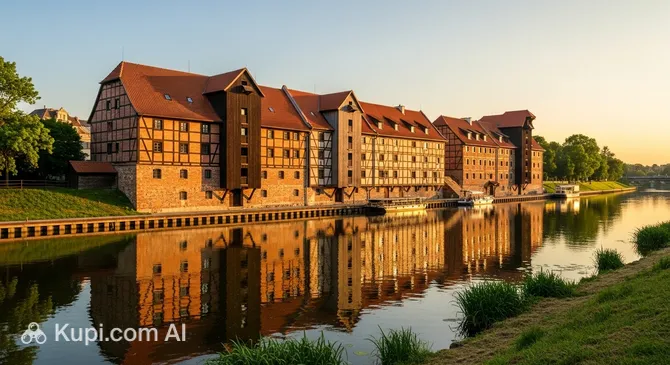
Granaries on the Brda River – Leon Wyczółkowski District Museum in Bydgoszcz
Granaries on the Brda River – Leon Wyczółkowski District Museum in Bydgoszcz. Иллюстрация. Источник: Kupi.com AI

The so-called "Dutch" granary is of particular interest, featuring a characteristic steep roof and rounded slopes. These buildings, with their recognizable timber-framed walls and brick filling, are so significant that their stylized image adorns the city's modern logo. Situated right on the riverbank, the granaries are a reminder of the city's glorious past as a major trading port.

The complex currently consists of three surviving structures, carefully adapted for museum use. This is not just a monument of industrial architecture, but a vibrant cultural space where old beams and creaky floors coexist with modern exhibitions detailing everyday life and the development of trade in bygone eras.

Contacts

To check the latest information regarding exhibitions and special events, you can use the official contact details:

How to contactContact
AddressGrodzka 7/11, 85-109 Bydgoszcz, Польша
Phone+48 52 525 38 03
Websitewww.muzeum.bydgoszcz.pl

What to Do

Inside the historic walls of the museum, visitors will find a fascinating journey through time. The main exhibitions are dedicated to city history: here you can see archaeological finds, ancient household items, and documents telling the story of how Bydgoszcz became a thriving river port. Pay special attention to the temporary exhibitions and educational programs often held in the museum's halls.

Be sure to linger at the entrance of the complex, where a cozy amphitheater is located. It is a popular spot for city concerts and cultural events. Nearby, you'll find a detailed bronze model of medieval Bydgoszcz — an excellent chance to study the old city layout and take some impressive macro shots for your travel blog.

Lovers of aesthetics will enjoy a walk along the Brda embankment. This vantage point offers the best panoramic views of the granaries' "Prussian walls" and the river. You can soak in the old town atmosphere while watching river trams glide by, or combine your museum visit with a trip to the neighboring Mill Island (Wyspa Młyńska) and the modern Opera Nova building.

Getting There

Finding this architectural ensemble is easy, as it is located in the heart of Bydgoszcz, on the Brda river embankment, very close to the Old Market Square and Mostowa Street. If you prefer walking, the route from the main railway station, Bydgoszcz Główna, takes about 15–20 minutes through the picturesque central streets.

For those using public transport, the most convenient options are trams and buses going to the Stary Rynek or Mostowa stops. From there, it is just a couple of minutes' walk along the embankment, which is a wonderful pedestrian zone in its own right.

If you are arriving by taxi or rental car, keep in mind that parking in the strict city center may be limited. It is best to leave your car at one of the nearby paid parking lots and continue on foot to enjoy the atmosphere of the old river port.

Ближайший город: Bydgoszcz

History & Facts

The history of these majestic structures began at the turn of the 18th and 19th centuries. Between 1793 and 1800, merchant Samuel Gottlieb Engelmann built them for grain storage, highlighting the city's status as the region's most important river port. Originally, the complex consisted of five buildings constructed in the traditional Fachwerk technique (also known as the "Prussian wall"), where a wooden frame was filled with brick.

Until the mid-19th century, the granaries were the center of economic life, linking waterways, mills, and merchant ships. However, with the development of railways, the importance of river transport began to decline, and the warehouses gradually changed their purpose. A tragic chapter in the complex's history occurred in 1960, when a major fire destroyed the two outermost buildings, leaving the city with only three surviving monuments.

In 1964, after a meticulous restoration, the remaining granaries at numbers 9 and 11 were handed over to the Leon Wyczółkowski Museum. Today, these buildings are the city's only surviving examples of warehouse architecture from that era standing directly by the water. They don't just house museum collections; they are valuable exhibits in their own right, telling the story of Bydgoszcz's industrial heyday.

Time Needed

To leisurely explore the museum's exhibitions and admire the unique architecture from the outside, most tourists need between 1 and 2 hours. This is plenty of time to get acquainted with the region's history and take some memorable photos by the river.

If you plan to visit temporary exhibitions or spend some time in the small amphitheater by the entrance, it's worth setting aside a bit more time. A visit to the museum fits perfectly into a weekend stroll through the city center, allowing for an exploration of the neighboring Mill Island (Wyspa Młyńska).

Working Hours

The museum welcomes visitors throughout the week, except for Mondays. Please note that the schedule may change depending on the season or public holidays, so it is recommended to check the official website before your visit.

The standard opening hours are as follows:

  • Tuesday – Wednesday: 10:00 – 18:00
  • Thursday: 10:00 – 18:00
  • Friday: 12:00 – 20:00 (a great option for an evening visit)
  • Saturday – Sunday: 11:00 – 17:00
  • Monday: Closed

DayWorking hours
понедельникЗакрыто
вторник10:00–18:00
среда10:00–18:00
четверг10:00–18:00
пятница12:00–20:00
суббота11:00–17:00
воскресенье11:00–17:00

Nearby

A walk around the granaries is just the beginning of your journey through the historic center. The museum's location makes it easy to include many other interesting sites within walking distance into your itinerary.

NameDistance
Man Crossing the River0 km
Old Market Square0.1 km
Young Burger0.2 km
Monument to Casimir the Great0.3 km
Museum of Soap and History of Dirt0.3 km
AVA 3.00.3 km
SEE YA0.3 km

Reached the end of the page?

That means the route is fully explored