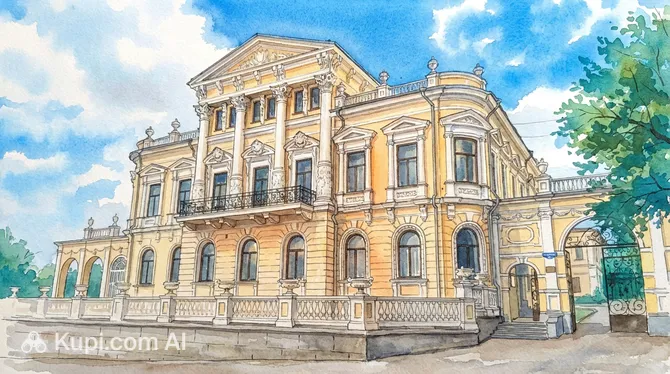
It is impossible to imagine diving into the history of the Kama region without visiting this place. The Perm Regional Museum is one of the oldest and most significant cultural centers, carefully preserving the region's chronicles. Housed in a majestic historical building in the city of Perm, it serves as a true portal to the past: from the era of ancient reptiles to the industrial boom for which Russia is famous.
Perm Regional Museum. Illustration.
Source: Kupi.com AI
Traveler photos:
The museum's main pride is its unique materials dedicated to the Permian geological period. This is the only period in Earth's history named after a Russian city. Here, you can see rare fossils and artifacts that tell the story of a world that existed hundreds of millions of years ago.
The museum combines the features of a scientific archive and a modern interactive space. Its collections include hundreds of thousands of exhibits, including ethnographic treasures of the Komi-Permyaks and archaeological finds recognized as world heritage. It is the perfect starting point for those who want to understand the spirit of the Urals and its significance in world history.
Contacts
To plan your visit and check current information, you can use the following contact details for the museum:
A fascinating journey through millennia awaits you in the museum halls. Be sure to stop by the natural history department, which features the skeletons of mammoths and other prehistoric giants. Examining the bizarre fossils of the Permian period is an experience that impresses both children and adult scientists alike.
Culture enthusiasts will enjoy exploring the ethnographic collections. Here, you can see authentic costumes, household items, and unique icons belonging to the old-timers and indigenous peoples of the Urals. Multimedia installations help bring ancient legends to life and provide a better understanding of how the first factories in the Kama region were built.
For family leisure, the museum offers a visit to the planetarium, where engaging lectures about space are held. Additionally, the museum frequently hosts temporary exhibitions of contemporary art and workshops on traditional crafts, making every visit to the museum unique and unforgettable.
Getting There
Located in the heart of the historical center, the Perm Regional Museum is within walking distance of the scenic Kama River embankment. The exact address is 11 Monastyrskaya St. If you prefer walking, the route from the city Esplanade or the Theater Garden will take no more than 10–15 minutes.
For those using public transport, the most convenient stops are "Monastyrskaya Ulitsa" or "Kreml." You can walk from the "Perm-I" railway station in just a few minutes, while from the main "Perm-II" station, you can take trams No. 3 and No. 4, or buses No. 3, No. 5, and No. 10 (the trip takes about 20 minutes to the "Leninskaya" stop).
If you are arriving by taxi or private car from Bolshoye Savino Airport, the trip will take approximately 30–40 minutes depending on traffic. Keep in mind that parking spaces directly at the museum entrance are limited, so it is better to look for a spot in paid parking lots on adjacent streets in advance.
Nearest city: Perm
History & Facts
The official history of this scientific and cultural center began on November 15, 1890. Initially, the museum was established as a commission under the Ural Society of Lovers of Natural Science. It opened its doors to the first visitors in January 1894 in a building on Pokrovskaya Street. Even then, it was clear that the region possessed enormous archaeological potential, which was confirmed by large-scale excavations at the Glyadenovskoye Kostishche site.
At the beginning of the 20th century, the museum became the main intellectual headquarters of the region. By 1916, it remained the only scientific institution in the area, and after the opening of Perm University, its staff was bolstered by distinguished professors. Expeditions from that period allowed for the collection of priceless ethnographic items reflecting the life and traditions of the people of the Kama region.
Over the decades of its existence, the museum has undergone many transformations and moves. It received its current name in 1957. A significant milestone was the opening of the planetarium in 1960, which remains one of the favorite attractions for residents and visitors of the city today.
Time Needed
To explore the main exhibitions dedicated to the nature and history of the region without rushing, an average visitor will need 2 to 3 hours. This is enough time to get acquainted with the primary archaeological finds and the impressive skeletons of ancient animals.
If you plan to attend a planetarium session, participate in a master class, or book a detailed guided tour, we recommend setting aside at least 4 hours for your visit. For those with limited time, an express tour of the most striking exhibits of the Permian period will take about an hour and a half.
Working Hours
The museum welcomes guests throughout the week, except for Mondays. The exhibition halls are open Tuesday through Sunday from 10:00 to 19:00. Please note that ticket sales at the box office stop 30–60 minutes before closing.
Working hours may change during public holidays, so it is highly recommended to check the official website or call for information before your visit.
Day
Working hours
Monday
Закрыто
Tuesday
10:00–19:00
Wednesday
10:00–19:00
Thursday
10:00–19:00
Friday
10:00–19:00
Saturday
10:00–19:00
Sunday
10:00–19:00
Nearby
Exploring the area around the museum is a great way to feel the city's atmosphere. Its location in the historical core makes it easy to combine a cultural program with relaxation in parks or visits to entertainment centers.