Support

Granada Bullring

About

The Bullring in Granada (Plaza de Toros de Granada) is an impressive historical structure that is an integral part of Spain's cultural heritage. This iconic site was specifically designed by architect Ángel Casas to host bullfights—a traditional Spanish spectacle that attracts both locals and tourists. In its architectural design, the arena resembles the majestic Roman Colosseum: an oval sand-covered ring is located at its center, with spectator stands rising around it in an amphitheater style.
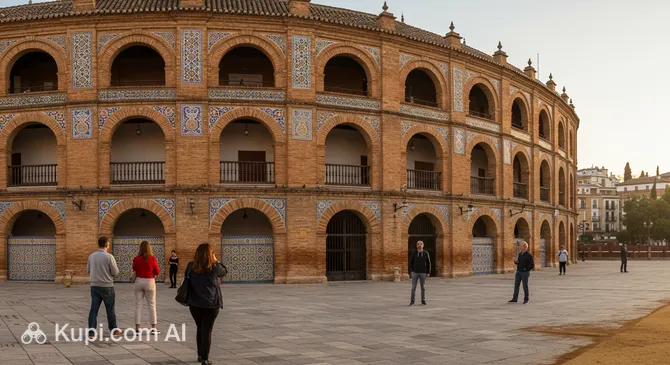
Granada Bullring. Illustration.
Source: Kupi.com AI

Traveler photos:

This arena is not just a sports venue, but a true cultural symbol of Granada. It serves as an important tourist attraction, allowing guests to touch upon the deep traditions of Spanish culture and feel the atmosphere of one of the most famous national spectacles. Visiting the arena provides a unique opportunity to learn more about the history and significance of bullfighting for the Spanish people.

It is worth noting that bullrings, or "plazas de toros," are a characteristic feature of many Spanish cities. However, the arena in Granada holds a special place among them, being one of the most significant and well-preserved historical structures of its kind in all of Spain. A visit here will be a bright and memorable event for any traveler interested in the culture and history of this amazing country.

Contacts

To get the most up-to-date information on opening hours, ticket prices, and the event schedule for the Bullring in Granada, we recommend visiting the official website of the attraction or contacting local tourist information centers in Granada. Usually, such iconic sites have their own web resources where all necessary information for visitors is published. Additionally, the Arena is a well-known landmark in the city and can be reached by public transport or taxi.

How to contactContact
AddressAv. Dr. Oloriz, 25, Beiro, 18012 Granada, Spain
Phone number+34 653 27 59 03
Websitewww.plazadetorosdegranada.es

What to Do

The main reason to visit the Bullring in Granada is, of course, the bullfight itself. If your visit coincides with the season, you can witness this traditional Spanish spectacle. The performance is usually divided into three parts, during which matadors demonstrate their skill and courage in the ring with the bull. This is a unique opportunity to immerse yourself in one of Spain's most famous and debated traditions and form your own opinion on this exciting, albeit controversial, event.

Even if you don't plan to attend the performance itself, the Bullring is worth seeing as an architectural and historical site. You can simply walk around, appreciate its monumentality, and take photos. Many arenas in Spain, and likely the one in Granada as well, have their own small museums. In such a museum, you can see matador costumes, old posters, photos of famous matadors, and other artifacts telling the story and evolution of bullfighting.

Additionally, guided tours are often held on the grounds. During such a tour, a guide will tell you about the history of the structure, its architectural features, as well as the rules and traditions of bullfighting. This is an excellent way to learn more about the significance of this spectacle for Spanish culture, even without attending an actual bullfight. Such tours allow you to look "behind the scenes" and see the arena from unusual perspectives.

Getting There

Reaching the Granada Bullring, located in the city of Granada, is quite simple as it is a well-known landmark. The arena is located within the city limits, making it accessible from various areas of Granada by public transport, taxi, or even on foot if you are staying nearby.

One of the most convenient ways to reach the Bullring is via the city's public transport. Granada has a well-developed bus network, and there are certainly routes that pass in close proximity to the arena or have a stop named after it. We recommend checking current route numbers and schedules on the official website of the Granada transport company or using popular mobile apps for trip planning. Information can also be obtained at the city's tourist information centers.

If you prefer a more comfortable and faster way to travel, you can always use a taxi. A taxi ride from the center of Granada or your hotel to the Bullring will not take long and will cost a reasonable amount of money, especially if you are traveling in a small group. For those who enjoy walking and want to get to know the city better, the walk to the arena from central districts can also be a pleasant experience, allowing you to see more interesting sights along the way.

Before your trip, it's a good idea to look up the location of the Granada Bullring on a map to get your bearings and choose the best route. In any case, as a significant attraction, the arena is well-known to locals, and you can always ask them for directions if you encounter any difficulties.

Nearest city: Granada

History & Facts

Although the exact date of construction for the Bullring in Granada (Plaza de Toros de Granada) is not recorded in historical sources, it is known that its design belongs to the talented architect Ángel Casas. Bullfighting itself, in the form we know it today, began to take shape in the 18th century. It was then, in 1726, that matador Francisco Romero revolutionized the art: he was the first to use the muleta — a special red cape designed to control the bull and provoke its charge. Furthermore, Romero structured the match, dividing it into three distinct acts, which subsequently became the canon for all performances.

Over time, by the 19th century, bullfighting transformed from a simple spectacle into an entire industry. Specialized farms appeared, dedicated exclusively to breeding fighting bulls with the qualities necessary for the ring. The beginning of the 20th century is rightfully considered the "Golden Age" of bullfighting. The popularity of the fights was so high that massive arenas, like the one built in Granada, were required to accommodate all the spectators. These grand structures became centers of social life and magnets for thousands of tauromachy fans.

Many prominent figures of their time were passionate fans of bullfighting. Notable among them are the famous Spanish poet Federico García Lorca, for whom bullfighting was an integral part of Andalusian culture, and the world-renowned American writer Ernest Hemingway. Hemingway not only admired the spectacle but also repeatedly covered tauromachy events, creating vivid reports for the popular Life magazine. Their interest emphasizes the deep cultural significance of bullfighting, which goes far beyond simple entertainment.

Time Needed

To tour the Granada Bullring and learn about its architecture and history, a typical visitor will need about 1-2 hours. This time is usually sufficient to walk around the arena, perhaps visit a small museum if there is one on-site, and take commemorative photos. If you plan to join an organized tour of the arena, its duration also typically fits within this timeframe, allowing you to learn interesting facts about the structure and bullfighting traditions.

However, if your goal is not just to see the building but to attend a bullfight itself, you should set aside significantly more time. A traditional performance featuring several bulls and matadors can last from 2 to 3 hours, and sometimes longer depending on the program and the number of matches. In this case, visiting the arena becomes an event that takes up nearly half a day, including time to take your seats and soak in the atmosphere before it begins.

Thus, when planning a visit to the Bullring in Granada, it is worth deciding in advance whether you just want to get acquainted with this iconic architectural and cultural site in Spain, or if your goal is to be a spectator at a traditional Spanish spectacle. The amount of time you will need for your visit will directly depend on this choice.

Working Hours

The exact opening hours of the Granada Bullring may vary depending on the season and scheduled events. As a rule, the bullfights themselves are a seasonal spectacle and most often take place during the warmer months or are timed to coincide with major festivals. On bullfight days, the arena opens to spectators some time before the performance begins. For visiting the arena as a tourist site—for example, for a tour or to visit the museum (if available)—separate opening hours may be set, which may differ from the days when fights are held.

Since specific information about opening hours and the need for advance ticket booking for the Bullring in Granada is not provided, it is highly recommended to check the most current data on the attraction's official website or contact local tourist information centers upon arrival in Granada. If you plan to attend a bullfight, tickets for such popular events are usually worth purchasing in advance, especially during the peak tourist season.

Nearby

A visit to the Granada Bullring will undoubtedly be a highlight of your trip to Granada. However, to make your experience even richer and more complete, it is worth paying attention to the attractions located nearby. Exploring the surrounding area will allow you to dive deeper into the atmosphere of this amazing city in Spain, discover new interesting places, and gain a more holistic understanding of its culture and history.

Often, the most memorable moments of a trip happen when you decide to deviate slightly from the main route. A short walk from the Bullring can lead you to charming streets, historical buildings, or cozy cafes, each holding its own piece of Granada's soul. Below is a list of some interesting places located nearby.

NameDistance
Elvira Gate1 km
Monastery of San Jerónimo, Granada1.1 km
San Cristóbal Viewpoint1.2 km
D'Sano Café1.3 km
Granada City Center1.5 km
San Nicolás Viewpoint1.5 km
Granada Cathedral1.5 km

Have you reached the end of the page?

So the route has been studied inside and out