Support

Ponferrada Castle

About

Perched on a hill at the confluence of the Boeza and Sil rivers, in the heart of Ponferrada, stands one of Spain's most impressive medieval fortresses — Ponferrada Castle. It is an outstanding architectural and historical monument, considered one of the largest and best-preserved castles in the northwest of the country. Its mighty walls and towers dominate the cityscape, drawing travelers from all over the world.

The castle's primary fame is linked to the mysterious and powerful Order of the Knights Templar. It was they, with the permission of King Ferdinand II of León, who settled here in 1178, transforming the fortress into an important outpost for protecting pilgrims on the road to Santiago de Compostela. Due to this historical connection, the castle is often called the “Templar Castle,” which adds an aura of mystery and attracts fans of medieval history.

Today, Ponferrada Castle is an extensive architectural complex covering about 8,000 square meters. Visitors can explore its numerous towers, fortifications, and courtyards, and even walk along the battlements. From here, breathtaking panoramic views of the city and the picturesque surroundings unfold, making a walk through the castle truly unforgettable.
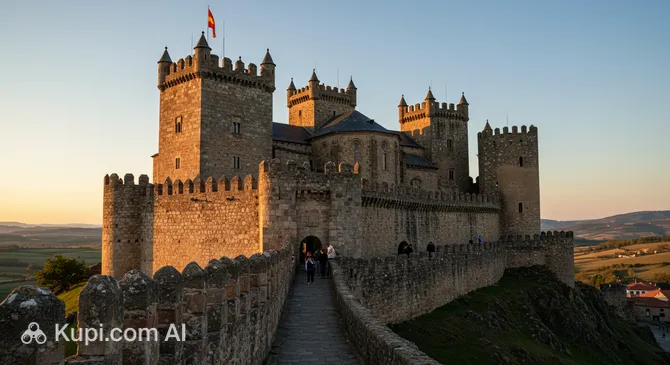
Ponferrada Castle. Illustration.
Source: Kupi.com AI

Traveller photos:

Contacts

To plan your visit to Ponferrada Castle, it is recommended to check the current opening hours and ticket prices in advance. You can find all the necessary information on the official website or by contacting the administration by phone.

How to contactContact
AddressC. Gil y Carrasco, 1, 24401 Ponferrada, León, Spain
Phone+34 987 40 22 44
Websitewww.castillodelostemplarios.com

What to Do

A visit to Ponferrada Castle is a true immersion into medieval history. Guests can take a fascinating tour of its extensive grounds, exploring the beautifully restored defensive walls with embrasures that once protected archers and crossbowmen. A walk along the crenellated upper gallery makes you feel like a sentry scanning the horizon. Of particular note are the entrance gates with two massive towers and a drawbridge, as well as the family coats of arms of former owners that adorn the walls, serving as reminders of the fortress's rich lineage.

Inside the castle, even more interesting discoveries await. Within the palace area is the unique Templar Library, home to around 1,400 rare volumes related to the order's history. Among the library's treasures are a facsimile of the Gutenberg Bible and the ancient “Book of Antidotes,” dating back to 1119. The highlight of the visit is climbing the spiral staircase to the 24-meter-high main tower. From its summit, a magnificent panorama of historic Ponferrada and the surrounding countryside opens up, allowing you to appreciate the city's beauty from a bird's-eye view.

Getting There

The Templar Castle is ideally located in the heart of the historic center of Ponferrada, making it easily accessible to all travelers. The city itself is situated in the province of León, within the autonomous community of Castile and León, and is a major point on the map for many tourists, thanks in part to its excellent transport links.

Getting to Ponferrada is convenient by public transport, as trains and buses run regularly from major cities in the region, such as León or Astorga. The train station is located about 1.5 kilometers from the castle, so from there you can either take a pleasant 20-minute walk or take a taxi to reach the site even faster.

If you are traveling by car, there are parking spaces near the city center where you can leave your vehicle. From the main square and principal streets, the castle is just a few minutes' walk away—simply follow the signs marked “Castillo de los Templarios”, which will guide you to this majestic medieval fortress.

Nearest city: Ponferrada

History & Facts

The history of Ponferrada Castle is rooted in antiquity, long before the famous knights arrived. The site upon which it stands has been strategically significant for many centuries. Originally home to an ancient Celtic fortification, it was later occupied by the Romans and Visigoths, all of whom left their mark on the region's history. This multi-layered past makes the castle more than just a medieval fortress; it is a true palimpsest where one culture succeeded another.

A key moment in the castle's history came in 1178, when King Ferdinand II of León granted these lands to the Order of the Knights Templar. The Knights Templar built a powerful fortress here, which became one of the main outposts on the Way of Saint James. The garrison's primary task was to protect pilgrims heading to Santiago de Compostela. It is thanks to the Templars that the castle acquired its majestic appearance and the fame that continues to attract visitors today.

Following the dissolution of the Templar Order in the 14th century, difficult times befell the castle. It changed hands many times, experienced periods of decay, and was even used as a quarry for building materials for city structures. Fortunately, in 1924, the castle was declared a national monument, marking the beginning of its extensive restoration. Thanks to these efforts, today we can see the fortress in all its glory as a living testament to the rich and dramatic history of Spain.

Time Needed

To fully enjoy the atmosphere and explore every corner of Ponferrada Castle, you should allow 1.5 to 2.5 hours for your visit. This will be enough time for a leisurely tour, allowing you to immerse yourself in the history of this magnificent structure without rushing.

The allocated time will allow you not only to walk along the powerful fortress walls and galleries but also to visit the unique Templar Library and climb the towers to admire panoramic views of Ponferrada. If you are short on time, you can take a quicker walk through the main parts of the castle, but for a complete experience of its rich history and architecture, it is best to stick to the recommended timeframe.

Working Hours

Ponferrada Castle is open to visitors year-round, although its opening hours change depending on the season. During the summer period, from April 1 to September 30, the castle welcomes guests from 10:00 to 14:00 and from 16:30 to 20:30. In the winter season, from November 1 to February 28, the hours are shorter: from 10:00 to 14:00 and from 16:00 to 18:00. In October and March, the castle is open from 10:00 to 14:00 and from 16:00 to 19:00. It is important to note that the castle is closed to the public on Mondays.

Advance ticket booking is generally not required, but for convenience, tickets can be purchased online through the official website. Please also keep in mind that the ticket office closes half an hour before the castle's closing time. On public holidays and during special events, such as the week before Easter (Semana Santa), the schedule may change, so it is recommended to check the current information on the attraction's official website before your visit.

DayOpening hours
MondayClosed
Tuesday10:00 – 14:00, 4:30 – 20:30
Wednesday10:00 – 14:00, 4:30 – 20:30
Thursday10:00 – 14:00, 4:30 – 20:30
Friday10:00 – 14:00, 4:30 – 20:30
Saturday10:00 – 14:00, 4:30 – 20:30
Sunday10:00 – 14:00, 4:30 – 20:30

Nearby

A visit to the majestic Templar Castle is only the beginning of discovering the rich heritage of Ponferrada. To fully experience the atmosphere of this corner of Spain, it is worth setting aside time to stroll through its surroundings. The city's historic center is very compact, and many other iconic sites are just a few steps away from the fortress walls.

Exploring nearby attractions will allow you to dive deeper into the culture and lifestyle of the El Bierzo region. From ancient churches and curious museums to cozy restaurants, every street holds its own story. Below is a list of interesting sites located within walking distance of the castle.

NameDistance
Radio Museum0.1 km
Basilica of Our Lady of La Encina0.2 km
Clock Tower0.3 km
Casa Aníbal Restaurant0.3 km
La Mafia Sits at the Table0.8 km
Ponferrada Railway Museum1 km
Richmond Discoteca1 km

Reached the bottom of the page?

Looks like you know this route inside out