Support

Museo de León

About

A journey through millennia begins here, in the very heart of the historic center. The Museum of León is rightfully considered the oldest and most significant cultural institution in the province. Located in the elegant Pallarés building on Plaza de Santo Domingo, it serves as the main gateway to the region's rich past, carefully preserving its heritage for future generations.
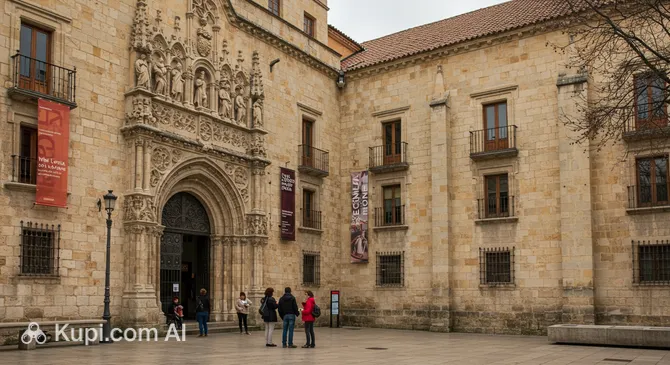
Museum of León
Museum of León. Иллюстрация. Источник: Kupi.com AI

This museum is a true treasure trove where Paleolithic artifacts and works of modern art meet in a single space. If you want to understand how León developed and what influence various civilizations had on it, this place will be the perfect point on your route. Spain is proud of such regional centers, which allow one to see history not just in textbooks, but in real, tangible objects of everyday life and art.

The museum specializes in several key areas: archaeology, art history, and ethnography. Carefully selected collections offer visitors a comprehensive look at the cultural identity of the region, turning a regular exhibition tour into a fascinating exploration of the evolution of human society on the Iberian Peninsula.

Contacts

For more information on special exhibitions or to book group tours, you can use the official communication channels. The museum provides up-to-date information on its activities via its website and phone.

How to contactContact
AddressPl. de Santo Domingo, 8, 24002 León, Spain
Phone+34 987 23 64 05
Websitewww.museodeleon.com

What to Do

Visitors can expect a fascinating journey divided into seven key thematic blocks. The exhibition is arranged chronologically: from the mysterious Prehistoric era and the Romanization period to the Middle Ages, the Modern Age, and the present day. The tour concludes with a panoramic area offering a unique look at the city itself through the prism of its historical development.

Special attention should be paid to the halls dedicated to the Roman presence. Here, an exceptional collection of Roman funerary stelae is presented, equipped with interactive audio accompaniment that literally "brings the ancient stones to life." No less impressive are the exquisite Roman mosaics, particularly the famous compositions depicting Hylas and the Nymphs, as well as rich collections of ancient coins, bronzes, and ceramics.

For lovers of medieval art, the museum has prepared some true rarities: the Mozarabic cross of Santiago de Peñalba and the famous Romanesque Corullón Crucifix. One of the most valuable exhibits is the 11th-century ivory Christ of Carrizo. In addition to the permanent exhibition, temporary exhibitions are often held on the first floor, and on the lower level, you can trace the change of monetary systems in a fascinating numismatic section.

Getting There

Thanks to its location in the heart of the city at Plaza de Santo Domingo, the museum is within walking distance of most popular tourist routes. If you are already exploring the historic center, a walk to the Pallarés building will take only a few minutes.

For those who prefer public transport, many city bus routes stop near the square. The well-developed transport network allows you to reach the museum quickly from any part of the city. If you arrive at the main train station, a taxi ride will take about 5–10 minutes, depending on traffic.

The museum building is fully accessible: elevators are installed inside, making movement between floors comfortable for all visitors. Its central location makes it an ideal starting or ending point for your cultural itinerary through the city.

Ближайший город: Leon

History & Facts

The institution's history began during the turbulent years of the 19th century. The Museum of León was founded shortly after the state's ecclesiastical confiscation (desamortización) process, when there was an urgent need to preserve the region's most valuable art objects and archaeological finds. It officially opened its doors to the public in 1869, originally located within the walls of the magnificent Convent of San Marcos.

For more than a century and a half, the museum has fulfilled a vital mission — it is the only state depository that systematically collects, researches, and popularizes the cultural heritage of this part of the country. In 1987, the management of the collections was transferred to the regional government of Castile and León, giving a new impetus to the development of museum work in the province.

The modern era of the museum's life is characterized by the expansion of its spaces. Today, the exhibition is divided between two iconic sites. The main part of the collection is housed in the modern headquarters — the Pallarés building, while the historical wing continues to occupy part of the monumental San Marcos ensemble, adjacent to the luxurious parador (a hotel in a historic building).

Time Needed

When planning your visit, you should allow for 2–3 hours of free time. This period is quite sufficient to see all seven thematic zones without rushing and to carefully study the key masterpieces of the collection, including the numismatic department and temporary exhibitions.

The museum features well-thought-out logistics and a compact layout, so even with a detailed study of the exhibits, you won't feel exhausted. If you are short on time, you can focus on the most significant sections, such as the Roman period or medieval art, which will take about an hour and a half.

Working Hours

The museum welcomes guests on a convenient schedule, divided into morning and evening hours with a siesta break. From Tuesday to Saturday, the doors are open from 10:00 AM to 2:00 PM and from 4:00 PM to 7:00 PM. On Sundays, visiting is only possible in the first half of the day — from 10:00 AM to 2:00 PM.

Please note that Monday is a day off when the museum is closed to visitors. It is recommended to plan your visit for the morning hours or right after the opening of the evening session to enjoy the tour in the most peaceful environment.

DayWorking hours
ПонедельникЗакрыто
Вторник10:00 – 14:00, 4:00 – 19:00
Среда10:00 – 14:00, 4:00 – 19:00
Четверг10:00 – 14:00, 4:00 – 19:00
Пятница10:00 – 14:00, 4:00 – 19:00
Суббота10:00 – 14:00, 4:00 – 19:00
Воскресенье10:00 – 14:00

Nearby

After visiting the museum halls, it is worth taking a walk around the neighborhood, as the city center is literally steeped in history. Just a few hundred meters from here, you will find unique architectural monuments and cozy squares that will help you feel the atmosphere of the region more deeply.

Exploring the nearby sites will allow you to get a complete picture of the past — from Roman times to medieval greatness. Below are the attractions located within walking distance:

NameDistance
Casa Botines0.1 km
Palace of the Guzmanes0.1 km
Cid Park0.1 km
El Romántico0.2 km
niMÚ Azotea0.2 km
Palace of the Count of Luna0.2 km
Museum of San Isidoro0.2 km

Reached the end of the page?

That means the route is fully explored