Support

Laboral Ciudad de la Cultura

About

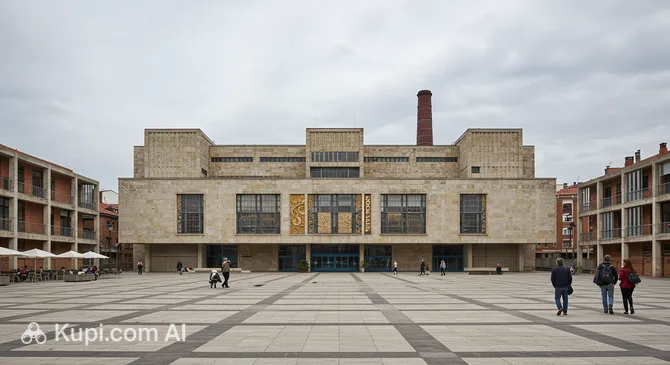
Laboral City of Culture is a truly grand architectural complex located in Gijón. It is often called the "Spanish Escorial of the 20th century," and for good reason: this monumental structure is considered the largest building in Spain, covering an area of about 270,000 m². Designed by architect Luis Moya Blanco, the complex is a unique example of utopian architecture, combining elements of Classicism and the Renaissance.
\n
Laboral City of Culture
Laboral City of Culture. Иллюстрация. Источник: Kupi.com AI
\n

Originally conceived as an autonomous city for educating the children of miners, today this site has transformed into a powerful cultural and educational cluster. Within its walls, a contemporary art center, a library, a theater, and even a television studio harmoniously coexist. The heart of the complex is a vast central square surrounded by majestic buildings, including an elliptical church and a famous tower standing over 117 meters tall.

\n

For tourists, this place is primarily interesting for its unusual atmosphere and scale. Here, you can see one of the world's largest churches with an elliptical floor plan and enjoy bird's-eye panoramic views of the surroundings. Laboral City of Culture is a must-see for anyone who appreciates architectural history and is looking for unique attractions in Asturias.

Contacts

To plan your visit to this architectural complex, it is worth saving the contact details in advance. On the official resource, you can find up-to-date information on upcoming exhibitions, theater productions, and the schedule for tours of the tower and interiors.

How to contactContact
AddressC. Luis Moya Blanco, 261, Periurbano - Rural, 33203 Gijón, Asturias, Испания
Phone+34 902 30 66 00
Websitewww.laboralciudaddelacultura.com

What to Do

A visit to this complex offers guests an incredible variety of experiences. Start with a walk through the Central Courtyard, whose dimensions (150 by 50 meters) and strict geometry instantly immerse you in the atmosphere of a majestic past. Be sure to stop by the elliptical church to appreciate its unique acoustics and massive dome, and then climb the tower — from there, you get the best view of the entire ensemble and the coastline.

For fans of modern creativity, the main point of attraction will be the LABoral Art Center. It hosts international exhibitions, installations, and media projects that create a vivid contrast with the building's classical walls. Additionally, the complex frequently hosts concerts, theater productions in the local theater (designed after ancient models), and various festivals.

If you're interested in going "behind the scenes," visit the library with its modern glass atrium or stroll through the Baroque courtyard inspired by Borromini's style. Many of the complex's rooms are now occupied by creative workshops and educational centers, filling the ancient corridors with lively energy. For a deep dive into history, we recommend taking an organized tour, which will allow you to see interiors that are closed to the general public.

Getting There

The attraction is located in the Cabueñes district, about 15–20 minutes by car from the city center. If you prefer public transport, city buses run regularly from the center to the Cabueñes stop. This is a convenient and budget-friendly way to get to the site without the need to find parking.

For those choosing a taxi, the trip from the city's main squares or the railway station won't take long. Drivers know this route well, as the site is one of the region's main landmarks. It is worth noting an interesting architectural detail: the entrance to the complex is not located on the city side but on the opposite side, dictated by the terrain and wind patterns.

Travelers by car can use the A-8 highway or local roads leading to the complex. On-site parking is provided for visitors. If you are arriving from Asturias Airport, you must first reach the city by bus or train and then transfer to local transport to "Laboral City of Culture."

Ближайший город: Gijon

History & Facts

The history of this ambitious project began in 1946. Originally, the Laboral City of Culture was conceived as a "utopian city" and an orphanage for the children of miners. Architect Luis Moya Blanco sought to create a completely autonomous space that would include not only educational buildings but also its own 100-hectare farm, a massive church, and a theater.

Construction continued until 1957, after which the project was officially halted. The building served as a technical college (Universidad Laboral) for training skilled workers, but by the 1980s, the complex had begun to fall into decline. The giant structure gradually deteriorated until 2001, when the government of Asturias decided on a massive transformation into a modern cultural center.

During the restoration, which was completed in 2007, more than 80,000 square meters of space were repurposed for art and education. Specialists managed to preserve the unique Neoclassical and Herrerian architectural styles while adding modern elements, such as a glass roof over the atrium. In 2016, the site received the prestigious status of Bien de Interés Cultural (B.I.C.), confirming its exceptional value to world heritage.

Interestingly, during construction, the architect was inspired by the classical canons of Vitruvius and Palladio. The result was an architectural ensemble that exceeds the scale of the famous Escorial monastery near Madrid. Today, it is not just a monument of an era, but a living space where historical walls stand alongside cutting-edge television technology and contemporary art.

Time Needed

To leisurely explore the scale of this "city within a city," we recommend setting aside 2 to 4 hours. This time is sufficient to walk through the central square, visit the church, and appreciate the modern exhibits in the art center. If you plan to climb the tower or attend a theater performance, your visit may last half a day.

Many travelers note that the maximum impression is left by guided tours, which usually last about two hours. A guide will help you not to miss hidden architectural details and will explain the complex's amazing engineering solutions, which are difficult to notice on your own.

Working Hours

The complex's opening hours depend on which specific parts you plan to visit. The LABoral Art Center and exhibition halls are usually open to the public from Tuesday to Sunday, 10:00 to 20:00. Monday is typically a day off for exhibitions.

Since the complex houses educational institutions and a theater, access to some buildings may be limited during classes or events. We strongly recommend checking the current schedule on the official website before your trip, especially if you want to join a specific tour or climb to the tower's observation deck.

Nearby

A visit to Laboral City of Culture can easily be combined with exploring other interesting places. The surroundings of the complex offer both nature parks for walking and modern entertainment centers, making this area an excellent starting point for exploring Asturias.

NameDistance
Laboral City of Culture0.1 km
Laboral Art and Industrial Creation Centre0.2 km
Atlantic Botanical Garden0.3 km
Evaristo Valle Foundation Museum1.1 km
Museum of the Asturian People2.1 km
Hermanos Castro Park2.7 km
Plaza de la República3 km

Reached the end of the page?

That means the route is fully explored