Support

San Telmo Museum

About

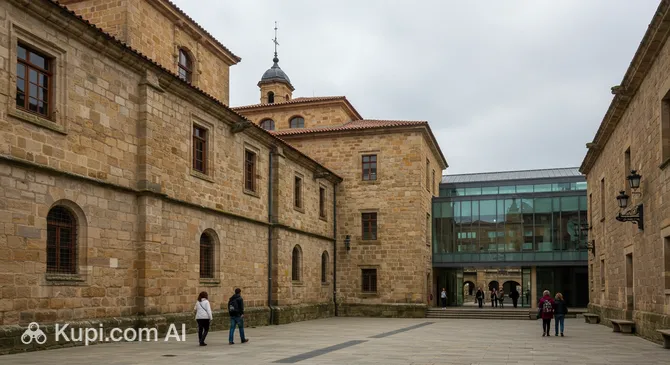
Imagine a place where the austere aesthetics of a medieval monastery meet the bold lines of modern architecture. This is the San Telmo Museum — the oldest cultural institution in the Basque Country, located in the picturesque city of San Sebastián. Nestled at the foot of Mount Urgull, this museum complex serves as the primary "gateway" to the fascinating world of Basque history and culture.
\n
San Telmo Museum
San Telmo Museum. Иллюстрация. Источник: Kupi.com AI
\n

The main part of the museum occupies a 16th-century Dominican monastery built in the unique "Isabelline" style — an elegant blend of Late Gothic and Renaissance. Spain is rightfully proud of this site, which gained a second life in 2011: a futuristic wing with a perforated facade that seems to merge with the mountain's rocky terrain was added to the historic walls.

\n

Today, the San Telmo Museum is not just a storehouse of antiquities but a living space for intergenerational dialogue. Here, ethnographic artifacts sit alongside contemporary art, telling the story of how Basque society was formed and the challenges it faces today. It is a must-visit for those who want to understand the true spirit of this unique region.

Contacts

For more information on special exhibitions or to book group tours, you can use the official communication channels. The museum actively maintains contact with visitors and provides up-to-date information on its operations.

How to contactContact
AddressPlaza Zuloaga, 1, 20003 Donostia, Gipuzkoa, Spain
Phone+34 943 48 15 80
Websitewww.santelmomuseoa.eus

What to Do

Inside the museum's halls, a deep dive into Basque identity awaits. The permanent exhibitions are divided into several thematic blocks, ranging from "Traces of Memory," which recounts the ancient roots of the people, to "Challenges for our Society." The collection is impressive in its scale, featuring over 35,000 exhibits, including archaeological finds, vintage photographs, and masterpieces of fine art.

Be sure to visit the old monastery church. Its walls are adorned with monumental frescoes by José María Sert, which depict key moments in the history of the province of Gipuzkoa. You can also see mysterious discoid stelae and traditional argizaiolak candles wound around wooden boards — living testimony to how ancient Basque rituals intertwined with Christian traditions.

After exploring the galleries, it is worth visiting the museum library, which houses a stylish bar. This spot has long been a gathering place for locals, hosting culinary workshops and cultural meetings that allow you to feel the rhythm of modern city life surrounded by centuries-old walls.

Getting There

The San Telmo Museum is located in the heart of the Old Town at Plaza Zuloaga, 1. Thanks to its position at the foot of Mount Urgull, the building serves as an excellent landmark. If you are already exploring the historic center, the easiest way to reach it is on foot — a walk from the waterfront takes very little time and allows you to soak in the atmosphere of the ancient streets.

For those who prefer public transport, many city buses stop near the Old Town. You can head to the stops in the Boulevard area, from where the museum is just a few hundred meters away. Taxis can also easily take you to the edge of the pedestrian zone of the Old Town, as close as possible to Plaza Zuloaga.

If you are using a navigator, use the coordinates 43.324993, -1.984844. Although the museum is in a restricted traffic zone, the well-developed pedestrian infrastructure makes the walk easy and pleasant from any point in the city.

Ближайший город: San Sebastian

History & Facts

The history of this site began long before the first exhibition opened. The building that houses the main part of the collection today was built in 1542 as a Dominican monastery. Construction was funded by Alonso de Idiáquez, Secretary of State to Emperor Charles V, and completed in 1562. This architectural ensemble is a rare example of the transition from Gothic to Renaissance.

The San Telmo Museum itself was founded in 1900 at the initiative of Mayor José Machinbarrena. At that time, the city was experiencing a cultural boom, and residents eagerly donated personal items, artifacts, and artworks to create a permanent collection. Initially, the museum was housed in small premises on other streets, and it wasn't until 1932 that it finally moved into the purchased and renovated former monastery building.

The museum's modern appearance is the result of a bold architectural decision. Between 2007 and 2010, a large-scale renovation was carried out under the direction of Nieto Sobejano Architects. The main goal was to preserve the historical character of the 16th-century monastery while adding an ultra-modern pavilion. The new facade, made of perforated metal through which live greenery grows, has become a symbol of harmony between history and the natural landscape of Mount Urgull.

Time Needed

To leisurely explore all the galleries and soak in the atmosphere of the ancient monastery, you should set aside 2 to 3 hours for your visit. This is usually enough time to see both the main historical collections and the contemporary art exhibitions.

If you plan to visit the temporary exhibitions or stop by the museum library and its stylish bar, your stay could easily last half a day. The museum is designed so that the transitions between the old and new buildings are an integral part of the experience, so it is best not to rush.

Working Hours

When planning your visit, keep in mind that the museum follows a standard schedule for European cultural institutions. The doors are open to visitors from Tuesday to Sunday, 10:00 AM to 7:00 PM. The museum is closed on Mondays.

A nice bonus for travelers: on Tuesdays, admission to the museum is completely free for everyone. Additionally, you can take advantage of a free audio guide to learn as much detail as possible about the exhibits without any extra cost.

DayWorking hours
ПонедельникЗакрыто
Вторник10:00 – 19:00
Среда10:00 – 19:00
Четверг10:00 – 19:00
Пятница10:00 – 19:00
Суббота10:00 – 19:00
Воскресенье10:00 – 19:00

Nearby

The museum's location in the historic center makes it an ideal starting point for further exploration of the city. A walk through the surrounding area allows you to see both ancient fortifications and modern recreational zones.

After visiting the exhibitions, be sure to check out these nearby points of interest, all within walking distance:

NameDistance
Baluarte del Mirador0.1 km
Bar Sport0.2 km
Bar Txepetxa0.2 km
Mendaur Berria0.2 km
Basilica of Saint Mary of the Chorus0.2 km
Mota Castle0.3 km
Whisky Museum0.3 km

Reached the end of the page?

That means the route is fully explored