Support

Pantheon of the Duchess of Sevillano

About

Imagine one of the most expressive and unusual buildings gracing the city of Guadalajara. The Pantheon of the Duchess of Sevillano is not just a majestic mausoleum, but a true masterpiece of eclectic architecture from the late 19th century. Commissioned by Maria Diega Desmaissières y Sevillano, this monument became a symbol of deep family love and selfless philanthropy.

The building stands out for its unique style, which harmoniously blends Neo-Romanesque, Byzantine, and Mudéjar motifs. Its most recognizable feature is the magnificent dome covered in shiny ceramic tiles resembling scales. This architectural ensemble, located in Spain, is rightfully considered one of the most significant cultural heritage sites in the region.
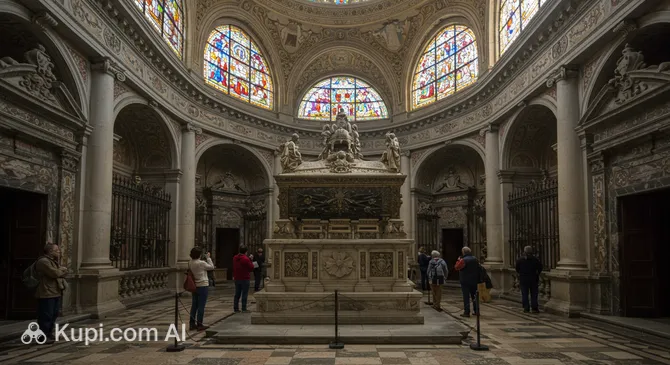
Pantheon of the Duchess of Sevillano
Pantheon of the Duchess of Sevillano. Иллюстрация. Источник: Kupi.com AI

In addition to the pantheon itself, the complex includes a church, a school, and an asylum, creating a single space dedicated to caring for others. Inside, visitors will find stunning mosaics, intricate stone carvings, and an impressive crypt, turning the visit into a fascinating journey through the history of the Spanish aristocracy and Art Nouveau art.

Contacts

If you are planning a visit, it is helpful to have up-to-date contact information on hand to clarify details or book a tour.

How to contactContact
AddressP.º Francisco Aritmendi, 2, 19002 Guadalajara, Spain
Websitewww.guadalajara.es

What to Do

Once inside the pantheon, the first thing to notice is the altar, adorned with the outstanding painting "The Calvary" by Alejandro Ferrán. The interior is striking for its wealth of materials: marble, bronze, and the finest mosaics create an atmosphere of solemnity and peace. Be sure to look up to admire the interior decoration of the dome, where light plays on the decorative elements.

The main impression of the visit will be the descent into the crypt. Here lies the monumental sculptural group "The Duchess's Funeral Procession" by Ángel García Díez. This Art Nouveau composition is considered one of the most touching and technically perfect in Spain. Examining the sarcophagi and bas-reliefs, you can feel the grandeur of the vision of architect Ricardo Velázquez Bosco.

Outside, it is worth strolling through the grounds of the Fundación de San Diego de Alcalá. You can see a 16th-century Renaissance patio and the Church of Santa María Michela. Thanks to the building's remote location on a hill, it offers beautiful panoramic views of the surroundings, and the lack of large crowds allows for great photos without unnecessary hustle.

Getting There

The Pantheon of the Duchess of Sevillano is located on the south-western outskirts of the city at P.º Francisco Aritmendi, 2. From the city's main square, it can be reached on foot in about 20–30 minutes, enjoying the quiet streets and views of San Roque Park. For navigation, you can use the coordinates 40.6276, -3.1560.

If you prefer public transport, use bus lines 1, 2, or 5. You will need the Panteón de la Duquesa or Parque San Roque stops, which are in the immediate vicinity of the complex entrance. A taxi ride from Guadalajara railway station (RENFE) will take no more than 10–15 minutes.

For those traveling by car from Madrid, the route follows the A-2 highway and takes about an hour. Parking can be found on the streets adjacent to the park or in specialized parking lots nearby. The area around the pantheon is very green and perfect for pleasant walks.

Ближайший город: Guadalajara

History & Facts

The history of this grand structure began in 1881, when Maria Diega Desmaissières y Sevillano, a woman of immense wealth, decided to create a worthy final resting place for her father and relatives. She invited the famous architect Ricardo Velázquez Bosco, whose works adorn Madrid, to bring to life a project that combined the functions of a mausoleum and a charitable center.

Construction lasted for 34 years (from 1882 to 1916). There is a beautiful legend that the Duchess intentionally delayed the work, and sometimes even ordered parts built during the day to be dismantled at night, in order to provide the workers of Guadalajara with paid labor for as long as possible. Her dedication to philanthropy was so great that thousands of grateful citizens gathered for her funeral in 1916.

The architectural ensemble became a striking example of late 19th-century eclecticism. In 1996, the complex was declared a Cultural Heritage Site (BIC). Today, it is not just a historical monument but also a symbol of the social responsibility of the aristocracy of that era. After the death of the Duchess, who left no heirs, the complex passed into the management of the Adoratrices order, which opened a school here.

Time Needed

To explore all the details of this architectural masterpiece without rushing, a typical tourist will need between 1 and 1.5 hours. This time is quite sufficient to examine the interior, descend into the crypt, and walk through the grounds of the Fundación de San Diego de Alcalá.

If you are interested in architectural photography or want to study the mosaics and ceramic tiles on the dome in detail, it is worth allowing a little more time. Viewing only the exterior of the building and the facades will take about 30 minutes, but the main treasures of the pantheon are hidden inside.

Working Hours

When planning your visit to the Pantheon of the Duchess of Sevillano, please note the opening hours, as they change depending on the day of the week. The complex is closed on Mondays.

  • Tuesday – Thursday: 10:30 AM – 12:30 PM and 5:30 PM – 7:30 PM
  • Friday – Saturday: 10:30 AM – 2:00 PM and 5:00 PM – 7:00 PM
  • Sunday: 10:30 AM – 2:00 PM

Please note that the schedule may change on public holidays, so it is recommended to verify the information before your trip.

DayWorking hours
ПонедельникЗакрыто
Вторник10:30 – 12:30, 5:30 – 19:30
Среда10:30 – 12:30, 5:30 – 19:30
Четверг10:30 – 12:30, 5:30 – 19:30
Пятница10:30 – 14:00, 5:00 – 19:00
Суббота10:30 – 14:00, 5:00 – 19:00
Воскресенье10:30 – 14:00

Nearby

A walk around the Pantheon of the Duchess of Sevillano is only part of discovering the historical heritage of this region. Exploring the surroundings will allow you to dive deeper into the atmosphere of the Spanish province and see how different eras intertwine in the city's architecture.

NameDistance
San Roque Park0.2 km
Fuente de la Niña Park0.2 km
Church of San Ginés0.8 km
Friendship Park0.8 km
The Wandering Irishman1 km
Casa Palomo1 km
Ferial Plaza Shopping Center1 km

Reached the end of the page?

That means the route is fully explored