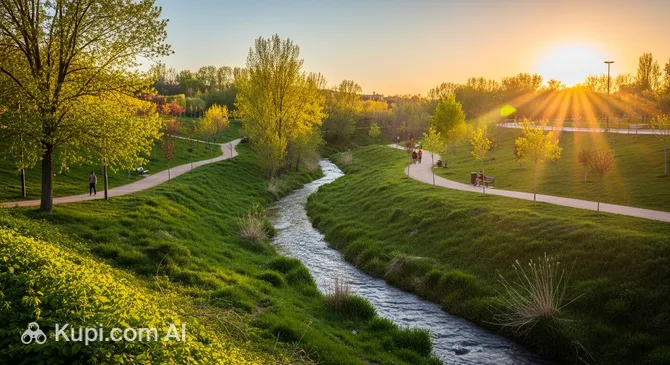
Imagine a deep river valley hidden amidst the modern bustle of the city. Barranco del Alamín Park is a unique natural oasis that is rightfully considered one of the most picturesque places in the city of Guadalajara. Here, the Alamín River has carved its path through steep cliffs, creating a spectacular canyon surrounded by Mediterranean greenery of pines and oaks. Barranco del Alamín Riverside Park. Illustration.
Source: Kupi.com AI
Traveler photos:
This area in Spain represents a harmonious blend of wild nature and thoughtful infrastructure. Tourists value the park for its stunning views of canyon-like cliffs and crystal-clear waters, which create a sense of privacy and peace just minutes away from residential neighborhoods. The park has a high rating among travelers thanks to its accessibility and exceptional ecology.
Occupying a significant area in the Castile-La Mancha region, Barranco del Alamín is an important part of the natural heritage. Here you can see rare species of ferns by the water and observe birds of prey circling over the rocky peaks. It is not just a walking area, but a full-fledged ecosystem adapted for comfortable family vacations and ecological tourism.
Contacts
For those planning a visit to Barranco del Alamín Park, it is helpful to have current contact information on hand. Although the park is an open natural area, it has an official address for navigation and a web resource with additional information.
For outdoor enthusiasts, the park offers a network of marked trails of varying difficulty. You can choose an easy walk along the riverbank or challenge yourself by climbing the steep paths to the cliff tops, which offer breathtaking panoramic views of the canyon. Special attention should be paid to the suspension bridges — they are a favorite spot for striking photographs.
For those who prefer a more relaxed pastime, the park features cozy picnic areas and barbecue spots. Here you can spend hours watching the local fauna: squirrels often flicker in the treetops, and majestic birds soar in the sky. Relaxation areas are set up by the water, where it is pleasant to cool off in the shade of the trees in summer, while yoga and meditation lovers will find quiet corners for outdoor practice.
The educational component of the park is represented by nature trails with information boards telling about the local flora and fauna. Cyclists and runners will appreciate the smooth sections of the paths, while families with children will enjoy the safe play areas and convenient access points to the water. In winter, the park is transformed, becoming a magnet for photographers seeking to capture misty mornings and the vibrant colors of the fading foliage.
Getting There
Reaching this natural corner from the center of Guadalajara is easy. If you prefer to drive, the trip from the main square via the N-400 road takes only 10–15 minutes. Free parking is available at the park entrance, and the exact coordinates for your GPS are 40.6416275, -3.1703543.
For public transport users, bus routes No. 1 and No. 5 run from the central districts to the Polígono Sgüel stop. After getting off the bus, you will need to walk for about 5–10 minutes. If you are coming from Madrid, it is most convenient to take the AVE high-speed train to the Guadalajara-Yebes station, from where you can reach the park by taxi or local bus in about 15–20 minutes.
Active lifestyle enthusiasts can reach the park on foot — the walk from the center takes about an hour (approximately 4–5 km) along scenic routes. Cycling is also an excellent option, as there are convenient dedicated bike paths leading to the park.
Nearest city: Guadalajara
History & Facts
The history of this place began thousands of years ago when the waters of the Alamín River gradually began to cut a deep channel into the limestone rock. Over time, erosion created an impressive river valley that is today a geological monument of the region. In the surrounding cliffs, archaeologists have found traces of prehistoric settlements: ancient people used the natural caves in the cliffs as reliable shelters.
During the Roman Empire, the area around the modern park was actively used for stone quarrying and water supply management. Later, in the Middle Ages, the rugged canyon served as a natural defensive barrier and an important landmark for trade caravans crossing the lands of Castile. Until the mid-20th century, these slopes were used by local residents for livestock grazing and timber harvesting, which largely shaped the current landscape.
Barranco del Alamín Park received its status as an officially designated recreation area only in the late 1990s. This was part of a large-scale program to preserve the unique ecosystems of river valleys in Spain. Today, the park carefully preserves the memory of the region's geological past, showcasing rock layers dating back to the Cretaceous period.
Time Needed
To fully enjoy the atmosphere of this place, a typical visitor is recommended to set aside 2 to 4 hours for the visit. This time is quite sufficient to leisurely walk along the main paths by the river, take beautiful photos, and have a small picnic at one of the specially equipped areas.
If your goal is more active recreation, such as completing all the cycling routes or low-cliff climbing, you should plan to stay for 4–6 hours. For those with limited time, a short introductory visit of 1 hour is also possible, during which you can see the central part of the valley and the suspension bridges.
Working Hours
One of the main advantages of Barranco del Alamín Park is its accessibility. It is open for visits 24 hours a day, every day, including weekends and holidays. This allows you to enjoy the beauty of the canyon both in the rays of the morning sun and in the mysterious atmosphere of the evening twilight.
Despite the 24-hour operation, it is recommended to plan your visit during daylight hours for safety while walking on rocky sections. Before your trip, you can check the official website to ensure there are no temporary restrictions due to events or weather conditions.
Open 24 hours
Nearby
A visit to the park can be easily combined with a tour of other iconic sites that Guadalajara has to offer. Since the natural area is within walking distance of the historic center, you can see both natural beauty and outstanding architectural monuments in a single day.
Below are the most interesting sites located in the immediate vicinity of the park: