Support

El Salvador Tower

About

In the heart of the historic center for which Teruel is famous, stands the majestic El Salvador Tower (Torre de El Salvador). This bell tower is one of the most striking examples of Mudéjar architecture. Built in the 14th century, it features a complex design of two towers nested one inside the other, with a staircase winding between them. This engineering solution traces back to the ancient minarets of the Maghreb, making the structure unique in European architecture.
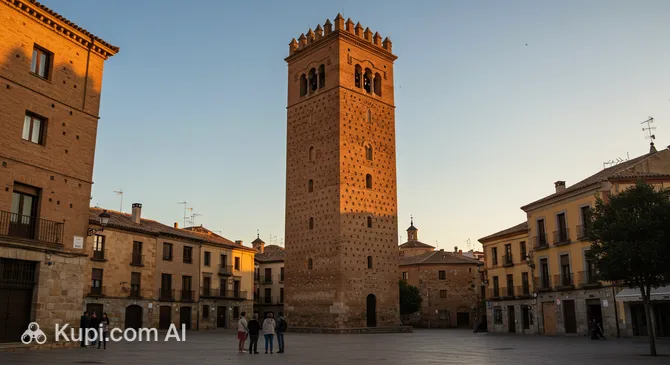
Torre de El Salvador
Torre de El Salvador. Иллюстрация. Источник: Kupi.com AI

The facade is stunning with its intricate brickwork interwoven with white and green glazed tiles, creating complex geometric patterns and eight-pointed stars. Due to its exceptional state of preservation and artistic value, the site was included in the UNESCO World Heritage list. Standing here, you understand why Spain is so proud of its multicultural heritage.

Today, the Mudéjar Interpretation Center is located inside the tower. Visitors can not only admire the external decoration but also pass through the arched gateway at the base of the tower, which once served as a vital link between the city streets. This is a place where history literally comes to life in every brick, inviting travelers to peer into Aragon's past.

Contacts

To check current ticket prices or group visit conditions, you can use the official contact channels.

How to contactContact
AddressC. el Salvador, 7, Bajo, 44001 Teruel, Spain
Phone+34 978 60 20 61
Websitewww.torredelsalvador.com

What to Do

The main adventure when visiting El Salvador Tower is climbing to the top. You will need to overcome about 120 steps, but the journey won't be boring: the halls of the Interpretation Center are located on three different levels. Here, information panels tell the secrets of Mudéjar construction and the legends associated with this place. Observant tourists might notice authentic graffiti left by the builders in the 14th century on the interior walls.

Once you reach the upper platform, be sure to take the opportunity to enjoy the panorama of Teruel. This spot offers the best views of the old town's tiled roofs and other towers, and the height itself allows you to feel the scale of the medieval settlement. In sunny weather, the tower's ceramic decor begins to shimmer with color, so it's worth bringing binoculars or a camera with a good zoom to see the delicate azulejo tiles in full detail.

A visit to the tower is often associated with the romantic legend of the two masters—Abdala and Omar—who competed in construction while trying to win the heart of the beautiful Zoraya. A stroll along Calle de El Salvador will complete your experience, allowing you to see how the tower is seamlessly integrated into the modern life of the city, looming over passersby with its famous arched passage.

Getting There

Finding this architectural gem is easy: it is located in the heart of the historical quarter at C. el Salvador, 7. If you are already walking through the old town, the walk from Plaza del Torico will take no more than 5–10 minutes at a leisurely pace. The tower literally rises over the narrow street, connecting its parts with its majestic arched passage.

For those arriving by public transport, the Estación de Teruel railway station serves as a landmark, located about two kilometers from the center. From the station, you can take city buses No. 1, 2, or 3, or use a taxi—the trip costs an average of 5–10 euros and takes about 10 minutes. If you are traveling by car from Valencia or Madrid via the A-23 highway, be aware that parking in the very center is limited.

Drivers are recommended to leave their cars in the lots near the Los Arcos Aqueduct or in marked parking spaces on adjacent streets, and then walk to the tower. The city's compactness makes walking the most pleasant and efficient way to get around.

Ближайший город: Teruel

History & Facts

The construction of the El Salvador Tower dates back to the first quarter of the 14th century (approximately 1320–1330). It was built by Mudéjars—Muslim craftsmen who remained in Christian lands—using unique bricklaying and decorative ceramic techniques. The tower's design was inspired by the earlier San Martín tower and reflects the traditions of Almohad minarets adapted for the needs of a Christian bell tower.

It is considered the last and most technically advanced of the city's great Mudéjar towers. At its base is a passage with a ribbed vault, which once served as an important transport hub connecting Guadalaviar and Zaragoza streets. The walls of the tower are a true "stone chronicle," with 14th-century graffiti preserved in the mortar of the interior rooms.

Global recognition came in 1986 when it was included in the UNESCO World Heritage list as part of the "Mudejar Architecture of Teruel" ensemble. This status emphasizes the exceptional value of the fusion of Islamic, Gothic, and Romanesque artistic traditions, which is almost impossible to find outside this region.

Interestingly, the modern Baroque Church of El Salvador standing next to it is much younger than its bell tower. The original temple collapsed in 1677, but the tower stood firm, surviving several restorations over the centuries and retaining its original appearance, which continues to fascinate researchers and tourists alike.

Time Needed

To do more than just see the tower from the outside and actually climb to the top while exploring all exhibition levels, you should plan for about 1–1.5 hours. This is plenty of time for a leisurely climb with stops at the information rooms.

If you are passionate about photography or architectural details, you might want to stay longer to catch the right light on the glazed ceramics or to study the city panorama from the top platform in detail. Climbing the stairs requires some effort, but the presence of intermediate rooms allows tourists of all fitness levels to rest and learn about the tower's history without rushing.

Working Hours

El Salvador Tower is open to visitors daily, though the schedule includes the region's characteristic siesta break. On Mondays, the landmark can only be visited in the morning from 11:00 AM to 2:00 PM.

From Tuesday to Sunday, the site operates on a two-shift schedule: morning hours from 11:00 AM to 2:00 PM and evening hours from 4:30 PM to 7:30 PM. It is recommended to plan your visit in advance, as the last entry may be half an hour before closing.

DayWorking hours
Понедельник11:00 – 14:00
Вторник11:00 – 14:00, 4:30 – 19:30
Среда11:00 – 14:00, 4:30 – 19:30
Четверг11:00 – 14:00, 4:30 – 19:30
Пятница11:00 – 14:00, 4:30 – 19:30
Суббота11:00 – 14:00, 4:30 – 19:30
Воскресенье11:00 – 14:00, 4:30 – 19:30

Nearby

Teruel is a compact city, and the concentration of historical masterpieces here is simply amazing. Exploring the surroundings of the El Salvador Tower will allow you to travel through the centuries in just a few hours, moving from medieval hydraulic structures to romantic legends and modern paleontological parks.

NameDistance
La Torre Boutique Apartments0 km
Óvalo Staircase0.1 km
Mausoleum of the Lovers of Teruel0.2 km
Locavore Restaurant0.2 km
Restaurante Yain0.2 km
Church of San Pedro0.2 km
Bar Torreón0.3 km

Reached the end of the page?

That means the route is fully explored