Support

Viaducto de Fernando Hué

About

Fernando Hué Viaduct, also known among locals as the "Old Viaduct" (Viaducto Viejo), is an impressive monument of early 20th-century engineering that has become one of the landmarks of the city of Teruel. Built in 1929, it connected the historical core of the city with its southern expansion, permanently changing the face of this region in Spain. The bridge is an elegant structure consisting of five large reinforced concrete arches resting on massive stone pylons.
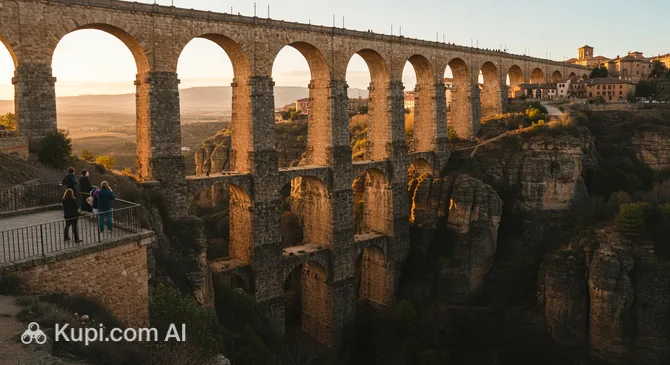
Fernando Hué Viaduct
Fernando Hué Viaduct. Иллюстрация. Источник: Kupi.com AI

This site is interesting not only for its functionality but also for its aesthetics: its design echoes the ancient 16th-century aqueduct, creating a harmonious link between eras. Upon completion, the viaduct held the national record for the largest concrete span, and its 34-meter-high central arch was considered one of the most magnificent in Europe. Today, it is a fully pedestrian zone offering breathtaking views of the Rambla de San Julián valley.

For a traveler, the Fernando Hué Viaduct is primarily an opportunity to see how bold technical solutions transform into an elegant urban landmark. The combination of rugged stonework, delicate concrete forms, and stunning panoramas makes it a must-see on any itinerary when visiting Aragon.

Contacts

For those who wish to study the technical details or history of this engineering structure in advance, information is available on specialized resources and official maps.

How to contactContact
AddressC. la Florida, 44003 Teruel, Spain
Websitehistoriasdecarreteras.com

What to Do

The main reason to visit the viaduct is for leisurely strolls. From a height of 34 meters, stunning panoramic views open up over the historical center of Teruel, the deep Rambla de San Julián valley, and the surrounding hills. It is an ideal spot for photographers: here you can capture the best angles of the city, especially during the "golden hour" when the rays of the setting sun highlight the texture of the stone supports.

Since the viaduct was closed to automobiles in 1994, visitors can peacefully study its architectural details, such as the decorative protrusions above the pylons and the powerful curves of the arches. Wide sidewalks allow for family walks without the worry of city traffic. Many tourists use the bridge as a starting point to cross into the Ensanche district, where modern life is in full swing with cozy cafes and green parks.

A fascinating experience is comparing this structure with the ancient Los Arcos Aqueduct, which can be seen nearby. This allows you to witness firsthand how engineering thought has evolved over the centuries. In the evening, the viaduct is transformed by artificial lighting, which makes its forms even more graceful, creating a romantic atmosphere to end the day.

Getting There

Reaching the viaduct is easy, as it is located in the very heart of the city at C. la Florida, 44003. If you are already in the historic center (Casco Antiguo), a walk to the structure will take no more than 5–10 minutes. The path from the famous Mudéjar towers to the start of the bridge is a pleasant pedestrian route that seamlessly transitions the visitor from the Middle Ages to the era of industrial modernism.

For travelers arriving by car, the most convenient route is via the N-234 road (Burgos — Sagunto). You can leave your car in parking lots in the modern Ensanche district or directly near the viaduct. If you are coming from the Teruel railway station, the walk to the site takes about 20 minutes, allowing you to appreciate the city's elevation changes and unusual terrain along the way.

Public transport is also well-developed, with city buses stopping in the immediate vicinity of the bridge. For those who prefer active recreation, a bike ride is an excellent option — there are rental points in the city, and routes across the Pinilla plateau offer interesting perspectives of the viaduct's structure.

Ближайший город: Teruel

History & Facts

The history of this bridge is inextricably linked with the name of the engineer Fernando Hué de la Barrera. The project was developed as early as 1920 to replace the exhausting and steep climb of Cuesta del Carajete with a modern and convenient crossing. However, due to financial difficulties, construction stretched over nearly a decade. Thanks to the support of Carlos Castel, the Director of Public Works, the process accelerated, and the main foundation work began in 1925.

The grand opening took place on October 29, 1929, although the first vehicle to test the structure's strength was a fire truck that drove across it back in September. At the time of its construction, the viaduct was a true triumph of Spanish engineering: its central arch set a national record for the largest reinforced concrete span, and the structure itself was considered the second most significant of its kind in Europe.

Interestingly, the viaduct's appearance was inspired by its much older neighbor — the 16th-century Los Arcos Aqueduct. In the 1970s, the structure underwent a complex rescue operation to fix the subsidence of its massive pylons. A new chapter in the bridge's history began in 1994 when, after the construction of a duplicate modern viaduct, the old Fernando Hué bridge was fully handed over to pedestrians, becoming a favorite walking spot and a symbol of architectural continuity.

Time Needed

For a quick introduction to the structure and to take a few memorable photos against the city panorama, 30–45 minutes will be quite enough. This is sufficient time to walk the bridge from end to end and appreciate the scale of its reinforced concrete arches.

However, if you want to enjoy the moment, watch the play of light on the old stonework in the rays of the setting sun, or continue your walk toward the modern Ensanche district, it is better to set aside 1–2 hours. The viaduct fits perfectly into a half-day excursion itinerary of key attractions, providing a pleasant pause between visiting towers and cathedrals.

Working Hours

The Fernando Hué Viaduct is a public urban site and part of the city's pedestrian infrastructure. It is open 24 hours a day, 7 days a week.

Visiting the bridge is absolutely free. You can come here in the early morning to catch the sunrise or late in the evening when the city illumination is turned on.

Круглосуточно

Nearby

Thanks to the compactness of the historic center, a visit to the viaduct can easily be combined with other iconic sites. A stroll through the surrounding area will allow you to dive deeper into the unique atmosphere of the city, where Mudéjar medieval heritage meets the engineering achievements of the last century.

NameDistance
Bar Torreón0.3 km
Óvalo Staircase0.3 km
Torre de El Salvador0.4 km
Mausoleum of the Lovers of Teruel0.4 km
Locavore Restaurant0.4 km
Restaurante Yain0.4 km
La Torre Boutique Apartments0.4 km

Reached the end of the page?

That means the route is fully explored