Support

Aqueduct of Los Arcos

About

If you are looking for a place where the history of engineering comes to life, then you must visit the city of Teruel. Here stands the Los Arcos Aqueduct—a majestic 16th-century structure that is rightfully considered one of the most outstanding monuments of the Spanish Renaissance. It is not merely an aqueduct, but a true two-level hybrid, combining the functions of a water conduit and a pedestrian bridge.
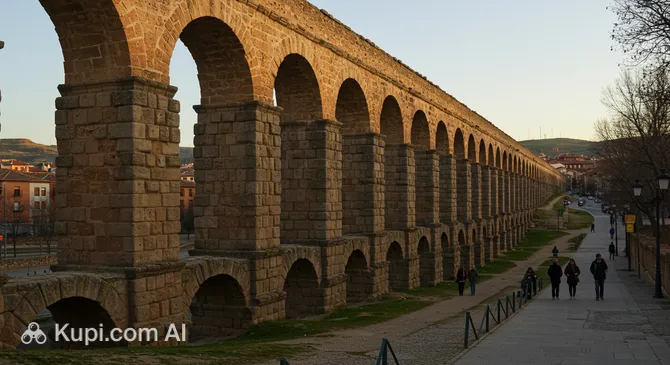
Los Arcos Aqueduct
Los Arcos Aqueduct. Иллюстрация. Источник: Kupi.com AI

Designed by the talented French architect Quinto Pierres Vedel, this landmark is reminiscent of classic Roman buildings thanks to its austere semicircular arches. Its uniqueness lies in its thoughtful design: while the upper tier delivered fresh water to the city from springs located seven kilometers away, the lower level served as a convenient crossing for residents.

Today, there are not many such functional structures from that era left in Spain. The Los Arcos Aqueduct still serves as a link between the medieval center and modern neighborhoods, offering tourists a unique opportunity to literally walk through the pages of history.

Contacts

To plan your visit to this architectural gem, it is helpful to know the exact coordinates and address. The aqueduct is conveniently located within walking distance of the city's main squares.

How to contactContact
AddressC. Bajo los Arcos, 10B, 44003 Teruel, Spain

What to Do

First and foremost, this place is a true paradise for walking enthusiasts. By crossing the lower level of the bridge, you can feel the scale of the structure and see how skillfully the stones, placed here over four centuries ago, are fitted together. It is an excellent opportunity to view the city from an unusual perspective, blending antiquity and modernity in a single walk.

For photographers, the Los Arcos Aqueduct offers endless perspectives. The play of light and shadow in the arches, the powerful supports, and the rhythmic pattern of the spans allow for impressive shots at any time of day. The structure looks particularly striking in the light of the setting sun, when the stone takes on a warm ochre hue.

A visit to the site allows you not only to enjoy the aesthetics but also to touch the engineering heritage of the past. While strolling under the arches, it is fascinating to imagine how water flowed through the upper channel for centuries, sustaining the entire city. This place is ideal for those who prefer calm, thoughtful sightseeing without the hustle and bustle.

Getting There

Reaching this architectural landmark is easy, as it is located directly within the city limits at C. Bajo los Arcos, 10B. If you are already in the historic center, the best way to get there is on foot — this will allow you to gradually see the massive arches rise above the urban landscape.

For those arriving by train, the walk from the railway station takes very little time, or you can use local public transport. If you prefer comfort, taxi services are available to quickly take you from any point in the city to the beginning of the pedestrian zone by the aqueduct.

For travelers arriving by car, it is recommended to use the following coordinates for navigation: 40.3457131, -1.1062896. The Carretera de Alcaniz runs nearby and serves as a good landmark for finding the site.

Ближайший город: Teruel

History & Facts

The construction of this grandiose structure began in 1537 and lasted for over twenty years. The project was designed by the talented French architect Quinto Pierres Vedel, who managed to harmoniously combine ancient traditions with the engineering requirements of the Renaissance era. By 1552, the main section of the water pipeline, stretching nearly 4.5 kilometers, was completed.

The aqueduct's design is striking in its complexity: it consists of 40 underground and 7 above-ground arches. The tallest and most majestic arch was built across a deep ravine in the northwest of the city, becoming the symbol of the entire project and giving it its name. Upon completion, fresh water was delivered through a system of pipes totaling 2,500 meters to 14 fountains throughout the city.

Interestingly, although the ancient channels are no longer used for the city's water supply due to modern utilities, the monument has retained its significance. It is recognized as an outstanding example of Spanish engineering and is included in the UNESCO World Heritage list as part of a unique architectural ensemble.

Time Needed

For a leisurely stroll along both levels of the structure and to take high-quality photos against the backdrop of the massive pillars, 30 minutes to one hour is sufficient for most visitors. This is plenty of time to appreciate the scale of the construction and enjoy the city panoramas.

If you are a connoisseur of ancient architecture and wish to study the masonry, Vedel’s engineering techniques in detail, or simply relax in the shade of the arches, you should set aside about 1.5–2 hours for your visit. The site is perfect for a short stop during a sightseeing tour of the city.

Working Hours

Since the Los Arcos Aqueduct is an important part of the city infrastructure and serves as a pedestrian bridge, it is accessible 24 hours a day, seven days a week. You can come here early in the morning to catch the sunrise or late in the evening for a stroll under the starlit sky.

Its open access (Monday — Sunday, 24/7) makes it an exceptionally convenient stop on any tourist itinerary, allowing you to visit without having to worry about museum opening hours.

Круглосуточно

Nearby

A walk across the aqueduct is just the beginning of discovering the wonderful world of this region. Numerous other historical monuments and cozy squares are concentrated in its immediate vicinity, allowing you to dive deeper into the atmosphere of the Middle Ages and the Renaissance.

Exploring the surroundings will help you gain a full understanding of the unique Mudejar style for which this region is so famous. Below is a list of interesting locations situated within walking distance.

NameDistance
Teruel Aqueduct0 km
Provincial Museum of Teruel0.2 km
Bar Serruchi0.3 km
Restaurante Yain0.3 km
Church of San Pedro0.3 km
San Martín Tower0.3 km
Torre de El Salvador0.4 km

Reached the end of the page?

That means the route is fully explored