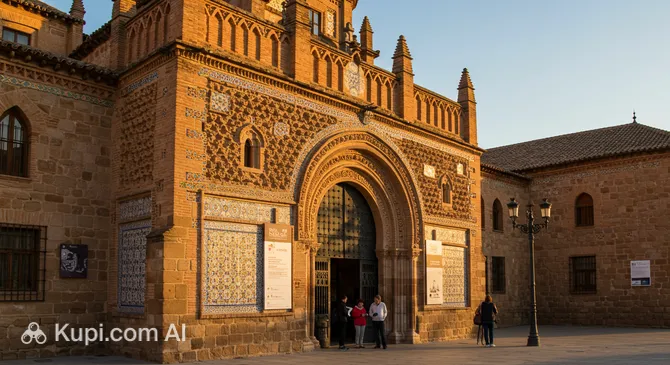
Located in the heart of the historic quarter, the Teruel Provincial Museum invites guests on a fascinating journey through time. It occupies a magnificent 16th-century building known as Casa de la Comunidad (Community House), which is a brilliant example of Aragonese Renaissance Mannerism. The main entrance is adorned with a majestic coat of arms, and the top floor is crowned by an elegant arcaded gallery, typical of palaces from that period in the city of Teruel.
Provincial Museum of Teruel. Illustration.
Source: Kupi.com AI
Traveler photos:
Inside this architectural landmark in Spain, six floors filled with unique artifacts await visitors. The museum combines archaeological treasures—from the Paleolithic era to Muslim rule—with an extensive ethnographic collection. Special attention is given to traditional Teruel ceramics, which have brought fame to the region for centuries with their unique style.
This site is ideal for those who want to better understand the cultural code of the Aragon region. The museum is famous not only for its exhibits but also for its modern presentation: it utilizes 3D technologies and high-quality lighting. Additionally, the top floor of the building offers panoramic views of the city's rooftops and medieval towers.
Contacts
To contact the museum administration, you can use the official phone number or visit their website for updated information on temporary exhibitions and events.
A visit to the museum offers guests a rich program spanning several eras. Particular attention should be paid to the archaeological halls, where masterfully restored Roman mosaics and Iberian vases are presented. Thanks to informative videos and 3D presentations, the province's ancient history literally comes to life, making the tour interesting even for those who are not professional historians.
Be sure to stop by the ethnographic section on the upper floors. Here you can examine everyday objects from past centuries: from antique pharmacy equipment to traditional costumes and artisans' tools. This is an excellent way to see how ordinary people lived in Teruel during the 18th–20th centuries and to get acquainted with the unique local pottery, whose patterns have become a symbol of the city.
It is recommended to end your visit on the open terrace of the top floor. This is one of the best spots in the city to enjoy a panoramic view of old Teruel. From here, you can take magnificent photographs of the Mudejar towers and tiled roofs, as well as appreciate the architectural details of the palace itself where the museum is housed.
Getting There
The museum is located at Plaza Fray Anselmo Polanco, 3, in the heart of the historic quarter. It is situated in close proximity to the city's main architectural monuments, including the famous cathedral. Thanks to this central location, walking to the museum from any point in downtown Teruel is easy.
If you are arriving in the city by train or bus, your journey will begin at the Estación de Teruel station. A walk from there to the museum doors takes only about 10–15 minutes, offering a great way to immediately experience the atmosphere of the ancient streets.
For those who prefer a taxi, the ride from the station is very quick and affordable. If traveling by private car, it is recommended to use the parking areas located around the perimeter of the historic center, as traffic within the quarter itself may be restricted.
Nearest city: Teruel
History & Facts
The majestic building that houses the museum is known as Casa de la Comunidad (Community House). It was built in 1542 by architects Juan de Rigol and Pedro de Heredia. Originally a Renaissance palace, it served as a meeting place for representatives of local communities, which explains its monumental and austere appearance.
The museum's collection began as a gathering of the most significant archaeological finds from across the province. Artifacts from the settlements of Alto de Chacón and La Caridad hold a special place. These exhibits allow visitors to trace the region's history from prehistoric times through the Iberian and Roman periods up to the Middle Ages.
The Teruel ceramics section deserves special mention. Local pottery traditions date back to the 13th century, and the museum preserves unique specimens demonstrating the skill of local artisans throughout the centuries. This part of the museum clearly shows how crafts and the aesthetic preferences of Aragon's inhabitants evolved over time.
Time Needed
To fully explore the museum's exhibits, 2 to 3 hours are usually required. This is enough time to carefully examine the archaeological halls, get acquainted with the ethnographic collection, and enjoy Teruel's ceramics without missing important details.
If you are planning only a brief overview of the main masterpieces and want to simply admire the architecture of Casa de la Comunidad with its famous terrace, you can manage in 1–1.5 hours. However, given the richness of the collection and the availability of interactive presentations, it is better not to rush and to set aside an entire afternoon for the visit.
Working Hours
The museum follows a schedule traditional for the region. From Tuesday to Friday, it is open for visits twice a day: the morning shift lasts from 10:00 to 14:00, and after a midday break, the doors open again from 16:00 to 19:00.
On weekends—Saturday and Sunday—the museum is open only in the first half of the day, from 10:00 to 14:00. Please note that Monday is a closing day, so plan your cultural itinerary accordingly.
Day
Working hours
Monday
Closed
Tuesday
10:00 – 14:00, 4:00 – 19:00
Wednesday
10:00 – 14:00, 4:00 – 19:00
Thursday
10:00 – 14:00, 4:00 – 19:00
Friday
10:00 – 14:00, 4:00 – 19:00
Saturday
10:00 – 14:00
Sunday
10:00 – 14:00
Nearby
Exploring the Teruel Provincial Museum is just one part of a deep dive into the city's rich history. Many other iconic landmarks are concentrated around the museum, showcasing the multifaceted character of the region.
A stroll through the surrounding area will reveal magnificent examples of Mudejar architecture, cozy squares, and ancient hydraulic structures that have sustained the city's life for centuries. Below is a list of interesting sites within walking distance.