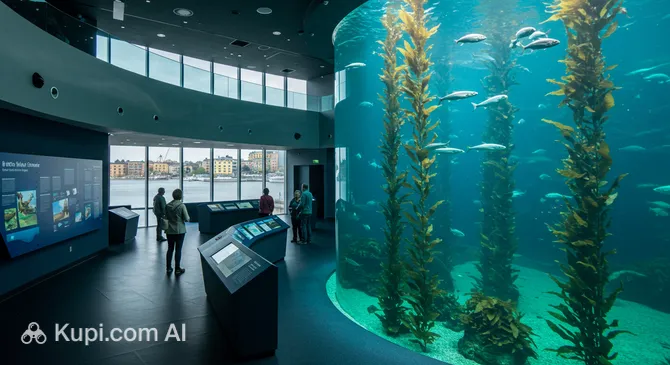
Located in the heart of the Swedish capital, the Baltic Sea Science Center is a jewel of the Skansen museum's educational space. This is a place where science meets nature, offering visitors a unique perspective on the ecological state and biodiversity of the Baltic Sea. Situated in Stockholm, the center serves as a vital link between researchers and the public.
Baltic Sea Science Center. Illustration.
Source: Kupi.com AI
Traveller photos:
The center is a modern marine research complex established in close cooperation with Stockholm University and the country's leading agricultural universities. Here in Sweden, they have successfully implemented an interdisciplinary approach that helps visitors understand the complex processes occurring beneath the water's surface and realize the scale of modern environmental challenges.
The main feature of this place is its ability to explain serious topics in a simple and engaging way. Thanks to the support of the BalticSea 2020 foundation, the Baltic Sea Science Center has become a flagship platform for everyone who cares about marine ecology and wants to learn more about preserving the natural balance of our region.
Contacts
The Baltic Sea Science Center is managed by the Skansen Museum, so all inquiries regarding visits can be directed through the museum's general communication channels. For specific information about special programs and group tours, it is recommended to visit the official website.
The primary activity at the center is observing underwater life through massive interactive aquariums. Here, you can see typical Baltic inhabitants in conditions that closely mimic their natural habitat and learn how various fish and plant species interact within this unique ecosystem.
Special attention should be given to the educational exhibitions, which clearly demonstrate human impact on the sea. Visitors can interact with exhibits to learn about pollution problems and water purification methods. Interactive panels allow you to literally "touch" science, making the learning process fascinating for both children and adults.
Additionally, you can discover the results of the latest scientific breakthroughs. The center regularly updates information on current research, informing guests about what each of us can do to save the marine environment. For school groups from the capital region, there are special educational programs conducted in collaboration with ecologists.
Getting There
The science center is located within the famous Skansen open-air museum, making it easily accessible for visitors. You can reach Djurgården island, where the facility is situated, in several ways. The most scenic route is to take a ferry that runs from Slussen or Nybroplan.
If you prefer land transport, you can conveniently take tram No. 7 or a bus from the city center to the Skansen stop. From the nearest metro station (Karlaplan), you can walk for about 15–20 minutes while enjoying the park views, or use one of Stockholm's efficient taxi services.
For those traveling by car, keep in mind that parking on Djurgården island can be limited, so public transport is often a more convenient and eco-friendly option.
Nearest city: Stockholm
History & Facts
The Baltic Sea Science Center at Stockholm University was officially founded on January 1, 2013. This was made possible by merging the efforts of the international Baltic Nest Institute and the former Stockholm Marine Research Centre with the Askö Laboratory. This merger created a powerful foundation for studying the region's fragile ecosystem.
A key milestone in the center's history was the development of a unique decision support system. Using complex numerical models and databases, scientists gained the ability to predict how various human activities affect water conditions and biodiversity. These developments formed the basis of the Baltic Sea Action Plan, signed by ministers of the coastal countries in 2013.
Today, the center serves as a bridge between high-level science and the general public. It has evolved from a closed research laboratory into an open educational space where complex environmental challenges are translated into a language understandable to every visitor striving to preserve the natural heritage of the North.
Time Needed
To fully explore the center's exhibits, you usually need 2 to 3 hours. This is enough time to carefully observe the aquarium inhabitants, study the interactive displays, and take part in educational experiments.
Since the center is located within Skansen, many tourists prefer to set aside half a day or even a full day to visit the entire site. If you are short on time, aim for a two-hour visit to cover the key scientific exhibitions.
Working Hours
The center welcomes visitors daily, though the operating hours vary slightly depending on the day of the week. On weekdays (Monday–Friday), the doors are open from 10:00 AM to 3:00 PM, and on weekends (Saturday–Sunday), the exhibitions are available until 4:00 PM.
As the center is part of the Skansen complex, opening hours may change depending on the season or special holiday events. Before your trip, it is highly recommended to check the information on the museum's official website to plan your visit as comfortably as possible.
Day
Opening hours
Monday
10:00–15:00
Tuesday
10:00–15:00
Wednesday
10:00–15:00
Thursday
10:00–15:00
Friday
10:00–15:00
Saturday
10:00–16:00
Sunday
10:00–16:00
Nearby
A visit to the Baltic Sea Science Center can be easily combined with a stroll to other interesting spots on Djurgården island. This area is considered a true cultural oasis, with museums, amusement parks, and scenic relaxation spots all located within a short distance of each other.
Exploring the surroundings will allow you to dive deeper into the atmosphere of the Swedish capital and find entertainment for every taste—from high-thrill rides to peaceful walks among historic buildings.
We use cookies and services to collect user information. This is essential for the functioning of the site and for marketing purposes. You can find out more in .
Other popular routes
Where travelers fly most — pick a route and check prices