Support

Uppsala universitet Evolutionsmuseet

About

Imagine a place where time has stood still for billions of years—this is the Museum of Evolution at Uppsala University. Located in the historic city of Uppsala, Sweden, this museum complex brings four fascinating worlds together under one roof: paleontology, mineralogy, zoology, and botany.
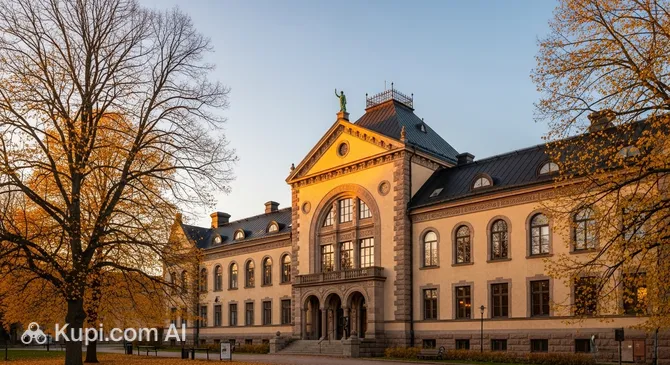
Uppsala University Museum of Evolution
Uppsala University Museum of Evolution. Иллюстрация. Источник: Kupi.com AI

As part of Scandinavia's oldest university, the museum houses thousands of exhibits illustrating the development of life on Earth. Here, you can trace the planet's journey from the formation of the first minerals to the emergence of today's most complex organisms. It is a true temple of science, where 4.6 billion years of history become tangible.

The crown jewel of the collection is Scandinavia's largest assembly of genuine dinosaur skeletons. Among them is the world's only specimen of the long-necked dinosaur Euhelopus zdanskyi, whose remains were brought from China. For lovers of nature and ancient mysteries, this place will be one of the highlights of your trip.

Contacts

To plan your visit to the Museum of Evolution, use the following up-to-date contact information. The museum is conveniently located within walking distance of other university sites.

How to contactContact
AddressVillavägen 9, 752 36 Uppsala, Швеция
Phone+46 18 471 27 39
Websitewww.evolutionsmuseet.uu.se

What to Do

In the museum's halls, visitors will embark on an exciting journey through the ages. The main draw for tourists is undoubtedly the paleontology section. Here, you can examine the massive skeletons of dinosaurs and ancient mammals in detail, imagining how these giants once roamed our planet. Don't forget to look for the unique Euhelopus zdanskyi—the pride of Swedish science.

For those drawn to the brilliance of the earth's depths, the mineralogy collection is a must-see. Thousands of crystals and gemstones amaze with their variety of shapes and colors. In the zoological and botanical departments, you can explore the diversity of modern species, studying their structures and adaptations, making the museum an ideal spot for family outings and educational tours.

Beyond looking at the displays, guests are welcome to take commemorative photos (without flash) and study the information panels that reveal the secrets behind the exhibits. A self-guided walk through the museum allows you to immerse yourself in the atmosphere of academic research and feel the scale of the university's contribution to global science.

Getting There

Finding the Museum of Evolution is quite simple: it is located at Villavägen 9, in the western part of the city. If you are already in the center of Uppsala, for example, near the cathedral, a walk to the museum will take about 15–20 minutes through picturesque university neighborhoods.

For those who prefer public transport, city buses stopping near the university are ideal. Cycling is also an excellent choice, as Uppsala is a true city of cyclists with a well-developed network of paths.

If you are arriving from another city, Uppsala Centralstation is just a 10–15 minute taxi or bus ride away. Travelers from Arlanda airport can reach the city by direct train or bus in 20–40 minutes and then transfer to local transport.

Ближайший город: Uppsala

History & Facts

The history of the museum is inextricably linked to Uppsala University, Scandinavia's oldest institution of higher education, founded in 1477. For centuries, the university has been a hub of scientific thought, home to great scientists such as Carl Linnaeus. It was his legacy and passion for classifying the natural world that laid the foundation for the museum's rich collections.

Exhibits have been gathered over centuries: geological samples, rare minerals, and fossil remains were brought here from all corners of the globe. A special place in history belongs to the paleontology collection, which is considered one of the most significant in Northern Europe thanks to unique finds made by Swedish expeditions in the early 20th century.

Today, the museum is not just a storehouse of antiquities but a living testament to how human understanding of the world has changed. It covers a colossal period of 4.6 billion years, carefully preserving the heritage of Swedish and international science for future generations.

Time Needed

To explore the wealth of the museum's four specialized departments without rushing, it is recommended to set aside 2 to 3 hours for your visit. This is enough time to examine the dinosaur skeletons, the impressive mineral collection, and the zoological exhibits in detail.

If you are planning a visit with children or have a deep interest in natural sciences, your stay may be longer. The museum is organized so that each section invites long and thoughtful study, so half a day within its walls will pass by unnoticed.

Working Hours

The Museum of Evolution warmly welcomes visitors from Tuesday to Sunday. The opening hours are fairly concise—from 12:00 PM to 4:00 PM—so plan your visit in advance to ensure you see all the collections.

Please note that the museum is closed on Mondays. Before your trip, it is recommended to check the official website, as opening hours may change during public holidays.

DayWorking hours
понедельникЗакрыто
вторник12:00–16:00
среда12:00–16:00
четверг12:00–16:00
пятница12:00–16:00
суббота12:00–16:00
воскресенье12:00–16:00

Nearby

A visit to the Museum of Evolution can easily be combined with exploring other iconic city landmarks. The area around the university is literally steeped in history and science, so a short walk after viewing the exhibits will be a great addition to your itinerary.

Nearby, you will find majestic castles, ancient gardens, and unique runestones that tell the ancient history of this region.

NameDistance
Uppsala Botanical Garden0.2 km
Museum of Evolution0.3 km
The English Park0.5 km
Uppsala Castle0.6 km
Uppsala Cathedral1 km
City Garden1 km
Biotopia1.1 km

Reached the end of the page?

That means the route is fully explored