Support

Evolution Museum of Paleontology

About

Imagine a place where time stood still millions of years ago. The Museum of Evolution, located in the historic city of Uppsala, is a unique scientific space belonging to one of the most prestigious universities that Sweden is proud of. The museum complex is divided into four fascinating sections: paleontology, mineralogy, zoology, and botany, offering guests a journey through 4.6 billion years of our planet's history.
\n
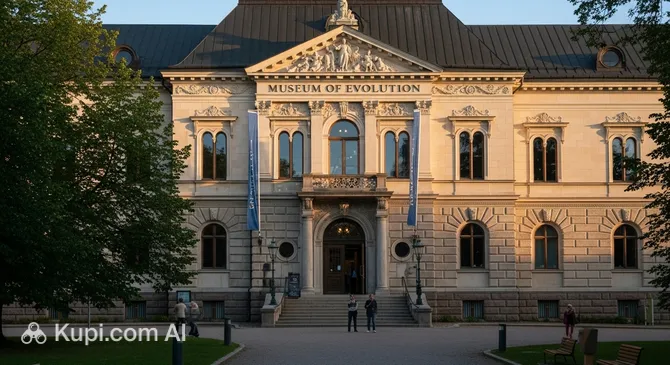
Museum of Evolution
Museum of Evolution. Иллюстрация. Источник: Kupi.com AI
\n

The main pride of the institution is the paleontology department. It houses the largest in Scandinavia collection of genuine dinosaur skeletons. The museum's calling card is rightfully considered the world's only specimen of Euhelopus zdanskyi — a giant long-necked lizard whose remains were discovered in China. Huge halls with high ceilings and an authentic atmosphere of academic science make this place a must-visit for all lovers of natural history.

\n

As an important educational platform, the museum does not just display exhibits but also tells the story of complex evolutionary processes. Thanks to its close connection with Uppsala University, the exhibitions are regularly updated and supplemented with the results of fresh research, ensuring the high scientific value of every display case.

Contacts

To check current information about special exhibitions or educational programs, you can contact the museum administration by phone. We also recommend visiting the educational institution's official website for news and possible changes to the schedule.

Below are the main contact details for planning your visit:

How to contactContact
AddressNorbyvägen 22, 752 36 Uppsala, Швеция
Phone+46 18 471 27 39
Websitewww.evolutionsmuseet.uu.se

What to Do

Once you find yourself in the museum halls, the first thing you should do is head to the paleontology gallery. Here you can literally stand face-to-face with prehistoric giants. Examining dinosaur skeletons and rare fossils is not only a visual delight but also an opportunity to realize the scale of life that existed long before humans. Pay special attention to the unique Euhelopus zdanskyi skeleton, which you won't find in any other museum in the world.

\n

In addition to paleontology, be sure to stop by the zoology and botany departments. This is a great chance to compare how life forms have changed over millions of years. For fans of geology, the mineralogy hall is open with an impressive collection of crystals and rare rocks. Many visitors note that a detailed study of the information panels and scientific reconstructions allows for a new perspective on the nature we are used to.

\n

The museum is ideal for family leisure. Children are usually delighted by the massive exhibits, while students and adults can gain a wealth of academic knowledge. Don't forget to bring your camera: scientific installations and skeletons of extinct animals serve as a magnificent backdrop for educational photos. In addition, the university sometimes holds themed tours here, which allow you to take a look behind the scenes of major science.

Getting There

The museum is located on the university campus in the northern part of Uppsala. Getting here from the center is quite easy: buses No. 20, 105, and 110 run regularly from the Uppsala Centralstation. You need to get off at the Norbyvägen or directly at the Evolutionsmuseet stop; the journey will take no more than 15–20 minutes.

If you are coming from Stockholm, the most convenient way is to take a train — the trip to Uppsala station takes about 40 minutes, after which you can change to a bus or take a taxi. For those who prefer private transport, parking is provided near the university buildings, although it is worth checking the parking rules during school hours in advance.

In the warmer months, walking or cycling is a great option. Uppsala is famous for its cycling infrastructure, and the path from the picturesque Fyris River to the museum is about 3–4 kilometers through pleasant student neighborhoods.

Ближайший город: Uppsala

History & Facts

This scientific center owes its existence to Uppsala University, the oldest in Scandinavia, which was founded back in 1477. Although the paleontology department itself was formed much later, it became a logical continuation of the rich research traditions for which Uppsala is famous. In the 19th century, the local school of paleontology became one of the leading in Europe, accumulating finds from all over the world.

Interestingly, the land where the buildings stand today has a "rural" past. Previously, the farm of Karl Malmen's family was located here. In 1928, he donated his property to the university for the development of science. Later, in 1945, a limnology laboratory was opened on this territory, and the complex acquired its modern look after a large-scale reconstruction of the main building in 1994.

One of the museum's most valuable acquisitions was the collection brought from expeditions to China in the early 20th century. It is thanks to Swedish scientists that the world saw the unique dinosaur remains that today form the core of the exhibition. The museum carefully preserves thousands of artifacts, demonstrating the continuity of knowledge from the Age of Enlightenment to the present day.

Time Needed

To immerse yourself in the world of ancient lizards and explore all four thematic sections without rushing, we recommend setting aside from 2 to 3 hours for your visit. This is quite enough time to examine the main paleontological finds and pay attention to the halls of zoology and botany.

If you are planning a visit with children or a detailed study of the information stands, the walk may take half a day. The museum encourages thoughtful exploration, so it is better not to plan other major events immediately after the visit, so that the impressions of evolutionary discoveries have time to "settle."

Working Hours

The museum welcomes visitors on a regular schedule: doors are open from Tuesday to Sunday from 12:00 to 16:00. Please note that Monday is a day off when the exhibitions are closed to the public.

Since the museum is part of the university infrastructure, opening hours may change on public holidays or during special academic events. Before your trip, we strongly recommend checking the official website to ensure the schedule is up to date.

DayWorking hours
понедельникЗакрыто
вторник12:00–16:00
среда12:00–16:00
четверг12:00–16:00
пятница12:00–16:00
суббота12:00–16:00
воскресенье12:00–16:00

Nearby

A trip to Uppsala would be incomplete without visiting other historical and natural locations within walking distance of the university halls. The area around the museum is steeped in an atmosphere of academic tranquility and ancient history, making it easy to combine viewing fossils with a walk around the castle or ancient gardens.

Check out the list of interesting places nearby:

NameDistance
Uppsala University Museum of Evolution0.3 km
Uppsala Botanical Garden0.4 km
The English Park0.7 km
Uppsala Castle0.9 km
Biotopia1.2 km
Uppsala Cathedral1.2 km
City Garden1.2 km

Reached the end of the page?

That means the route is fully explored