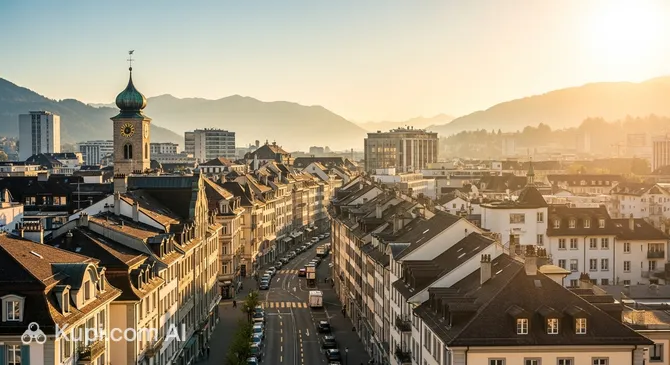
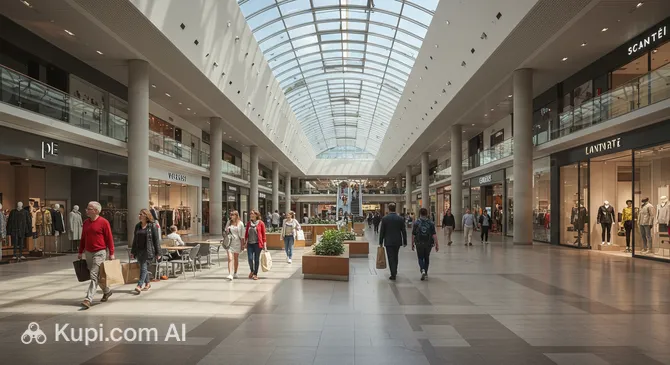
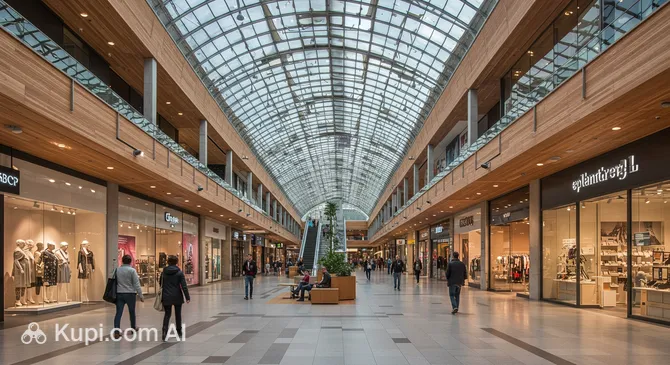
La Chaux-de-Fonds is a unique factory city nestled in the Jura Mountains, often called the watchmaking capital of the world. Situated at an altitude of approximately 1,000 meters above sea level, it is one of the highest cities in Europe. It is here that Switzerland demonstrates its famous pursuit of precision and craftsmanship in its most visible form.
La Chaux-de-Fonds. Illustration.
Source: Kupi.com AI
The city's architectural appearance is characterized by strict geometry: wide, straight streets were designed specifically to provide maximum natural light for watchmakers' workshops. This unique urban planning concept, along with the rich history of La Chaux-de-Fonds, has earned the city a place on the UNESCO World Heritage list. Strolling through the center, you will notice many Art Nouveau buildings adorned with stained glass and decorative moldings.
Among the main highlights is the International Museum of Horology, which houses an impressive collection of timepieces from different eras. Additionally, the city is known as the birthplace of the legendary architect Le Corbusier—tourists can visit his "White House" (Maison Blanche) and see the master's early works. With a population of about 39,000, La Chaux-de-Fonds offers a peaceful yet rich cultural program, perfectly suited for inquisitive travelers.
Weather Overview
The climate of La Chaux-de-Fonds is largely determined by its location in the Jura Mountains at an altitude of about 1,000 meters. A fresh atmosphere prevails here, and exhausting heat is extremely rare. Summer in the city is pleasant and moderately warm: in July and August, the average temperature stays around 18.5°C, while during the day the air warms up to a comfortable 23°C.
Winters here are cool but usually not excessively harsh. The coldest month is January, with an average temperature of about 1.3°C and nighttime frosts down to -1.4°C. Precipitation occurs quite regularly throughout the year: even in summer months like June, the number of rainy days can reach 18, so an umbrella will be a useful accessory in any season.
Overall, expect a warm summer with occasional rain and cool winters with high humidity. To choose the ideal time for your visit and not depend on the whims of nature, we recommend checking the detailed weather in La Chaux-de-Fonds before your departure.
Average monthly temperature
Average monthly precipitation
Interesting Facts
In addition to its status as the watchmaking capital, La Chaux-de-Fonds holds many fascinating secrets and unexpected historical parallels. This city can surprise even seasoned travelers with its unique traditions and famous natives.
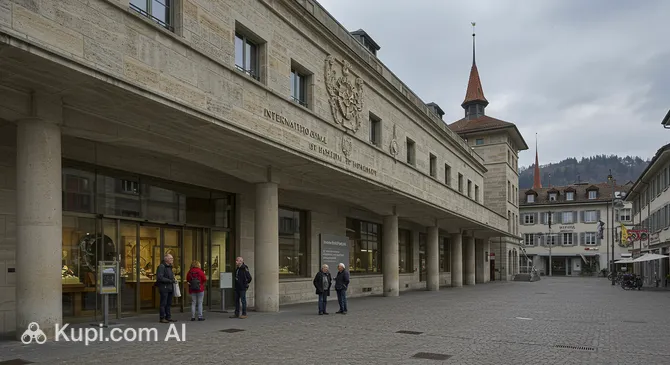
International Museum of Horology. Illustration.
Source: Kupi.com AI
Traveler photos:
Birthplace of an automotive legend. Few know that it was here in 1878 that Louis Chevrolet was born—the famous racing driver and co-founder of one of the largest car brands in the world. Although his career flourished in the USA, the roots of the Chevrolet dynasty go back to the Swiss Jura Mountains.
Unique "Spruce Style". A special branch of Art Nouveau emerged in the city's architecture, known as "Style Sapin" or "Spruce Style." Local artists and architects were inspired by the region's flora, which is why stylized images of pine cones, spruce branches, and thistles can often be found on building facades and in clock decorations.
A Bunker Museum. The famous International Museum of Horology impresses not only with its exhibits but also with its building. Most of the museum is located underground: the architects chose this solution to avoid cluttering the historic park and to preserve the harmony of the urban landscape.
The city in the works of Marx. The unique organization of labor in La Chaux-de-Fonds even caught the attention of Karl Marx. In his work "Capital," he analyzed the city's structure, calling it a "huge watchmaking manufacture" due to the high specialization and division of labor among its residents.
How to Get There
When planning a trip to this high-altitude city, it's worth considering your route in advance, as there is no direct air service. However, thanks to Switzerland's advanced transportation system, getting here is easy. You can find out more about how to get to La Chaux-de-Fonds by exploring all available options, and below we will look at the main transport hubs.
The nearest major air hub is EuroAirport Basel-Mulhouse-Freiburg (IATA: EAP), located in the city of Basel. It is about 75.5 km from La Chaux-de-Fonds. A taxi or transfer from this airport takes about 2 hours. This is a convenient option for those traveling from European countries.
Another popular choice remains Geneva Airport (IATA: GVA) in Geneva, 111 km away. The journey from there takes about 3 hours, but the scenic views along the way will brighten the time. If you are flying in from afar, you can use the country's main hub—Zurich Airport (IATA: ZRH) in Zurich (136.4 km), from where the journey to the city takes over 3.5 hours.
For convenience, here is summary information on the main airports:
The railway service in the region is excellently developed. There is no international-scale hub station in La Chaux-de-Fonds itself, so tourists often change at stations in nearby major cities. One of the key transit points is Bern station in the city of Bern, which is only 49 km away. Trains regularly depart from there into the Jura Mountains.
Another important transport hub is Basel SBB station in Basel (75.6 km). After arriving here on a high-speed train, you can easily transfer to a regional express or reach La Chaux-de-Fonds by car in about 2 hours.
Below is information on the nearest major railway stations:
La Chaux-de-Fonds is a city where industrial history intertwines with art and nature. The main points of interest here are related to watchmaking and unique architecture, but there is also room for quiet relaxation.
The undisputed symbol of the city is the International Museum of Horology. It is not just an exhibition of timepieces, but a true encyclopedia of time, dedicated to the history of measurement from antiquity to the present day. The collection includes thousands of exhibits, ranging from rare pocket watches and complex grandfather clocks to modern atomic devices. The museum building itself, partially hidden underground, is considered a masterpiece of Brutalist architecture and is harmoniously integrated into the park landscape.
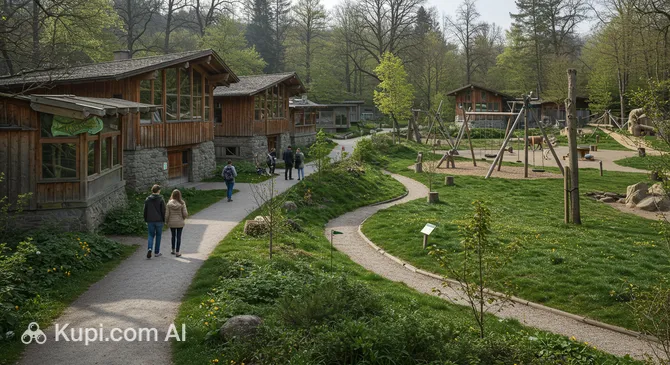
Bois du Petit-Château Zoo. Illustration.
Source: Kupi.com AI
Traveler photos:
For those who want to take a break from the city's geometry, the Bois du Petit-Château Zoo is open. This is a picturesque corner of nature within the city limits, where you can see both representatives of local Alpine fauna and exotic animals. The park is ideal for family walks: a peaceful atmosphere reigns here, and well-maintained paths lead through enclosures and green zones, allowing you to enjoy silence and fresh air.
Another important attraction is the Maison Blanche (White House)—the first building constructed by the famous architect Le Corbusier as an independent master. The villa, created for his parents in 1912, is located on a hillside and offers a magnificent view of the surroundings. A visit to this house allows you to touch the origins of Modernism and see the early experiments of a genius whose name is inextricably linked with La Chaux-de-Fonds.
Local Cuisine
The gastronomic scene of La Chaux-de-Fonds reflects the rugged yet beautiful character of the Jura Mountains. Local cuisine combines Swiss heartiness with French sophistication, offering tourists filling dishes perfectly suited for the cool climate of this high-altitude region. Quality farm products, especially cheeses and meat delicacies, are highly valued here.
The main culinary symbol of the region is the Neuchâtel fondue (Fondue Neuchâteloise). Unlike other variations, this recipe typically uses a mix of Gruyère and Emmental cheeses in equal proportions, melted in local white wine. Another must-try dish is Saucisson neuchâtelois. This is a smoked pork sausage that is traditionally boiled and served with potato salad or stewed lentils. The taste of this dish is considered the standard of home comfort in the canton.
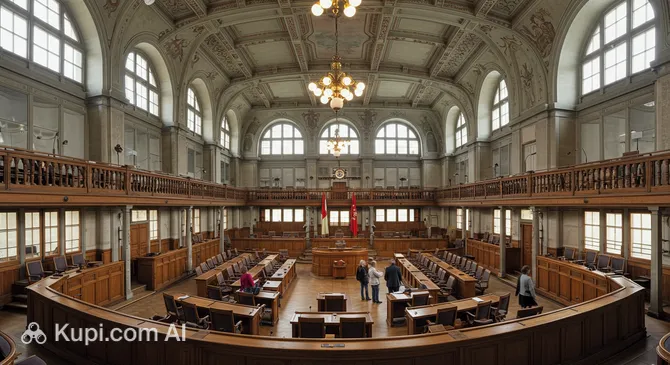
Hotel de Ville. Illustration.
Source: Kupi.com AI
Traveler photos:
As for drinks, the proximity to the Val-de-Travers valley makes it mandatory to mention absinthe. The "Green Fairy" was born in these parts, and today in the city, you can find bars where this drink is served according to all the rules of the traditional ritual—with sugar and ice water. Wine lovers should pay attention to Œil-de-Perdrix (Partridge Eye)—an exquisite rosé wine made from Pinot Noir grapes, which is the pride of Neuchâtel winemakers.
The dining culture in the city is democratic: cozy brasseries where you can grab a quick bite are popular, as are historic establishments with a special atmosphere. Locals love to spend time over long lunches discussing the news. An excellent example of a traditional establishment is the Hôtel de Ville. This place attracts not only with its cuisine but also with its historical charm, allowing guests to immerse themselves in the authentic atmosphere of the watchmakers' city.
Travel Tips
Traveling to La Chaux-de-Fonds, located at an altitude of 1,000 meters, requires a little preparation so that the changeable weather or local characteristics do not catch you off guard. We have compiled a list of useful recommendations to help you feel confident in this "watchmaking capital" and enjoy its unique atmosphere without extra worries.
Clothing and Items. Due to its high-altitude location, the climate here is cooler than in the lowlands. Even in summer, evenings can be fresh, so use the "layering" principle: bring a windbreaker or a light sweater that you can take off or put on as needed. Be sure to bring comfortable flat-soled shoes: the city has a strict geometric layout and is very pleasant to explore on foot, covering long distances.
Transport. The city center is quite compact, and its chessboard layout makes navigation intuitive. Yellow post buses and city routes are excellent for trips to the outskirts. A car rental is unlikely to be needed unless you plan to travel to remote corners of the Jura Mountains; public transport here works with textbook precision.
Finances. The official currency is the Swiss Franc (CHF). Although Switzerland is a country of advanced technology and cards are accepted almost everywhere (including museums and supermarkets), it is still worth having a little cash for small purchases at kiosks or markets. Tips are usually already included in the bill, but rounding up the amount is considered good manners.
Health and Safety. La Chaux-de-Fonds is a very safe city where you can safely walk even after dark. Water can be drunk directly from street fountains unless there is a sign "Eau non potable" (non-potable water)—it is clean and tasty. Pharmacies operate on a standard schedule (usually until 18:30), with few 24-hour ones, so it's better to have a personal first-aid kit with basic medicines.
Communication. The city is located in the French-speaking part of the country (Romandie). Locals will appreciate it if you start a conversation with a polite "Bonjour" (Good day), even if you later switch to English. English is understood in tourist spots and hotels, but in smaller shops, it may not be as common. For navigation and transport schedules, be sure to download the SBB Mobile app.
Local Etiquette. Restrained politeness prevails here. It is customary to greet those present when entering a shop or an elevator. Swiss people highly value silence and personal space, so loud conversations on public transport or in the street are not welcomed.
What to Avoid. Do not make noise after 22:00—nighttime quiet is strictly enforced here, and neighbors calling the police is a real practice. Also, avoid crossing the road in the wrong place or on a red light, even if there are no cars: this causes sincere disapproval from locals and may result in a fine.
Useful Lifehack. If you stay in a hotel or official guesthouse in the Canton of Neuchâtel (to which the city belongs), you must be issued a Neuchâtel Tourist Card. This card entitles you to free travel on public transport throughout the canton and free entry to 28 museums. Be sure to ask about this at check-in!
By following these simple tips, you can avoid typical tourist mistakes and focus on the main thing—exploring the unique architecture and rich history of this amazing city. May your trip to La Chaux-de-Fonds go smoothly and leave only warm memories!
Entertainment & Nightlife
Nightlife in La Chaux-de-Fonds differs from noisy metropolises: you won't find endless rows of neon signs like in Zurich or Geneva, but the city possesses its own unique charm. Evenings here are spent in an atmosphere of cozy gatherings, live music, and cultural events. The main activity is concentrated along the city's main artery—Avenue Léopold-Robert. This wide street, piercing the city from east to west, is the center of attraction for locals and tourists after sunset.
It is on "The Pod" (as locals call this avenue) and its adjacent streets that the most popular bars, pubs, and brasseries are located. It is customary here to leisurely enjoy a glass of local wine or traditional absinthe while discussing the day's events. The crowd in these establishments is very diverse: from students and creative intellectuals to watchmakers. The dress code in most places is casual—the casual style will be appropriate almost everywhere.
If you want to start the evening with quieter entertainment or shopping, it's worth paying attention to the major city centers. For example, Métropole Centre is one of the key leisure spots for residents. Here you can not only shop but also spend a pleasant time before heading to dinner or a bar.
Metropole Centre. Illustration.
Source: Kupi.com AI
Traveler photos:
Another important point on the entertainment map is Les Eplatures Centre. Although primarily a shopping space, it plays a significant role in the city's social life as a popular meeting point. After visiting the shopping galleries, many head to nearby restaurants or the cinema to continue their evening.
For fans of alternative music and more active nightlife, the Bikini Test club is a cult venue. This legendary concert space is located in a former mill building. It regularly hosts performances by rock bands, electronic musicians, and themed parties. Culture enthusiasts should also check the program of the L'Heure Bleue theater or the concert hall, which often host evening performances ranging from classics to modern dance.
Regarding the practical side, nightlife here winds down relatively early: on weekdays, bars close around midnight or 1 AM, while staying open longer on weekends. Prices are consistent with Swiss levels: a cocktail costs on average 12–18 francs, and a beer is about 7–9 francs. The city is very safe, and nighttime walks along the well-lit, geometrically regular streets are worry-free. For late-night travel, the "NoctamRUN" night bus network operates on Fridays and Saturdays.
During the day, La Chaux-de-Fonds offers no less interest: besides the aforementioned museums, you can visit old cinemas or stroll through picturesque parks, which serve as an excellent place to relax before an eventful evening.
Parks & Museums
Despite its strict industrial appearance and fame as a "factory city," La Chaux-de-Fonds knows how to surprise with cozy green zones and a rich museum life. The cultural landscape here is not limited to watch movements: it includes unique art collections and picturesque parks where nature harmoniously coexists with urban architecture.
The city's main green oasis is rightfully considered the Bois du Petit-Château Zoo. It is not just a place for observing animals but also a magnificent landscape park occupying a vast forest area. Residents come here to walk under the canopies of ancient trees and escape the city's hustle and bustle. Another significant natural zone is Parc des Crêtets. This historic garden, laid out in the English style around an old villa, offers an atmosphere of romantic seclusion with winding paths, age-old trees, and well-kept lawns, ideal for picnics.
The city's museum map is impressive in its diversity. The undisputed flagship is the International Museum of Horology, which preserves the history of time measurement. However, no less interesting is the Museum of Fine Arts (Musée des Beaux-Arts). It is a must-visit for those who want to understand the unique local "Spruce Style" (Style Sapin)—a variety of Art Nouveau inspired by the flora of the Jura. The museum's collection features works by Swiss and international masters, and the building itself is an architectural monument.
To immerse yourself in the daily life of past centuries, the History Museum (Musée d'histoire), located in a 19th-century mansion, will help. Here, the interiors of bourgeois houses of that time are recreated, allowing tourists to literally step over the threshold of the past and learn how watchmaking industrialists' families lived. The exhibition pays special attention to social history and the development of the urban environment.
For those seeking unconventional experiences, we suggest paying attention to the Ancien Manège—a former riding school. The inner courtyard of this residential complex is decorated with impressive frescoes and architectural elements hidden from the eyes of simple passers-by on the street. This place is a real gem for lovers of secret corners and photogenic locations.
Getting Around
The transport system of La Chaux-de-Fonds is characterized by the convenience and punctuality for which Switzerland is so famous. Although the city has a unique grid layout that makes it easy to navigate on foot, public transport is an excellent aid for trips to distant neighborhoods or museums. The main operator is TransN, providing connections not only within the city but throughout the canton.
The main form of transport here is buses. There are no trams in the city, but the yellow buses run with enviable regularity: during peak hours, the interval is 10–15 minutes. The central hub is the square in front of the railway station, from where routes diverge to all parts of the city. An interesting feature is the presence of several small railway stations within the city limits, which locals use as a ground metro for fast movement between districts.
The payment system is part of the Onde Verte ("Green Wave") tariff union. The fare depends on the number of zones (the city belongs to zone 10). There is great news for tourists: if you stay in a hotel, hostel, or apartment, you will be issued a Neuchâtel Tourist Card. It grants the right to free travel on public transport throughout the canton (including trains and funiculars) for the entire duration of your stay.
If you don't have a tourist card, a ticket must be purchased strictly before boarding. This can be done at vending machines at stops or via mobile apps such as SBB Mobile or FAIRTIQ. The latter is especially convenient: it calculates the best fare via GPS; you only need to activate the trip upon entering and end it upon exiting. Controllers operate frequently, and fines for not having a ticket are quite substantial.
Buses start running around 05:30 AM and finish around midnight. For fans of late-night strolls, the NoctamRUN night network operates on Fridays and Saturdays, though a special surcharge may be required if it is not covered by your pass. Please note: doors on transport usually do not open automatically; you need to press a button on the handrail or the door itself.
As an alternative, you can use the Velospot bike-sharing system. The wide and straight streets of the city are ideal for cyclists, although the terrain should be taken into account. Classic taxis are expensive, and it is better to look for cars at station ranks or order via apps, as "hailing" them on the street can be difficult.
Accommodation
La Chaux-de-Fonds offers tourists a balanced choice of accommodation options that reflect the city's industrial and cultural character. You won't find massive resort complexes here, but you can stay in cozy hotels, often located in historic buildings, or choose modern apartments. The range of housing varies from functional mid-range hotels, ideal for connoisseurs of horology, to small guesthouses and budget bed-and-breakfast options.
In terms of location, the best choice is accommodation in the city center, in the grid of streets around Avenue Léopold-Robert and near the railway station. Thanks to the city's compactness and unique planning, you can walk to the main museums and architectural monuments from here. Staying in the center also provides quick access to cafes and shops, which is particularly convenient for evening strolls.
The price range here can be characterized as medium to above average, which is typical for this region. It is worth booking accommodation in advance, especially during the summer months and on dates of major events. To find rooms, it is better to use major international online platforms or the hotels' own websites. Don't forget that official accommodation in the city grants you the Neuchâtel Tourist Card, which will significantly save your budget on transport and excursions.
Nearby Cities
For those looking to explore the surroundings, La Chaux-de-Fonds serves as an excellent starting point for day trips to several interesting nearby locations:
Just 14 km away is Neuchâtel—a charming city spread along the shores of the lake of the same name. It attracts tourists with its majestic medieval castle towering over the old center and picturesque embankments, ideal for leisurely strolls with views of the Alps.
Lovers of unique culture should visit Biel/Bienne, located 32 km away. It is the country's largest bilingual city, where German and French traditions blend harmoniously. Situated at the foot of the Jura Mountains, it serves as a gateway to the Lake District and, like La Chaux-de-Fonds, is an important center of watchmaking.
If you are ready to drive a bit further (50 km), head to Bern. The federal capital of Switzerland impresses with its Old Town, which is under UNESCO protection. The famous Zytglogge clock tower, the Bear Park, and kilometers of old shopping arcades make it one of Europe's most memorable cities for a day visit.
These nearby destinations offer an insight into the diverse culture and landscapes of the region, from lakeside scenery to capital grandeur.
Shopping & Souvenirs
Shopping in La Chaux-de-Fonds has its own unique character, inextricably linked with the city's history. As the watchmaking capital of the world, the city offers tourists not just purchases, but an opportunity to touch high craftsmanship. You won't find endless labyrinths of fashion outlets like in big metropolises, but instead, you can visit specialized boutiques and cozy shops where quality is valued over quantity.
The city's main shopping artery is the famous Avenue Léopold-Robert. This wide street, crossing the city from east to west, is literally dotted with clothing stores, bookstores, pharmacies, and, of course, watch salons. Strolling here, you can find both well-known international brands and goods from local producers. It is also worth checking out the nearby Rue de la Serre, where the atmosphere is calmer and the assortment of small shops pleasantly surprises with its variety.
For those who prefer to shop in one place under one roof, modern shopping complexes operate in the city. In the very center, within walking distance of the station, is Métropole Centre. It is convenient for its accessibility and the presence of a large supermarket, electronics stores, and fashion outlets. This is a great place to buy everything you need without leaving the historical part of the city.
Eplatures Centre. Illustration.
Source: Kupi.com AI
Traveler photos:
If you are looking for larger-scale shopping, it is worth heading to Les Eplatures Centre, located in the western part of La Chaux-de-Fonds, near Les Eplatures airport. This is one of the largest shopping centers in the region, offering a wide selection of hypermarkets, sports goods stores, furniture, and accessories. It is convenient for big purchases, and seasonal sales are often held here.
The local flavor of commerce can be experienced at the city market, which traditionally unfolds at the Market Square (Place du Marché). On Wednesdays and Saturdays (in the morning), farmers from across the region bring fresh vegetables, fruits, flowers, and homemade delicacies here. This is the perfect place to try local cheeses or buy honey from Jura mountain beekeepers, immersing yourself in the authentic atmosphere of town life.
Speaking of souvenirs, it is impossible not to mention Swiss watches. Buying them right here, in the city where many legendary brands were born, is a special ritual. Besides timepieces, an excellent gift would be a bottle of real absinthe from the neighboring Val-de-Travers valley or a set of handmade chocolates from local confectioneries (chocolateries). Traditional sets for cheese fondue and the famous Swiss Army knives are also popular.
Shops usually open Monday to Friday from 09:00 to 18:30 or 19:00. On Thursdays, many retail outlets are open later—until 20:00 or 21:00 (so-called "night shopping"). Saturday is a shorter day, with most places closing at 17:00 or 18:00. On Sundays, shops are closed, with the exception of small shops at the station and at gas stations. Bank cards are widely accepted, but it is better to have some cash Swiss francs for markets and small kiosks.
Tourists residing permanently outside of Switzerland can take advantage of the Tax Free system. If the purchase amount in one store exceeds 300 Swiss francs (including VAT), you are entitled to a tax refund. Be sure to ask the seller for a special form (Tax Free Form) and present it along with your passport and unpacked purchases at customs when leaving the country.