Support

Moshi Airport

About the Airport

Moshi Airport is not merely a runway, but a true aerial gateway to one of the most thrilling adventures in Africa. Located at the foot of the majestic Mount Kilimanjaro, it serves as a starting point for thousands of climbers and travellers dreaming of conquering the "Roof of Africa". Although it is smaller in size compared to its international neighbour, Kilimanjaro Airport (JRO), it is here, in a welcoming and less formal atmosphere, that the journey to the summit and the amazing safari parks of northern Tanzania begins.
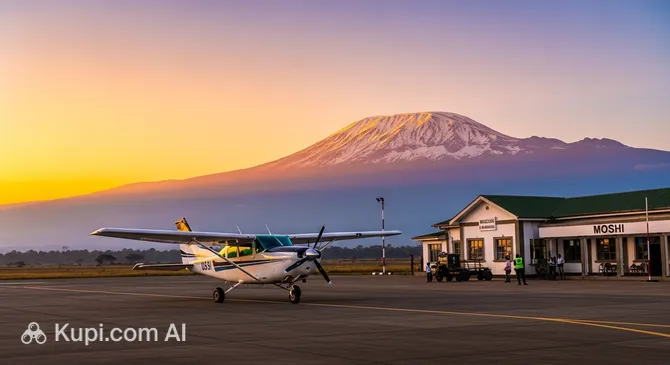
Moshi Airport. Source: Kupi.com Binoculars
IATA Code QSI
ICAO Code HTMS
City Moshi
Distance to Centre approx. 10 km
Status Domestic
Annual Passengers Less than 20,000 (estimated)
Popular Airlines Coastal Aviation, Auric Air, Regional Air Services

The main advantage of Moshi Airport is its strategic location. It is situated in immediate proximity to the town of Moshi, which acts as the base camp for expeditions to Kilimanjaro. Thanks to its compact size, the airport offers fast and convenient service without the long queues and bustle characteristic of major air hubs. From here, it is easy to reach national parks such as Arusha, Tarangire, and Lake Manyara, making it an ideal choice for tourists planning a safari in the north of the country. The airport mainly serves small aircraft of local airlines, offering charter and scheduled flights across the most picturesque corners of Tanzania.

Contact Information

Below are the contact details for Moshi Airport (QSI). Given the small size of the airport, some services may be combined or available via general contacts.

  • Official Website: Moshi Airport does not have a separate website. All official information is published on the airport's page on the Tanzania Airports Authority (TAA) portal: taa.go.tz/airports/moshi-airport.
  • Phone: +255 784 785 107 (Airport Manager contact).
  • Address: P.O. Box 602, Moshi, Tanzania.
  • Email: am.moshi@taa.go.tz
  • Social Media: There are no dedicated social media accounts for the airport.
  • Lost & Found: For issues related to lost or damaged luggage, you should first contact your airline's representative. If this is not possible, you may use the general airport phone number.
  • Passenger Support Service: For enquiries and assistance, it is recommended to use the phone number and email address listed above.

How to Get to the Airport

Moshi Airport (IATA: QSI) is a small airport serving domestic flights, located in close proximity to the town of the same name. It is important not to confuse it with the region's main international hub — Kilimanjaro International Airport (JRO), which is approximately a 30-40 minute drive from Moshi. Getting to the town's Moshi Airport from the centre is quite simple, and the journey will take just 10-15 minutes.

Taxi or Transfer is the most popular and convenient way to get to the airport. You can hail a taxi on the street or order a car through your hotel. The cost of the trip is low, but always negotiate the price with the driver before starting the journey to avoid misunderstandings. Many hotels and tour operators also offer pre-booked transfer services, which is particularly convenient if you have a lot of luggage or are travelling in a group. This is the most reliable option, guaranteeing you arrive on time.

For the most budget-conscious travellers, there is public transport in the form of local minibuses known as dala-dala. This is the cheapest way to travel, though it may not be the most comfortable: minibuses are often overcrowded and may not have a strict schedule. Furthermore, the dala-dala might not pull up directly to the terminal, and you may have to walk a short distance. This option is suitable for experienced tourists travelling light and wishing to immerse themselves in local life.

Car Rental in Moshi is a good option for those planning to explore the surroundings independently, for example, to visit the neighbouring city of Arusha or national parks. Several local and international companies offer rental services. Please note that an International Driving Permit may be required to drive in Tanzania. Parking at Moshi Airport generally consists of a simple open lot next to the terminal. It is suitable for short stops to drop off or pick up passengers.

Terminals and Map

Moshi Airport (QSI) is a small regional air hub characterised by a simple and clear structure. It consists of one compact terminal, serving primarily domestic flights within Tanzania, as well as charter and tourist flights. Thanks to its modest size, the airport offers passengers fast and convenient navigation without the unnecessary bustle typical of large international hubs.

The entire airport infrastructure is concentrated in one building. Here you will find a general area with several check-in counters, a small waiting lounge for departing passengers, and an arrivals area with baggage claim. Since there is only one terminal, the concept of transferring between terminals does not apply here. Departure and arrival zones are clearly demarcated but are within walking distance of each other, making movement around the airport extremely simple.

Passing through pre-flight formalities at Moshi airport usually does not take much time. Flight check-in and security screening are significantly faster than at major airports. Nevertheless, it is recommended to arrive at the airport approximately 1–1.5 hours before the departure of a domestic flight to calmly check in luggage and go through all procedures. During peak hours or the tourist season, the time may increase slightly, but critical queues are practically non-existent here.

Navigation within the terminal is intuitive. Signs will help you easily find the necessary zone, whether it is your airline's check-in counter or the boarding gate. Given the compactness of the building, getting lost here is virtually impossible. This makes Moshi Airport particularly convenient for those who value simplicity and do not wish to spend time on long walks and searching for the right gate.

Airport History

The history of Moshi Airport (QSI) is closely intertwined with the development of tourism at the foot of Kilimanjaro. Founded in the mid-20th century as a small airfield, for decades it was the region's main air gateway. Initially, the runway was used for administrative needs, servicing coffee plantations, and receiving the first brave climbers and travellers striving to conquer the "Roof of Africa". In those times, every flight was a real event, and the airport played a key role in logistics and communication with remote areas of northern Tanzania.

A significant turning point in the history of Moshi Airport was the opening of the larger and more modern Kilimanjaro International Airport (JRO) in 1971. From that moment, the main flow of international flights was redirected there, and Moshi Airport shifted its focus. It did not enter the race for records and massive reconstructions, but instead found its unique niche. The airport became an ideal base for light aviation: charter flights, private jets, medical evacuations, and companies organising air safaris.

Today, Moshi Airport is an important transport hub for those seeking exclusive and fast ways to travel through national parks. Scenic sightseeing flights over Kilimanjaro and the savannahs, as well as rapid transfers to remote lodges and camps, start from here. Its history is not a tale of giant terminals and millions of passengers, but a story of a reliable and welcoming airfield that continues to play its indispensable role in the region's tourism infrastructure, bringing the great wonders of Africa a little closer.

Services and Amenities

Moshi Airport (QSI) is a small regional airport that serves as a gateway to Mount Kilimanjaro and the national parks of northern Tanzania. The infrastructure here is compact and offers a basic set of services necessary for a comfortable wait for your flight.

Restaurants, Cafés, and Shops. In the terminal, you will find a small café or snack bar where you can order drinks, sandwiches, and light snacks. There are also several souvenir shops selling items by local artisans, clothing, and other memorabilia from your trip to Tanzania.

Lounges and Wi-Fi. Specialised VIP lounges are generally absent at Moshi Airport. Passengers can spend time in the general waiting hall. Access to Wi-Fi may be limited, and the number of power outlets for charging electronic devices is small, so it is recommended to carry a portable power bank.

Financial and Medical Services. A currency exchange point or ATM may be available at the airport, but it is better to arrange cash exchange in advance in the town of Moshi. Medical assistance is limited to basic first aid services.

Services for Passengers with Special Needs. There are no specialised mother-and-child rooms or children's play areas at the airport. Passengers with reduced mobility should contact their airline in advance to request escort services and assistance with boarding.

Hotels and Business Services. There are no hotels on the airport grounds. A wide selection of hotels and lodges can be found in the town of Moshi itself and its surroundings. Business centre and conference room services are not provided at the airport.

Where to Eat

Moshi Airport (QSI) is a small regional air hub serving mainly charter and domestic flights. Consequently, the choice of dining establishments here is very limited, and passengers are advised to plan their time and meals in advance, especially if you have specific dietary preferences.

Inside the terminal building, there is usually a small café or kiosk offering a basic range of drinks and snacks. Here you can buy coffee, tea, bottled water, carbonated drinks, and packaged snacks. Sometimes the assortment includes fresh pastries and simple local snacks, such as samosas or mandazi buns, which are excellent for a light bite while waiting for a flight.

For a full lunch or dinner, it is strongly recommended to eat at one of the numerous cafés or restaurants in the town of Moshi before travelling to the airport. Options for passengers with strict dietary restrictions (vegan, gluten-free, Halal meals) are generally unavailable at the airport. If you follow a special diet, it is safer to bring food with you.

The opening hours of the local café depend directly on the flight schedule — it is open during flight departure and arrival periods. Prices for food and drinks may be slightly higher than in town, which is standard practice for airports. Overall, this place is intended more for a quick snack than for a leisurely meal.

Travel Tips

To ensure your journey through Moshi town airport goes as smoothly as possible, make use of our tips. This small airport is the gateway to Kilimanjaro, and knowing a few nuances will make your experience more comfortable.

Arrival Time and Check-in. Moshi Airport (QSI) serves mainly domestic and charter flights. We recommend arriving 1.5–2 hours before departure. Despite the compact size, it is better to have a buffer of time in case of unforeseen queues. Keep your passport, ticket, and visa ready if one is required for your trip within Tanzania. The security screening procedure is standard but usually proceeds quite quickly.

Seat Selection on the Plane. If you are flying out of Moshi in clear weather, try to get a window seat on the left side of the aircraft. There is a high probability that a breathtaking view of the majestic Kilimanjaro peak will open up to you. When flying into Moshi, conversely, the best views often open up from the right side.

Hand Luggage. Sharp objects and liquids in containers larger than 100 ml are prohibited in hand luggage. All liquids must be packed in a transparent bag. Critically important: Tanzania has a strict ban on the import and use of plastic carrier bags. Ensure that there are none in your luggage or hand luggage to avoid fines. We recommend taking a change of clothes, necessary medications, sunscreen, and insect repellent into the cabin with you.

Customs Control and Transfers. Upon arrival, be ready to present your passport and possibly a Yellow Fever vaccination certificate (if you have arrived from a country where the disease is prevalent). Transfers directly within Moshi Airport are rare; it is most often a final or starting point. If you have a connection at larger airports, such as Kilimanjaro (JRO) or Dar es Salaam (DAR), allow at least 2-3 hours between flights.

Saving Time and Money. To save money, book a taxi or transfer from the airport in advance through your hotel or a verified company. Exchanging currency at small airports is often unfavourable; it is better to withdraw some cash from an ATM or prepare Tanzanian Shillings in advance. Food and souvenirs outside the airport will also be significantly cheaper.

In Case of Flight Delay. If your flight is delayed, first contact your airline representative for information. Waiting facilities in the small airport are limited, so download films or books to your devices in advance. Check if your travel insurance covers expenses related to flight delays.

Reached the end of the page?

That means the route is fully explored