Support

Pamukkale View Terrace

About

The Pamukkale Observation Terrace is an integral part of the stunning Pamukkale natural and historical complex, located in the Denizli province of southwestern Turkey. The name "Pamukkale" itself translates from Turkish as "cotton castle," which perfectly describes the surreal landscape: a cascade of dazzling white terraces that look as if they were sculpted from giant cotton balls.
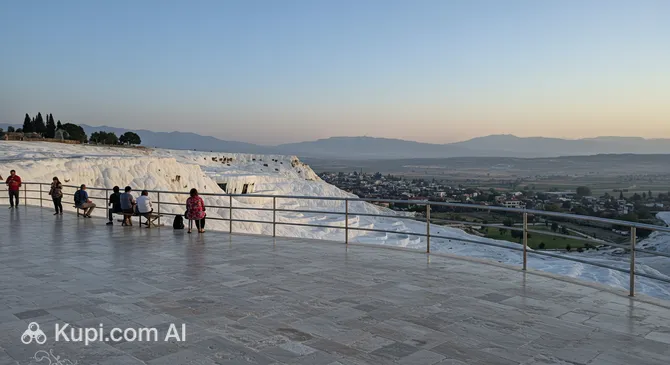
Pamukkale View Terrace. Illustration.
Source: Kupi.com AI

Traveler photos:

This specially equipped observation deck offers visitors breathtaking panoramic views of the famous snow-white travertines of Pamukkale. From here, you get a magnificent view of the Çürüksu River valley and the surrounding mountain ranges. On a clear day, you can even see the outline of the city of Denizli from the terrace, making it even more attractive to tourists.

The Pamukkale Observation Terrace is considered one of the best spots for photographing this natural wonder. Especially impressive shots are captured at sunrise or sunset, when the soft sunlight paints the travertine formations in incredible shades, creating a truly magical atmosphere. Visiting this platform allows you to fully appreciate the scale and beauty of the unique landscape created by nature over thousands of years.

Contacts

Since the Pamukkale Observation Terrace is part of an extensive natural and historical complex, it may not have separate direct contact details. For up-to-date information on visiting the entire Pamukkale complex, including opening hours, ticket prices, and how to get there, it is recommended to contact the tourist information center in the city of Denizli. You can also find useful information on the official website of the Ministry of Culture and Tourism of Turkey.

How to contactContact
AddressKınıklı, Hüseyin Yılmaz Cd. no:110, 20160 Pamukkale/Denizli, Türkiye
Phone number+90 4449220
Websitepamukkaleseyirtepesi.com

What to Do

At the Pamukkale Observation Terrace, the main activity is undoubtedly admiring the breathtaking snow-white travertines. These unique calcium terrace formations, filled with natural pools, are a truly unforgettable sight. The terrace is an ideal spot for photographers looking to capture this natural beauty, especially in the soft light of morning or evening when the lighting best emphasizes the splendor of this natural phenomenon. Interestingly, the shade of the travertines can change from dazzling white to yellowish or even grayish, depending on the season, weather conditions, and the mineral composition of the water.

In addition to the travertines themselves, the observation deck offers a magnificent panorama of the ruins of the ancient city of Hierapolis. This ancient city, along with the Pamukkale springs, is a UNESCO World Heritage site, and its presence adds historical depth to the surrounding landscape. From here, you can also see the famous Cleopatra's Pool, another popular attraction within the complex. It is important to remember that while you can admire the travertines as much as you like, swimming is only permitted in designated areas, not in the travertine pools themselves, to preserve their natural beauty.

For the convenience of visitors who wish to enjoy these views without a tiring climb, a cable car leads to the observation terrace. This makes it easy to reach one of the best viewpoints in Pamukkale and fully appreciate the scale and uniqueness of this natural phenomenon, created over millennia.

Getting There

Getting to the Pamukkale Observation Terrace is quite simple, as it is part of a well-organized tourist complex. The main starting point for most travelers is the nearby city of Denizli. Buses and shuttle taxis (dolmuses) run regularly from Denizli to Pamukkale. The trip usually takes about 20-30 minutes, making this a convenient and affordable option.

Once you arrive at the Pamukkale complex itself, you will have several options for reaching the observation terrace. One of the most popular and comfortable ways is the cable car. It not only saves time and energy but also allows you to enjoy scenic views during the ascent. The cable car will take you directly to the required height, offering the best panoramas.

For those who prefer a more active holiday and want to get closer to the unique landscapes, it is possible to reach the observation terrace on foot. Specially equipped paths lead through the travertine terraces within the complex. This option requires more time and physical effort but provides an unforgettable experience through direct contact with nature.

If you are traveling by rental car, you can drive to the parking lot at the entrance to the Pamukkale complex. After leaving your car, you can also choose between taking the cable car or walking along the scenic trails to the observation terrace. The choice depends on your preference and physical fitness.

Nearest city: Denizli

History & Facts

The history of the Pamukkale Observation Terrace is inextricably linked with the ancient city of Hierapolis, whose majestic ruins can still be seen nearby. This unique natural and historical complex has been forming over thousands of years. Geothermal springs rich in calcium are at the heart of this process. Water from these springs, descending the slopes from a height of about 60-70 meters, has slowly deposited calcium carbonate century after century. This is exactly how the famous snow-white travertines were formed, creating the truly fairytale landscape that visitors admire today from the observation decks.

There are as many as 17 geothermal springs in the region, with water temperatures ranging from 35 to 100°C. However, notably, Pamukkale's dazzling white cascades owe their existence to the water from just one spring. This specific spring features an impressive flow rate of 466.21 liters per second and a temperature of 35.6°C. The uniqueness and beauty of this site were recognized globally in 1988 when Pamukkale, along with the ruins of Hierapolis, was included in the prestigious UNESCO World Heritage List under the official name "Hierapolis-Pamukkale".

Unfortunately, in recent years, the pristine appearance of the travertines has begun to change due to heavy tourist traffic and general human impact. In some places, they are taking on a yellowish or grayish tint, which is a concern for conservationists. To preserve this natural wonder, the park administration is taking active measures. In particular, tourist flow is regulated, and compliance with visiting rules is monitored. Additionally, the water supply is periodically turned off in different parts of the complex. This is done to prevent further erosion and to allow natural calcium deposition processes to restore the original whiteness and structure of the travertines.

Time Needed

To fully enjoy the Pamukkale Observation Terrace and see the main surrounding sights, it is recommended to set aside 2 to 4 hours. This time is usually enough to leisurely admire the breathtaking panoramic views from the terrace, take memorable photos, and feel the unique atmosphere of the site.

If your plan includes a more detailed exploration of the complex—such as visiting the nearby snow-white travertines, walking through the ruins of the ancient city of Hierapolis, or swimming in Cleopatra's Pool—you should aim for the upper end of this time range, and perhaps a little more. Many travelers note that for the best photos and experiences, it is worth planning your visit for the morning or evening hours, when the lighting highlights the beauty of this natural wonder.

Thus, while the time spent on the observation deck itself might be about an hour, a full exploration of the surrounding beauties and historical sites can easily stretch to half a day. Plan your time based on how deeply you want to immerse yourself in the magic of Pamukkale, Denizli's main attraction.

Working Hours

The Pamukkale Observation Terrace, like the entire Pamukkale complex, is usually open to visitors daily. During the summer period, which runs from April to October, opening hours are typically 8:00 AM to 9:00 PM. In the winter period, from November to March, access to the terrace is usually possible from 8:00 AM to 5:00 PM. Thus, you can enjoy the views year-round, while keeping seasonal schedule changes in mind.

It is important to remember that the stated operating hours may change depending on weather conditions and other factors. Therefore, when planning your visit to the Pamukkale Observation Terrace, it is highly recommended to check the current schedule and the potential need for advance ticket booking on the official website of the complex or at local tourist information centers. This will help you avoid surprises and plan your trip in the best possible way.

9:00 – 21:30

Nearby

Visiting the Pamukkale Observation Terrace undoubtedly leaves a lasting impression. However, to make your trip to Denizli even more rewarding and memorable, it is worth paying attention to other nearby attractions. Exploring the surroundings will allow you to immerse yourself deeper in the region's atmosphere, its culture, nature, and daily life, complementing the vivid emotions from seeing the famous travertines.

There are many interesting places around Turkey's main gem, Pamukkale, that can enrich your itinerary. From cozy parks for a quiet break to lively urban locations—there is something for everyone. Below is a list of some attractions near the Pamukkale Observation Terrace, including the distance to each.

NameDistance
Pamukkale Thematic City Forest Park0.1 km
Çamlık Park0.7 km
Mufti Ahmet Hulusi Efendi Mosque1.1 km
Forum Çamlık2 km
Rast Studio Denizli2.3 km
Duman Mangalbasi2.7 km
Denizli Officers' Club3.6 km

Have you reached the end of the page?

So the route has been studied inside and out