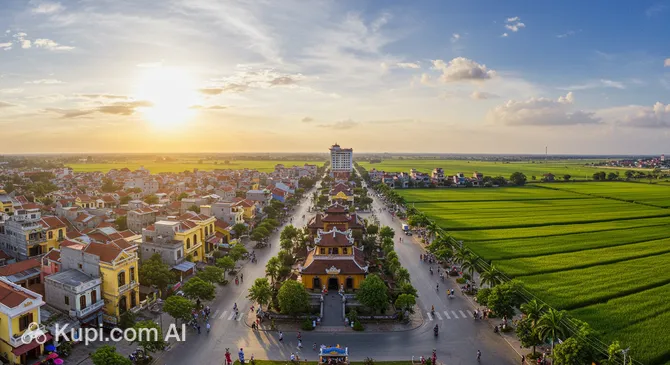
Located in the heart of Binh Dinh province, An Nhon is a unique corner of Vietnam where modern industrial life is closely intertwined with a grand past. This city, sprawling across the picturesque plains of the central part of the country, has long served as an important administrative and cultural hub of the region. Today, An Nhon is home to over 317,000 people, making it a bustling center that still retains the charm of provincial authenticity.
An Nhon. Illustration.
Source: Kupi.com AI
The city possesses a rich cultural layer, as it was once the capital of the ancient Champa kingdom and a significant center during the Tay Son dynasty. You can immerse yourself in the deep history of An Nhon by exploring the remains of imperial citadels and elegant Cham towers that rise above the rice fields like silent witnesses of bygone eras. The atmosphere here is filled with tranquility: away from the noisy tourist metropolises, life flows at the measured pace of traditional crafts and agriculture.
For travelers, An Nhon reveals itself like a box of secrets: here you can find secluded pagodas, mirror-like lakes, and hospitable locals who are always happy to share stories of their land. Despite active industrial development, the city remains a place where authentic Vietnamese life has been preserved in its original form. We invite you to visit An Nhon to feel the spirit of history and enjoy the silence surrounded by majestic architectural monuments.
Weather Overview
The climate in An Nhon is classified as tropical monsoon, typical of the entire central part of Vietnam. Two seasons are clearly defined here: dry and wet. If you want to learn more about temperature records and precipitation, check the An Nhon weather section.
The most pleasant time to visit is the period from March to May, when the air temperature stays around a pleasant 25–29°C and humidity has not yet reached its peak. Summer (June-August) brings real heat, with temperatures often rising to 34°C. During this time, it is worth planning excursions for early morning to avoid the scorching sun.
The rainy season arrives in October and lasts until December. During this period, An Nhon receives a significant amount of rainfall — in November, the norm can exceed 340 mm. Winter (January-February) is mild and cool by local standards: the average temperature is about 23°C, which is ideal for viewing ancient Cham towers without exhausting heat.
Average monthly temperature
Average monthly precipitation
Interesting Facts
Capital of Ancient Kingdoms: An Nhon once served as the political center of the powerful Champa state and later became the cradle of the Tay Son dynasty under Emperor Thai Duc.
Unique Pagoda: It is believed that the Thap Thap Pagoda was built using bricks from ten destroyed Champa towers, which gave it its name, meaning "Ten Towers."
Home of Elite Vermicelli: The city is famous for producing a special vermicelli called Song Than, which is made from green mung beans and is considered a valuable delicacy in the Binh Dinh region.
Wrestling Festival: The traditional Do Gian festival in Nhon Phuc commune is famous for its competitions, where participants demonstrate strength and agility, honoring the ancient customs of local villages.
Administrative Reform: In 2025, the city underwent a major reorganization, as a result of which it was officially dissolved as a separate administrative unit, transitioning to the status of an important residential and industrial hub.
How to Get There
Reaching An Nhon is easy thanks to its strategic location on the country's main transport artery — National Highway 1A. The city serves as an important transit point for those traveling through central Vietnam. You can find more detailed information about routes and logistics on the how to get to the city page.
Air communication is provided through the nearest airport, Phu Cat (UIH), located just 25 kilometers from the city center. This is a modern air hub receiving regular flights from Hanoi and Ho Chi Minh City. A transfer from the airport by taxi or private car takes about 30-45 minutes, providing comfortable access to the region's historical monuments.
Railway transport is also a popular way to travel. The famous "Reunification Express" passes through An Nhon, and trains from Da Nang or Nha Trang make a stop here. The railway station is conveniently located, allowing for quick access to the main residential quarters by local buses or motorbike taxis. The travel time from Da Nang is approximately 5-6 hours.
Station
Passenger traffic
Distance
Dieu Tri Railway Station
5
9 km
Tuy Hoa Railway Station
5
91 km
Quảng Ngãi railway station
5
141 km
Nha Trang Railway Station
8
181 km
Tam Ky Railway Station
4
197 km
Main Attractions
An Nhon is a true open-air museum for those who appreciate historical heritage. One of the most impressive attractions is the Banh It Towers, located on a hill offering a panoramic view of the surroundings. These majestic brick structures, built during the peak of the Champa culture, amaze with the delicacy of their carvings and the monumentality of their forms. No less important is the Canh Tien Tower, which was once part of the ancient capital of Do Ban and today serves as a vivid example of Cham architectural mastery.
Spiritual seekers should visit the Thap Thap Pagoda. This ancient sanctuary, whose name translates to "Ten Towers," was built from the bricks of destroyed Cham buildings and is one of the oldest Buddhist temples in central Vietnam. Inside, an atmosphere of absolute peace reigns, and the well-kept gardens and ancient stupas set a meditative mood. It is also worth noting the remains of the Imperial Citadel, which preserves memories of the Tay Son dynasty and Emperor Thai Duc.
If you are looking for natural beauty, head to Nui Mot Lake. This is one of the most picturesque spots in the region, surrounded by dense forests and waterfalls. The lake is ideal for quiet walks or picnics away from the city bustle. For those who want to get acquainted with living traditions, An Nhon offers visits to craft villages where for centuries masters have been creating unique bamboo products and producing the famous rice paper according to ancient recipes.
Local Cuisine
A gastronomic journey through An Nhon is an introduction to the true flavors of Binh Dinh province. The city is famous for its traditional crafts directly related to food. Be sure to try the local rice paper from An Thai village and the unique dry vermicelli Song Than. This noodle is made from green mung beans and is considered an ideal base for soups or side dishes due to its texture and nutritional properties.
Local cuisine is unthinkable without the freshest seafood. In establishments such as Trung Luong Seafood Restaurant, guests are offered the catch of the day, prepared according to classic Vietnamese recipes using aromatic herbs and spices. For meat lovers, An Nhon offers a variety of street food options, where you should pay attention to nem nuong — grilled pork sausages served with vegetables and a special sauce.
The food culture here is simple and soulful: main meals take place at bustling markets or in small family cafes. Among drinks, strong Vietnamese coffee with condensed milk and freshly squeezed tropical fruit juices lead the way. Check out the Tuan Tu restaurant to appreciate home cooking and feel the hospitality of the locals. Food in An Nhon is primarily about the freshness of ingredients and loyalty to centuries-old traditions.
Travel Tips
Planning a trip to An Nhon is a step toward authentic Vietnam. To make your journey as comfortable as possible and bring only positive emotions, we have prepared several practical recommendations.
Clothing and Essentials: Choose light clothing made from natural fabrics, as it can be quite hot in the region. When visiting pagodas and temples like Thap Thap, be sure to cover your shoulders and knees — this is a mark of respect for local traditions.
Transport: The most convenient way to explore the surroundings is by renting a motorbike. If you prefer comfort, use the Grab app to call a taxi. Remember that traffic on Highway 1A can be very heavy.
Finance: Vietnamese Dong (VND) is the currency used in An Nhon. Cards are only accepted in large hotels, so always carry cash for markets and small cafes. ATMs are located in the city center.
Health: Drink only bottled water and use insect repellent, especially if you plan to walk near Nui Mot Lake. Pharmacies can be found along the main streets.
Communication: English is not widely spoken here. We recommend learning a few basic phrases in Vietnamese or having an offline translator handy. It's better to buy a SIM card in advance at Phu Cat airport.
Local Etiquette: Vietnamese people are friendly. Greet people with a light nod of the head. Try not to raise your voice in public places — calmness and restraint are valued here.
What to Avoid: Do not leave chopsticks standing vertically in a bowl of rice — this resembles a memorial ritual and may upset those around you. Also, avoid walking in industrial areas late at night.
Seasonality: The best time to visit is spring (March-May), when the weather is mildest and nature delights with bright colors.
May your introduction to the historical heritage of An Nhon become a bright event, full of discoveries and pleasant encounters. Have a nice trip!
Entertainment & Nightlife
Leisure in An Nhon differs from the usual noise of tourist centers. Here you won't find the neon signs of nightclubs or crowded bars; however, the city offers a deeper and calmer immersion into local culture. Life after sunset is centered around family dinners in cozy cafes and walks in central squares where residents gather to socialize. This place is perfect for those who want to take a break from the hustle and enjoy the quiet of a provincial night.
The main entertainment event of the year is the Do Gian Festival, which takes place in An Thai village in the middle of the 7th lunar month. This bright and spectacular event includes traditional games, sports competitions, and ritual offerings, attracting guests from all over Binh Dinh province. During the day, it's worth visiting the central markets, which turn into real centers of social activity, offering tourists the opportunity to observe the authentic life of a Vietnamese town.
If you crave more dynamic recreation, beach parties, or modern music, locals recommend heading to nearby Quy Nhon, located just a 30-40 minute drive away. In An Nhon itself, evening time is best spent relaxing by Nui Mot Lake or tasting local delicacies in small restaurants along the main roads, where you can feel the true spirit of central Vietnam in a calm and safe environment.
Parks & Museums
The main "natural museum" of An Nhon is the area around Nui Mot Lake. This is an extensive green zone where the water surface meets hilly terrain and dense forests. The park by the lake is very popular among locals for picnics and outdoor recreation. Here you can find small waterfalls and even caves, making a walk an exciting adventure for ecotourism enthusiasts.
While there are few classic art galleries in the city, their role is successfully fulfilled by historical and cultural sites such as the Canh Tien and Phu Loc towers. These architectural monuments function as open-air museums, allowing visitors to study the unique masonry and symbolism of the ancient Champa civilization. The structures themselves are living testimonies to the skill of builders of the past and do not require additional exhibits to strike the imagination.
For a more traditional acquaintance with culture, it is worth visiting the grounds of the Thap Thap Pagoda, which is surrounded by a well-kept garden. This place combines the functions of a religious center and a historical park, where ancient steles and stupas tell the centuries-old history of Buddhism in the region. The city's greenery in general has a natural character typical of rural Vietnam, where landscapes smoothly transition from rice fields into picturesque green zones.
Getting Around
The transport system of An Nhon is highly functional and oriented toward practicality. The main form of public transport is intercity and suburban buses that run along National Highway 1A, connecting the city with Quy Nhon and other settlements in the province. Bus fares are usually paid in cash to the conductor, and ticket prices are extremely low.
For getting around the city, renting a motorbike is an ideal solution. This is the most popular way to travel among locals and expats, allowing you to freely explore remote Cham towers and Nui Mot Lake. If you are not ready to drive yourself, you can always use motorbike taxi (xe ôm) services or call a car through the Grab app, which works stably in the region.
The railway also plays an important role: the station in An Nhon receives trains connecting the north and south of the country. Train tickets can be bought online or at the station's ticket offices. Traffic in the city itself is calm compared to Hanoi or Ho Chi Minh City, though traffic jams can occur on the main highway during peak hours. For tourists, An Nhon remains a convenient and easy-to-navigate city where all key points are within a short ride.
Accommodation
Accommodation options in An Nhon are primarily geared toward transit travelers and those seeking an authentic experience away from major resorts. Budget hotels and cozy guesthouses (nha nghi) predominate here, offering basic comfort at very affordable prices. Notable options include the Osaka Quynhon Hotel, which offers a decent level of service, as well as more modest but clean hotels like the Phuong Danh Hotel.
Most hotels are concentrated along National Highway 1A or in the central part of the city, which is convenient for quick access to transport hubs. If you are planning to visit An Nhon for historical sites like the Cham towers, staying in the local center will save you travel time. The price range for accommodation here is very democratic: a standard room in a guesthouse can cost between $10 and $20 per night.
While there are no luxury five-star resorts in An Nhon itself, the city attracts with its simplicity and sincerity. For a short stay of 1-2 days, the existing infrastructure is quite sufficient. It is recommended to book accommodation in advance through international services or directly, especially if your trip coincides with major local festivals when the demand for rooms increases.
Nearby Cities
An Nhon serves as an excellent starting point for exploring the central part of Binh Dinh province, offering travelers convenient routes to neighboring cultural and natural centers. Thanks to its location at the intersection of important roads, the city allows you to visit both the coast and the mountainous areas of the region in a single day.
Just 16 kilometers away is the sunny city of Quy Nhon. This destination is ideal for those who miss the sea breeze: magnificent beaches, modern embankments, and excellent seafood restaurants await you here. Also within reach are the cities of Phu Yen and Tuy Hoa, known for their wild landscapes and unique geological formations, such as basalt columns.
Exploring the surroundings of An Nhon will give you plenty of impressions: from majestic Cham towers scattered throughout the region to quiet fishing villages. We highly recommend not limiting yourself to just the city center and taking a small trip to neighboring cities to fully appreciate the diversity and beauty of central Vietnam.
Shopping & Souvenirs
Shopping in An Nhon is primarily an introduction to local production and traditional markets. The city has no huge shopping centers with glass showcases, but there is an abundance of colorful places where you can purchase essentials and unique souvenirs. Life bustles at the central markets, where farmers and craftsmen bring their products every morning. Here you can find the freshest tropical fruits, vegetables, and seafood.
The main pride of An Nhon is its edible souvenirs. From An Thai village, it is worth bringing back the famous rice paper and the special dry vermicelli Song Than. These products are famous throughout Vietnam for their quality and are often packaged specially for tourists in easy-to-transport packs. The city is also known for bamboo and rattan handicrafts, which will be a great addition to any interior.
Most shops are located along National Highway 1A and on the city's main streets. Payment is made primarily in cash (Vietnamese Dong), so it's worth taking care of exchanging money at banks or ATMs, which are easy to find in the center. Shops usually operate from early morning until late evening, and markets are most active from 6 AM to 10 AM. The Tax-Free system is practically non-existent in this small town, as purchases are of a local nature.