Support

Casa Rosada

About

Casa Rosada, which translates to "Pink House," is one of the most recognizable and significant buildings in Buenos Aires, the capital of Argentina. It is not just a beautiful structure, but the official working residence of the country's president. The palace earned its name and worldwide fame thanks to the characteristic deep pink color of its facade, which makes it stand out against the city's architecture and serves as a true symbol of the Argentine nation.
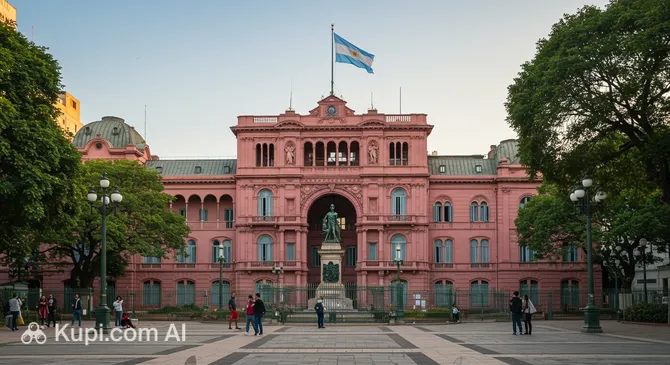
Casa Rosada. Illustration.
Source: Kupi.com AI

Traveler photos:

Located on the historic Plaza de Mayo (May Square) at 50 Balcarce Street, Casa Rosada primarily serves as the head of state's workplace and a venue for official events. It is important to note that while it is the official residence, the President of Argentina typically lives elsewhere—at the Quinta de Olivos residence. The building is not only the center of political life but also a silent witness to many key moments in the country's history.

The architectural style of Casa Rosada can be described as eclectic, with a predominance of Italian Renaissance and Neoclassical elements. The appearance of this three-story building and its interior spaces harmoniously combine various stylistic solutions, creating a majestic and memorable image. In 1942, Casa Rosada was officially declared a National Historical Monument, highlighting its immense cultural and historical value to Argentina and its people.

Contacts

To get the most up-to-date information on visiting Casa Rosada, such as opening hours and tour conditions, it is recommended to check official sources. This will help you plan your visit as effectively as possible.

How to contactContact
AddressBalcarce 78, C1064AAC Cdad. Autónoma de Buenos Aires, Argentina
Phone number+54 11 4344-3600
Websitewww.casarosada.gob.ar

What to Do

A visit to Casa Rosada offers several interesting opportunities to learn about the history and culture of Argentina. One of the main attractions inside the palace is the Museum of the Government House, located in its basement levels. Here, visitors can see personal belongings of the country's former presidents. An interesting feature of the museum is the rule that exhibits related to a particular head of state are displayed no earlier than thirty years after the end of their term, allowing for a perspective on their legacy with some historical distance.

While walking through the complex, guests can appreciate the beauty of its inner courtyards. There are three in total: the Palm Courtyard (Patio de las Palmeras), the Aljibe Courtyard (Patio del Aljibe), and the Malvinas Argentinas Courtyard (Patio Malvinas Argentinas), each decorated with ornamental elements and creating a special atmosphere. On the eastern side of the palace lies Plaza Colón—an open square that serves as a site for important official ceremonies, including presidential inaugurations. This is an iconic place where you can feel the pulse of the country's political life.

Additionally, other symbolic objects can be seen on the grounds of Casa Rosada. A tall mast with the national flag of Argentina, which is effectively illuminated at night, is an important attribute of the presidential palace. For those interested in more ancient history, it will be curious to discover the preserved wall fragments and the portal of the old fort, on the site of which the palace was subsequently built. These details allow you to touch the past of Buenos Aires and appreciate the many layers of its history.

Getting There

Reaching Casa Rosada is quite simple, as it occupies a central position in Buenos Aires, on the famous Plaza de Mayo. This is the historic heart of the city, where many transportation arteries converge, making the presidential palace easily accessible from most areas of the capital of Argentina.

The most convenient way to reach Casa Rosada by public transport is the Buenos Aires subway, known as the "Subte." Several stations are located in the immediate vicinity: Plaza de Mayo station (Line A) opens directly onto the square. Also nearby are Catedral (Line D) and Bolívar (Line E) stations, which are just a few minutes' walk from the palace. Additionally, numerous city bus routes ("colectivos") pass through Plaza de Mayo, so you can easily find a suitable line from almost anywhere in the city.

If you prefer comfort and speed, you can always use taxis or popular ride-sharing services, which are widely available in Buenos Aires. A trip from the city's central districts to Casa Rosada usually doesn't take much time. For those staying in nearby neighborhoods such as San Telmo or Montserrat, a pleasant walk is a great alternative—it allows you not only to reach your destination but also to enjoy the architecture and atmosphere of the Argentine capital's historic center.

Nearest city: Buenos Aires

History & Facts

The history of Casa Rosada has roots dating back to the distant past, long before the building acquired its famous pink hue. Back in the late 16th century, in 1594, shortly after the founding of Buenos Aires by Juan de Garay, a fort named after Juan Baltasar of Austria was erected on this strategically important site. More than a hundred years later, in 1713, this defensive structure was rebuilt into the more imposing fortified Castle of San Miguel. It was this castle that served for many years as the official residence of the Spanish colonial authorities in the region, testifying to the site's significance in governing the territory.

In the 19th century, the appearance and purpose of the building on the site of the future Casa Rosada continued to change. In 1825, at the initiative of President Bernardino Rivadavia, the Castle of San Miguel was transformed, receiving a design in the neoclassical style popular at the time. In this form, it served as the seat of government for Buenos Aires until 1857. Then, by order of President Justo José de Urquiza, the old building was dismantled to make way for a grand new structure—the Customs House. This new building, designed in the Italianate style by Edward Taylor, was the largest in the city at the time, highlighting the growing economic importance of Buenos Aires.

The modern appearance of Casa Rosada as we know it today is the result of a unique architectural solution from the late 19th century. Instead of constructing an entirely new building, it was decided to merge two existing but differently purposed structures: the city post office building, which now forms the right side of the palace (when looking at the famous arch), and the Government House itself, located to the left of the arch. This ambitious project to connect them into a single complex was designed by architect Francesco Tamburini, who gave it Italianate features. It was then that the walls of the building were painted in the characteristic pink color that gave the palace its world-famous name.

Time Needed

When planning a visit to Casa Rosada, you should set aside approximately 1-2 hours for a general overview of this iconic Buenos Aires landmark. This time is usually enough to see the building from the outside, walk through the adjacent Plaza de Mayo, and perhaps visit the inner courtyards if they are open to the public at the time of your visit.

If you are interested in a deeper dive into history and wish to visit the Museum of the Government House, located in the palace's vaulted galleries, your visit time may increase. A tour of the museum, which displays personal belongings of former presidents of Argentina and other historical artifacts, can take an additional 45 minutes to 1.5 hours, depending on your pace and interest in the exhibits. It's also worth noting that organized tours of the palace itself may be held on certain days, which will also affect the total duration of your visit.

Thus, for a quick external view and photos, 30-60 minutes might suffice. However, for a more complete experience, including a museum visit and a leisurely stroll through accessible areas, it's better to plan for half a day or at least 2-3 hours. It is recommended to check the museum's opening hours and tour availability on the official website in advance to plan your time optimally.

Working Hours

Casa Rosada, as an active presidential residence, has a specific visiting policy. Free guided tours are usually organized for the public on certain days, most often on weekends and public holidays. However, opening hours and tour dates can change, so it is crucial to check for the latest information on the official Casa Rosada website before planning your visit. There, you can also find out about the need for prior registration or ticket booking, which is often a mandatory requirement for participating in a tour.

Since this is a government building, access may be restricted during official events. Generally, the opportunity to visit Casa Rosada exists year-round, but it is always recommended to check the schedule and visiting conditions in advance on the official web portal or through tourist information centers in Buenos Aires to avoid disappointment and plan your visit in the best possible way.

Nearby

After visiting the majestic Casa Rosada, don't be in a hurry to leave this historic district of Buenos Aires. Exploring the surroundings of the presidential palace will allow you to dive deeper into the atmosphere of the Argentine capital, discover other iconic spots, and get a more complete impression of the city. There are many interesting sites in the immediate vicinity of Casa Rosada, each reflecting the rich culture and history of Argentina in its own way.

Strolling through the nearby streets and squares is a great opportunity to see more than just one landmark. You can appreciate the architectural diversity, visit cozy cafes, browse souvenir shops, or simply enjoy the dynamic life of one of South America's most vibrant cities. Below is a list of some interesting places located near Casa Rosada, along with their approximate distances.

NameDistance
Plaza de Mayo0.2 km
La Pampa National Park1 km
Obelisk of Buenos Aires1.1 km
Teatro Colón1.4 km
Güerrín Pizzeria1.5 km
Paseo La Plaza1.9 km
El Molino Confectionery2 km

Have you reached the end of the page?

So the route has been studied inside and out