Support

Galileo Galilei Planetarium

About

The Galileo Galilei Planetarium is not just a building, but a true portal to the Universe located in the scenic Tres de Febrero Park in Buenos Aires, the capital of Argentina. This modern scientific and educational complex, a five-story structure with a recognizable futuristic dome, attracts both locals and tourists with its unusual design and the promise of incredible cosmic journeys.
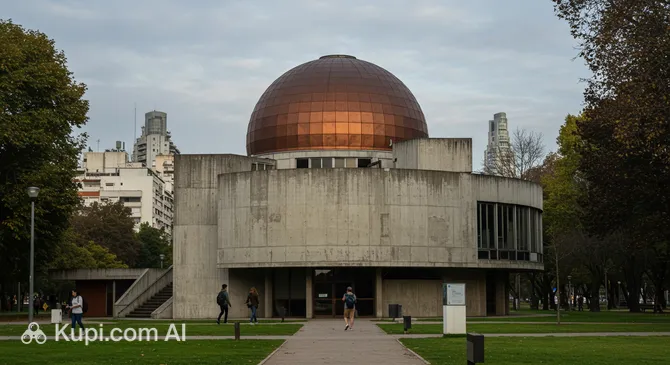
Galileo Galilei Planetarium. Illustration.
Source: Kupi.com AI

Traveler photos:

The heart of the planetarium is its impressive dome, 20 meters in diameter. Beneath it lies a powerful projection system capable of recreating the celestial sphere on the vault with amazing accuracy. Visitors can see about 8,900 fixed stars, distant nebulae, and familiar constellations, as if observing the night sky from any point on our planet.

A visit to the Galileo Galilei Planetarium is a unique opportunity to expand your knowledge of space and be inspired by its mysteries and beauty. It is a place where science meets imagination, offering fascinating programs for all ages and immersing visitors in the secrets of the universe. This iconic Buenos Aires landmark is a must-visit for curious travelers and stargazers alike.

Contacts

For the most up-to-date information on opening hours, ticket prices, and how to contact the Galileo Galilei Planetarium, it is recommended to visit its official website. You can also find useful information on the Buenos Aires tourism portals or check locally upon arrival in Argentina.

How to contactContact
AddressAv. Sarmiento s/n, C1425 Cdad. Autónoma de Buenos Aires, Argentina
Websitewww.planetario.gob.ar

What to Do

At the Galileo Galilei Planetarium, visitors can expect captivating popular science presentations that immerse them in the world of astronomy. Under the massive dome, the starry sky comes to life thanks to a modern system with multiple lasers. Guests can see detailed projections of the night sky over Buenos Aires, Argentine Antarctica, and even the South Pole, as well as observe various celestial objects and impressive astronomical phenomena.

In addition to regular astronomical shows, the Galileo Galilei Planetarium serves as an important scientific and educational center. It frequently hosts scientific conferences, opening new horizons of knowledge for specialists and enthusiasts. For the general public, thematic exhibitions dedicated to space and astronomy are organized, where you can see interesting exhibits and space-themed works. Special attention is given to educational programs for schoolchildren and students, making science accessible and exciting for the younger generation.

With its state-of-the-art equipment and variety of programs, a visit to the planetarium becomes a truly engaging and educational experience for people of all ages. It is a wonderful opportunity not only to admire the beauty of the Universe but also to expand your knowledge of it, touch the mysteries of space, and perhaps be inspired for your own explorations.

Getting There

There are several ways to reach the Galileo Galilei Planetarium in Buenos Aires, as it is located in the popular Tres de Febrero Park in the Palermo neighborhood. One of the most common options is public transport. Numerous bus routes (colectivos) pass near the park, and you can always find a convenient option depending on your location in the city. It is recommended to check the appropriate route numbers in advance using online maps or transport apps.

Another option is the Buenos Aires Underground (Subte). The closest stations to Tres de Febrero Park, where the planetarium is located, are Line D stations such as "Plaza Italia" or "Palermo." From these stations, you may need to take a short walk through the scenic park or a quick taxi or bus ride directly to the planetarium entrance.

For those who prefer comfort and speed, taxis or popular ride-hailing services are always available. A trip from the center of Buenos Aires to the planetarium takes a reasonable amount of time, depending on traffic. This is a particularly convenient option if you are traveling with children or are short on time.

Before your trip, it is always helpful to check current routes and public transport schedules, as well as traffic conditions, to choose the most efficient way to reach the Galileo Galilei Planetarium and enjoy its cosmic wonders hassle-free.

Nearest city: Buenos Aires

History & Facts

The idea of creating the Galileo Galilei Planetarium in Buenos Aires was conceived back in 1958. It was initiated by councilman José Luis Pena and Aldo Cocchi, the municipal Secretary of Culture. Work on this ambitious project began in 1962. The architectural design was by Argentine architect Enrique Jan, and the construction was carried out under the auspices of the General Directorate of Architecture of the city of Buenos Aires by the company Construcciones Civiles SA.

The grand opening of the planetarium took place on December 20, 1966, and the ceremony was led by then-mayor Eugenio Schettini. However, the first performance under its dome did not occur until June 13, 1967. Its first audience consisted of students from a commercial school in Banfield and students from Buenos Aires. Geography and mathematics professor Antonio Cornejo showed them the sky over the Argentine capital, Argentine Antarctica, and the South Pole. The doors of the Galileo Galilei Planetarium opened to the general public on April 5, 1968, becoming an important cultural and educational center.

Decades later, in 2011, the Galileo Galilei Planetarium underwent a major renovation. This update equipped it with state-of-the-art projection and technological equipment, significantly expanding its capabilities for demonstrating breathtaking cosmic phenomena. At the same time, architects and restorers paid great attention to preserving its original, recognizable historical appearance, which is so beloved by residents and visitors of Buenos Aires.

Time Needed

When planning a visit to the Galileo Galilei Planetarium in Buenos Aires, expect a standard visit, including the main show under the dome, to take approximately 1.5 to 2 hours. This is usually enough time to enjoy the breathtaking projection of the starry sky and learn something new about the Universe.

However, if you wish to dive deeper into the world of astronomy, your visit may last longer. For instance, if the planetarium is hosting temporary exhibitions, interactive displays, or special lectures, you might need an extra hour or two. Visitors with a particular interest in science may want to study the materials in more detail or attend several different programs if they are offered on the same day.

Overall, to comfortably experience the main offerings of the Galileo Galilei Planetarium, it is best to set aside 2 to 3 hours. This allows you to enjoy the main performance without rushing, see the available exhibits, and perhaps visit the museum section if it is open. It is recommended to check the schedule of shows and events on the official website in advance to plan your visit efficiently.

Working Hours

The exact opening hours of the Galileo Galilei Planetarium in Buenos Aires may vary depending on the day of the week, the season, and special events. Generally, such institutions are open to visitors year-round, offering various sessions and programs. To get the most up-to-date schedule information, it is highly recommended to visit the planetarium's official website or contact local tourist information centers directly before your planned visit.

Given the popularity of the Galileo Galilei Planetarium, especially on weekends and during school holidays, it may be wise to check in advance about booking tickets online or the need to pre-register for certain sessions. This will help avoid queues and guarantee a visit at a time convenient for you. Checking official sources will also allow you to learn about any potential changes to the schedule or special offers.

DayOpening hours
MondayClosed
Tuesday12:00 – 17:00
Wednesday12:00 – 17:00
Thursday12:00 – 17:00
Friday12:00 – 17:00
Saturday12:00 – 20:00
Sunday12:00 – 20:00

Nearby

Visiting the Galileo Galilei Planetarium is an exciting adventure in itself, but exploring its surroundings can make your trip to Buenos Aires even more rewarding and memorable. The Palermo district, where the planetarium is located, is rich in parks, museums, and other points of interest within walking distance or a short drive away.

By exploring nearby attractions, you can dive deeper into the culture and atmosphere of this vibrant city in Argentina, complementing your cosmic impressions from the planetarium with earthly discoveries. Below is a list of some interesting places located near the Galileo Galilei Planetarium.

NameDistance
Museum of Latin American Art of Buenos Aires1.1 km
Mandarine Park & Tent1.1 km
National Museum of Decorative Arts1.7 km
National Museum of Fine Arts2.3 km
Parque Norte3.5 km
Hotel Buenos Aires3.5 km
Teatro Picadero4.1 km

Have you reached the end of the page?

So the route has been studied inside and out