Support

Liege Airport

About the Airport

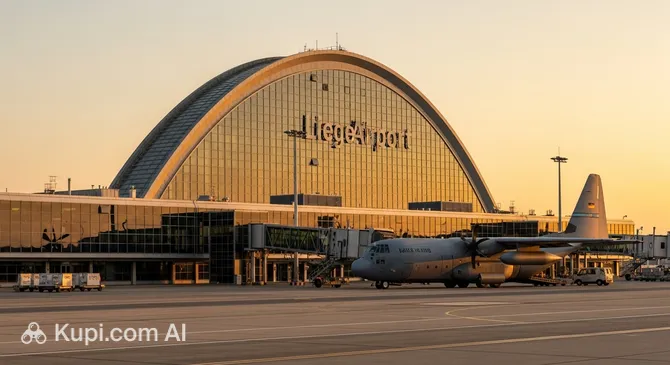
Liege Airport. Source: Kupi.com Binoculars

Liege Airport, known worldwide primarily as a giant cargo hub, serves as an unexpectedly convenient and peaceful gateway to Belgium and neighboring countries for many travelers. Despite its status as one of Europe's largest cargo airports, it also offers passenger flights, mainly to popular holiday destinations. It is an excellent alternative to the busier airports of Brussels and Charleroi, allowing you to start your journey in a relaxed atmosphere.

IATA Code LGG
ICAO Code EBLG
City Liege
Distance to Center approx. 9 km
Status International
Annual Passengers over 175,000 (2023)
Popular Airlines TUI fly Belgium, Tunisair, Pegasus Airlines
Schedule online flight board "Liege Airport"

The main feature of Liege Airport is its specialization in cargo transport. It is a European leader in this sector and a base for major logistics companies, making it a strategically important facility. For passengers, this means the airport is rarely overcrowded, and check-in and security processes generally move faster than in major tourist hubs. The modern passenger terminal, opened in 2005, is compact and functional. The airport is particularly popular for charter flights to Mediterranean and other resorts, offering convenient departures for those seeking a holiday in the sun.

Contact Information

You can contact representatives of Liege Airport (LGG) in several ways. Below you will find the main contact details to obtain necessary information and assistance.

  • Official Website: You can find all the latest information on flights, services, and regulations on the official airport portal — www.liegeairport.com.
  • Information Desk Phone: For immediate information and inquiries, you can call: +32 4 234 84 11.
  • Airport Address: Rue de l'Aéroport, B-4460 Grâce-Hollogne, Belgium.
  • Email: For general questions and suggestions, you can use the address: info@liegeairport.com.
  • Social Media: Follow news and updates on the airport's official pages on Facebook, Instagram, and LinkedIn.
  • Lost Luggage Information: If your luggage has been lost or damaged, you should immediately contact your airline's representative or the handling company's baggage tracing service. Service phone (Aviapartner): +32 4 234 85 99.
  • Passenger Support Service: To resolve issues related to your journey, it is recommended to use the information desk phone or the feedback form on the airport's official website.

How to Get to the Airport

Reaching Liege Airport (LGG), located approximately 10 kilometers west of the city center, is possible via several methods. The choice depends on your budget, time, and comfort preferences. A trip from the center of Liege usually takes 15-20 minutes by car.

Public Transport is the most economical option. TEC buses are the main means of connecting the airport with the city. Route No. 53 connects the airport with the main railway station Liège-Guillemins and the city center, while route No. 57 goes to the station and continues to the Jemeppe district. This is a convenient method if you are arriving in Liege by train from other cities in Belgium or Europe. The bus ride takes about 20-30 minutes, and the ticket cost is just a few Euros.

For maximum convenience, especially if you are traveling with large luggage or in a group, taxis or pre-booked transfers are best suited. The taxi rank is located directly outside the arrivals terminal exit. A trip to the city center will cost approximately 25-35 Euros. Pre-booking a transfer online can guarantee a fixed price and the availability of a car upon your arrival.

If you plan to actively travel around the Wallonia region, renting a car is an excellent solution. Offices of major international rental companies are present at Liege Airport. The airport is conveniently located near key highways (E42), allowing easy access to other interesting places. For those arriving at the airport in their own vehicle, several parking lots are provided: P1 and P2 for short-term and long-term parking, located within walking distance of the terminal.

Terminals and Map

Liege Airport (LGG) is an example of efficient and passenger-friendly space organization. Despite being one of Europe's largest cargo hubs, its passenger infrastructure is extremely compact and consists of one modern terminal. This makes the airport particularly convenient for tourists who value speed and the absence of the hustle and bustle typical of giant airports.

The terminal layout is intuitive. It has two main levels:

  • Ground Floor — Arrivals area. Here you will find baggage claim belts, customs control, and the exit to the city. Car rental desks, taxi offices, and public transport stops are also located here.
  • First Floor — Departures area. Upon reaching this level, you will find check-in counters, security checkpoints, and passport control. After completing formalities, passengers proceed to the secure area with shops and boarding gates.
Since there is only one passenger terminal, there is no need for transfers between terminals or the use of shuttles. Everything is within a few minutes' walk.

One of the key features of Liege Airport is the rapid completion of all procedures. Thanks to low passenger traffic, queues for check-in and security are usually minimal. Typically, arriving at the airport 1.5-2 hours before departure is sufficient to go through all formalities without rushing. This makes traveling through LGG much less stressful compared to major international hubs.

Navigating the airport requires no special effort. There are clear and understandable signs in multiple languages everywhere. The main advice is simply to follow standard logic: "arrivals downstairs, departures upstairs." Thanks to its compactness and thoughtful layout, getting lost here is practically impossible, making Liege Airport an excellent choice for starting or ending your journey through Belgium.

History of the Airport

The history of Liege Airport begins with its military roots. Initially, the airfield was founded back in 1914, but the modern history of the air gateway is linked to the base established by the Belgian Air Force in 1930 in Bierset. After World War II, the facility was transferred to civilian management and began to gradually develop to serve commercial flights, laying the foundation for its future growth.

A turning point in the airport's history was the end of the 20th century. In 1998, TNT Express chose Liege Airport as its main European hub. This decision radically changed the airport's status, transforming it into one of Europe's leading cargo nodes. A key advantage that attracted the express delivery giant was the ability to operate 24/7, which was ideal for night cargo flights.

With the onset of the cargo boom, the airport entered an era of large-scale modernization. To meet growing needs not only in cargo but also in passenger transport, a new modern passenger terminal was opened in 2005. At the same time, cargo infrastructure was constantly expanded: new warehouses, aprons, and taxiways were built. Thanks to this, the airport consistently ranks among the top ten largest cargo airports in Europe.

Among interesting facts is the airport's nickname, "Flexpress," which reflects its flexibility and specialization in express delivery. In recent years, Liege Airport has confirmed its strategic importance on a global level. During the COVID-19 pandemic, it became one of the key humanitarian hubs for transporting vaccines and medical equipment around the world, once again proving its indispensability in Belgium's global logistics chain.

Services and Amenities

Liege Airport (LGG) offers passengers all the key services necessary for a comfortable start to their journey. Although the airport specializes mainly in cargo transport, its passenger terminal is well-equipped. Free Wi-Fi is available throughout the territory, and waiting areas have outlets for charging gadgets.

You can have a snack or drink coffee before your flight at local cafes. For shopping enthusiasts, there is a Duty-Free shop where you can purchase perfumes, cosmetics, confectionery, and souvenirs. If you prefer to wait for your flight in a quieter environment, the Horizon Lounge VIP area is at your service, offering comfortable seating and refreshments.

In the terminal, you will find ATMs and currency exchange points, which is convenient for those arriving in or departing from Belgium. In case of need, the airport has a first aid station ready to assist passengers who feel unwell.

The airport is fully adapted for passengers with reduced mobility: ramps, elevators, and specially equipped restrooms are provided. For assistance with boarding or moving around the terminal, it is recommended to contact your airline in advance. Travelers with small children can use the mother and child rooms to care for little ones in a peaceful setting.

Although there are no hotels directly inside the airport building, several hotel complexes of varying comfort levels are located just a few minutes' drive away. For business travelers, some of these hotels offer conference rooms and business centers, allowing you to hold a meeting or work while waiting for a flight.

Dining

Liege Airport (LGG), despite its reputation as one of Europe's largest cargo aviation hubs, offers passengers all necessary amenities, including several options for dining before departure or after arrival. Although the selection here is not as vast as in giant international airports, you certainly won't go hungry.

The main dining establishment is located in the public area of the terminal (landside), before security control. Here you will find a brasserie-style restaurant where you can have a full lunch or dinner in a relaxed atmosphere. The menu usually includes European and Belgian classics: sandwiches, salads, hot dishes, soups, and desserts. This is an ideal option for those who arrived at the airport early or are seeing off travelers.

After passing through control, in the departures area (airside), there is typically a bar or small cafe focused on quick snacks. Here you can order coffee, fresh pastries, ready-made sandwiches, and enjoy a refreshing beverage while admiring the view of the runway. It is a great place to pass the time while waiting to board your flight.

As for cuisine, do not miss the opportunity to try something local if the chance arises, such as a genuine Liège waffle. For passengers with special dietary needs, such as vegetarians, salads or meat-free sandwiches are usually available. However, choices for vegans or those adhering to a gluten-free diet may be limited, so it is recommended to carry a small supply of food just in case. Halal options may be available within the vegetarian selection, though strict certification varies.

The price range in Liege Airport establishments is average for European air hubs — be prepared for prices to be slightly higher than in the city. The opening hours of cafes and restaurants depend directly on the passenger flight schedule and may change, so they might be closed during quiet periods or at night. It is always better to check current information on-site.

Travel Tips

To ensure your journey through Liege Airport goes as smoothly as possible, it is worth preparing in advance. Generally, it is recommended to arrive at the airport 2 hours before domestic or Schengen flights and 3 hours before international flights. This time is sufficient to go through all formalities without rushing, even during peak hours. To save time, check in for your flight online and, if traveling light, save your boarding pass on your phone.

When passing through security control, prepare all liquids in advance (in containers up to 100 ml, packed in a transparent bag), and remove laptops, tablets, and other large gadgets from your pockets and hand luggage. This will significantly speed up the process. Regarding seat selection on the plane: if you want to admire the views, choose a window seat, and if you value the ability to stretch your legs and exit quickly after landing, choose an aisle seat.

Standard rules for carry-on luggage in airports in Belgium and the entire EU prohibit taking sharp objects, weapons, and liquids in volumes exceeding 100 ml per container (total volume not exceeding 1 liter) on board. Always check your airline's rules, as they may have additional restrictions on the weight and dimensions of hand luggage. Passengers with connections should allow at least 1.5-2 hours between flights to calmly go through all procedures, especially if re-screening or passport control is required.

Customs control at Liege Airport is standard for European Union countries. If you are arriving from a non-EU country, be prepared for possible questions about the purpose of your visit and the contents of your luggage. Declare goods exceeding established limits to avoid fines. You can save money at the airport by booking parking online in advance, bringing an empty water bottle (it can be filled after security), and having a snack before leaving home.

In case of a flight delay or cancellation, first contact your airline's counter for information. According to European regulations (EU261), for long delays, passengers are entitled to meals, drinks, and if necessary, hotel accommodation. Keep all receipts and boarding passes, as they may be needed to claim compensation.

Reached the end of the page?

That means the route is fully explored