Support

Latin Bridge

About

The Latin Bridge, also known by its former name, the Princip Bridge, is one of the iconic historical landmarks of Sarajevo, the capital of Bosnia and Herzegovina. This stone bridge, gracefully spanning the Miljacka River, is not just an engineering feat but a living witness to the city's centuries-long history and one of the oldest surviving bridges in Sarajevo.
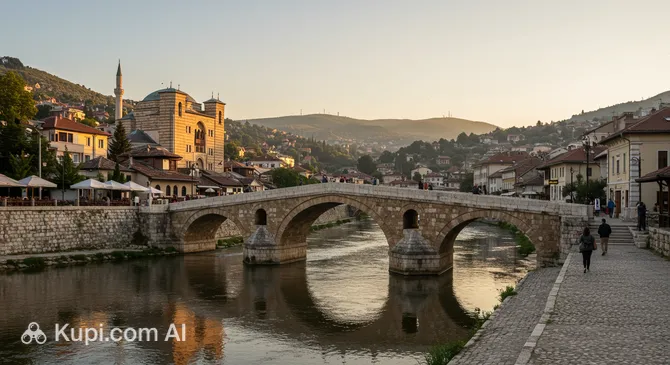
Latin Bridge. Illustration.
Source: Kupi.com AI

Traveler photos:

Built during the Ottoman period, the Latin Bridge is a striking example of the architecture characteristic of that era. Originally, the bridge rested on four powerful pillars and had five arches. However, in the late 19th century, during the reconstruction of the embankment to create a wider riverside area, one of the arches was removed, and four graceful arches remain today. Despite these changes, the bridge has retained its historical charm.

Walking across the Latin Bridge is an opportunity to touch the past, feel the atmosphere of the old city, and enjoy picturesque views of the Miljacka River and its surrounding buildings. This site attracts tourists with its historical significance and photogenic qualities, making it an essential part of any Sarajevo itinerary. The bridge serves as a reminder of the rich cultural heritage of Bosnia and Herzegovina and as an important symbol of the city.

Contacts

The Latin Bridge is a public historical landmark, so it does not have a dedicated administration or direct contact details for visitors. For up-to-date tourist information about Sarajevo and its iconic sites, including the Latin Bridge, you can contact the City Tourist Information Center. Useful information is also often available on the official tourism portal of Sarajevo.

How to contactContact
AddressObala Kulina bana 71000, Sarajevo 71000, Bosnia and Herzegovina

What to Do

Visiting the Latin Bridge is primarily an opportunity to connect with the history of Sarajevo and enjoy its unique atmosphere. While walking across this ancient stone structure, you can admire picturesque views of the Miljacka River and the surrounding historic city center. The bridge itself is not only an important architectural site but also a place that holds the memory of significant past events.

Right at the northern end of the Latin Bridge is a museum with an exhibition dedicated to the history of Sarajevo. Here, you can deepen your knowledge of the city's past and the bridge itself, learning many interesting facts. After an educational tour or just a stroll, it is nice to relax in one of the many cafes or restaurants located nearby. Many of them offer traditional Bosnian cuisine, which will be a great addition to your experience.

Furthermore, the Latin Bridge serves as an excellent starting point for further exploration of Sarajevo's historic heart. It is a convenient base for walking tours, discovering narrow streets, ancient buildings, and other landmarks that this incredible city is so rich in.

Getting There

The Latin Bridge is conveniently located in the heart of Sarajevo, making it easily accessible for tourists. If you are staying in the central part of the city, you can likely walk to the bridge while enjoying the views of the capital of Bosnia and Herzegovina. The bridge is situated at the intersection of Obala Kulina Bana and Zelenih Beretki streets and is easy to find while strolling through the historic center.

For those who prefer public transport, Sarajevo offers an extensive network of trams, buses, and trolleybuses. Many routes pass through the city center, and the nearest public transport stops are just a few minutes' walk from the Latin Bridge. This is a convenient and cost-effective way to reach the landmark from more distant areas of the city.

Another comfortable option is to use a taxi. Taxis in Sarajevo are widely available, and the ride to the Latin Bridge from most points in the city will not take long. This is especially convenient if you are short on time or traveling with luggage.

If you are traveling by car, keep in mind that traffic and parking options in central Sarajevo can be limited. It is recommended to leave your car in one of the public parking lots located a bit further away and then take a pleasant walk to the Latin Bridge. This way, you will avoid the hassle of searching for a parking spot and can better experience the city's atmosphere.

Nearest city: Sarajevo

History & Facts

The history of the Latin Bridge dates back to the 16th century, making it one of the oldest surviving bridges in Sarajevo. According to chronicle sources of the Bosnian Sanjak from 1541, a crossing already existed at this site, built by the tanner Husein, son of Sirmerd. It was likely a wooden bridge. However, by 1565, thanks to the efforts of a prominent citizen, Ali Ajni-beg, a stone bridge was built here, becoming an important part of the city's infrastructure.

Over its long history, the Latin Bridge has been rebuilt and reconstructed several times. It was the third stone bridge built in Sarajevo. One major test came on November 15, 1791, when a severe flood caused significant damage. The restoration was funded by a Sarajevo merchant, Hadji Abdullah Briga, which saved the bridge. Later, in the late 19th century, during work on the Miljacka River embankment, one of the original five arches was removed, giving the bridge its modern four-arch appearance.

However, the Latin Bridge gained worldwide fame due to the significant events of the 20th century. It was here, at the northern end of the bridge, on June 28, 1914, that the Serbian student Gavrilo Princip carried out the assassination of the Austro-Hungarian Archduke Franz Ferdinand and his wife Sophie. This event became the formal catalyst for the start of World War I, forever etching the Latin Bridge into the pages of world history. In memory of this incident, the bridge was renamed Princip Bridge for a time. Later, its historical name — the Latin Bridge — was restored, and it is still known by this name today, attracting tourists with its rich history and symbolic significance.

Time Needed

When planning a visit to the Latin Bridge in Sarajevo, consider how much time you want to spend at this iconic site and its surroundings. If your goal is simply to see the bridge, walk across it, admire its architecture, and take a few souvenir photos, then you will only need a short amount of time — about 15-30 minutes will be plenty.

However, for a fuller experience, it is recommended to set aside a bit more time. Near the Latin Bridge, there is a museum dedicated to the history of Sarajevo that may be worth a visit. If you want to check out the museum and take a leisurely stroll through the nearby streets to soak up the atmosphere of the old city, plan for 1-2 hours.

For those planning a deeper dive into Sarajevo's historic center, the Latin Bridge can be one of the key points on your route. In this case, to see not only the bridge but also other major landmarks nearby, it is best to schedule half a day. This will allow you to enjoy all the iconic spots of this amazing area without rushing.

Working Hours

The Latin Bridge in Sarajevo is an open public landmark, so access is 24/7 and completely free. You can visit the bridge at any time of the day or night, as it has no entrance gates or ticket offices. No advance booking or registration is required to visit the Latin Bridge.

Since the bridge is always open, you are free to walk across it and enjoy the views. However, to take beautiful photos and fully appreciate the architecture and surrounding scenery, it is recommended to plan your visit for daylight hours. This will allow you to see the details better and enjoy the atmosphere of this historic site.

Open 24 hours

Nearby

A visit to the Latin Bridge is undoubtedly an essential part of any traveler's itinerary in Sarajevo. However, to truly soak up the spirit of this historical site and the entire city, it is worth taking time to explore its immediate surroundings. Just steps away from the famous bridge, there are other interesting sites hidden away, each capable of telling equally fascinating stories.

Exploring nearby attractions will allow you to get a more complete picture of Sarajevo's rich cultural and historical heritage. This is a wonderful opportunity to broaden your horizons, discover new facets of the city, and make your journey even more fulfilling and memorable. Every street and building near the Latin Bridge holds its own secrets and is ready to share them with curious guests.

NameDistance
Emperor's Mosque0.1 km
Gazi Husrev-beg's Bezistan0.2 km
Dveri0.2 km
Gazi Husrev-beg Mosque0.2 km
Sebilj0.3 km
Sacred Heart Cathedral0.3 km
Orthodox Church of the Nativity of the Theotokos0.3 km

Have you reached the end of the page?

So the route has been studied inside and out