Support

Santiago's Plaza de Armas

About

Plaza de Armas, or Weapons Square, is not just a central plaza; it is the very heart of Santiago and the historical cradle of Chile's capital. The history of the city began at this very spot in 1541, when the Spanish conquistador Pedro de Valdivia established the first settlement. The square owes its "martial" name to its past: initially, gunpowder storehouses and military garrisons were located here.

Today, Plaza de Armas is a vibrant and picturesque place where history meets modernity. Here, you can relax in the shade of sprawling palm trees, watch street artists and musicians, and feel the true pulse of the Chilean capital. It is a popular spot for walks and meetings for both tourists and locals alike.
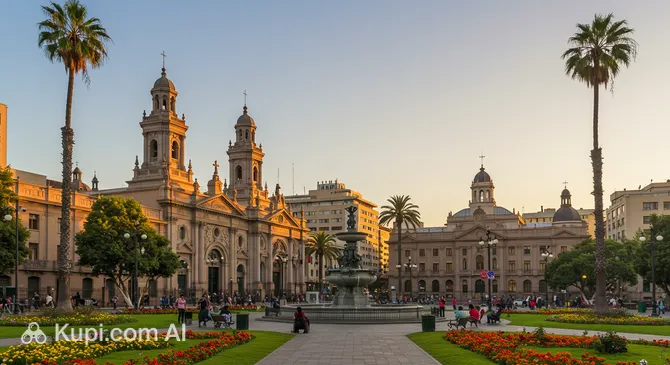
Santiago's Plaza de Armas. Illustration.
Source: Kupi.com AI

Traveler photos:

The square is an impressive architectural ensemble surrounded by iconic colonial-era buildings. Dominating the scene is the majestic Metropolitan Cathedral, which combines Neoclassical and Baroque styles. Nearby are the former Royal Court building, which now houses the National History Museum, the elegant Archbishop's Palace, and the monumental Central Post Office building, which is recognized as a national monument of Chile.

Contacts

Plaza de Armas is a central public square, so it does not have specific contact details such as a phone number or email address. The most convenient way to reach this iconic landmark is by public transport. Right beneath the square is the namesake “Plaza de Armas” metro station, which serves Lines 3 and 5 of the Santiago Metro.

How to contactContact
AddressPl. de Armas, 8320341 Santiago, Región Metropolitana, Chile
Websitewww.munistgo.cl

What to Do

Plaza de Armas offers many activities for travelers wishing to immerse themselves in the atmosphere of Santiago's historic center. It is an excellent place for leisurely walks: you can relax in the picturesque garden designed in 1896 by French landscape architect Guillermo Renner. By observing the daily city life, street performers, and locals, you will feel the true rhythm of the Chilean capital.

The main value of the square lies in its architectural surroundings. Visitors can view and visit several iconic buildings, each with its own story. Highlights include the Metropolitan Cathedral (1799), the National History Museum located in the former Royal Audience building, and the majestic Archbishop's Palace (1852). It is also worth noting the historic Edwards commercial building with its unique wrought-iron work from France and the central post office building, which is a national monument of Chile.

Furthermore, Plaza de Armas serves as the perfect starting point for further exploration of the city's historic center. It is a convenient place to begin a walk through the streets planned on a grid system by architect Pedro de Gamboa, discovering other hidden corners and attractions of the capital.

Getting There

Reaching Plaza de Armas, the central point of Santiago, is easy thanks to its location in the heart of the city and excellent transport accessibility. The fastest and most convenient way is the metro. Directly under the square is the “Plaza de Armas” station, which is a major interchange hub for Lines 3 and 5. Upon exiting the metro, you will find yourself right in the center of the historical part of the capital of Chile.

In addition to the metro, numerous city bus routes lead to the square. Public transport stops are located in the immediate vicinity of Plaza de Armas, making it easy to get here from various parts of the city. You can also always use taxi services or popular ride-sharing apps. This is especially convenient for trips from more distant areas, though it is worth remembering that traffic jams are possible in central Santiago during peak hours.

If you are staying downtown or exploring other nearby attractions, walking is a wonderful option. Plaza de Armas is within walking distance of iconic sites such as Santa Lucía Hill, La Moneda Presidential Palace, and the Central Market. A stroll through the colorful streets of the historic district will allow you to fully enjoy the atmosphere of the Chilean capital.

Nearest city: Santiago

History & Facts

The history of Plaza de Armas is inextricably linked to the founding of Santiago itself. In 1541, by order of the Spanish conquistador Pedro de Valdivia, a gunpowder storehouse was established on this site, serving as the starting point for the construction of the future city. The design of the new capital was entrusted to architect Pedro de Gamboa, who laid it out according to the famous chessboard grid principle. Plaza de Armas became the central element of this plan, surrounded by the key buildings of that era: the governor's house, the cathedral, and the prison.

The young city and its central square survived many harsh trials. Just a few months after its founding, on September 11, 1541, Santiago was almost completely devastated during a local uprising while Valdivia was away. In the following decades, the square and its buildings suffered from massive earthquakes in 1575 and 1647, a smallpox epidemic in 1590, and destructive floods caused by the Mapocho River overflowing in 1608 and 1618. Despite all these disasters, Plaza de Armas always remained the center of urban life and was rebuilt alongside Santiago.

Over time, the square was transformed, reflecting the growth and development of the capital. In 1826, Plaza de Armas officially received the status of the city's main square. It began to take on its modern, more picturesque appearance in 1896, when the famous French landscape architect Guillermo Renner designed a shaded garden here with palm trees and winding paths, which still serves as a favorite resting spot for locals and tourists today. Thus, having passed through centuries of trials, the former military parade ground has turned into the green and vibrant heart of modern Santiago.

Time Needed

For a general introduction to the atmosphere of Plaza de Armas and its architectural ensemble, 1–2 hours is sufficient. This is enough time to leisurely stroll along the shaded paths of the central square, watch street artists and musicians, and take memorable photos against the backdrop of historical buildings. You can fully feel the lively rhythm of Santiago's heart simply by relaxing on one of the benches and people-watching.

If you plan a deeper dive into history and culture, you should set aside at least half a day to visit the square. Most of your time will be spent touring the iconic buildings located around its perimeter. For example, a visit to the majestic Metropolitan Cathedral takes about an hour, and exploring the rich exhibits of the National History Museum, which tells the story of Chile, will require another 2–3 hours. Thus, the duration of your visit depends directly on your desire to explore not only the square itself but also its cultural treasures.

Working Hours

Plaza de Armas in Santiago is a central public square, so it is open 24 hours a day, year-round. No tickets or advance reservations are required to visit the square itself—you can come here at any time that suits you to stroll, rest on a bench, or simply enjoy the atmosphere of the city's historical heart. This makes it accessible for a visit on any day of your journey through the capital of Chile.

However, it is important to remember that the attractions located around the square's perimeter, including the Metropolitan Cathedral, the National History Museum, and other institutions, have their own specific opening hours. Their schedules may change depending on the season, the day of the week, or special events. Before heading out to tour these iconic sites, it is highly recommended to check the latest information on opening times and any booking requirements on their official websites or at Santiago tourist centers.

Open 24 hours

Nearby

A visit to Plaza de Armas is just the beginning of your journey into the rich history and culture of Santiago. Thanks to its central location, the square serves as an ideal starting point for exploring other iconic landmarks of the capital of Chile. Many of them are within walking distance, making it easy to create a full and interesting itinerary for the entire day.

A stroll around the square's surroundings will allow you to dive deeper into the city's atmosphere. Just steps away from the historic center, you will find bustling markets, majestic palaces, and modern cultural centers. Exploring these sites will enrich your experience and show Santiago from different angles, from the daily life of its residents to the heights of its cultural heritage.

NameDistance
Amistar Apart Hotel0.5 km
Neptune Fountain0.7 km
National Museum of Fine Arts0.7 km
Gabriela Mistral Cultural Centre1 km
Club Ámbar1.3 km
Cousiño Palace1.7 km
National Zoo of Chile1.7 km

Have you reached the end of the page?

So the route has been studied inside and out