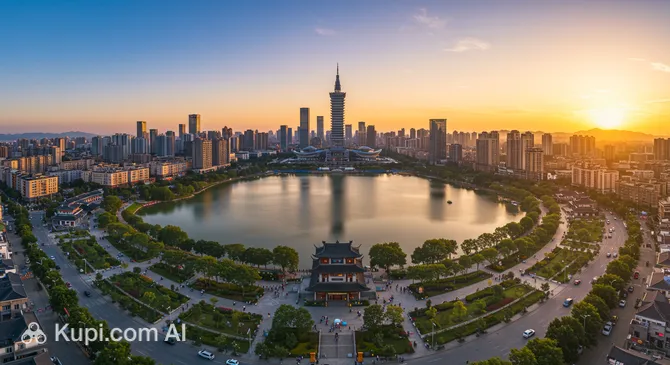
Jieyang is a dynamic prefecture-level city located in Guangdong Province in southern China. The city is not your typical postcard tourist destination, but it possesses a unique "water town" atmosphere characteristic of South China. Its appearance is defined by numerous canals, ponds, and ancient bridges nestled amidst the greenery of majestic banyan trees and bamboo groves. As part of an important metropolitan area in eastern Guangdong, Jieyang harmoniously combines the energy of a modern industrial hub with the tranquility of traditional residential neighborhoods.
Jieyang. Illustration.
Source: Kupi.com AI
Geographically, the city is situated in a lowland, just eight meters above sea level, which has historically shaped its close connection to water resources. According to 2020 census data, the prefecture-level city has a population of approximately 5.58 million people. Despite its scale, Jieyang retains a local charm: there is no metropolitan hustle and bustle, and life flows at the measured pace typical of the Chaoshan region. Jieyang's rich history can be traced in the layout of its old districts, such as Rongcheng, where traditional buildings have been preserved.
For the traveler, this city is interesting primarily as an authentic place where you can see the real China without the tourist gloss. Walking along the embankments, visiting local temples, and getting acquainted with the traditional way of life make a trip here both educational and profound. We invite you to discover this cozy corner of Guangdong Province, which will serve as an excellent starting point for exploring the country's entire eastern coast.
Weather Overview
Jieyang is dominated by a humid subtropical climate, which determines the character of the weather throughout the year. Summers here are long, hot, and very humid. Between May and September, average air temperatures often exceed 28-30°C, and frequent monsoon downpours bring temporary relief from the heat. It is worth noting that during this time of year, the region can be influenced by typhoons.
Winters in the city are mild and relatively dry, making this period the most comfortable for excursions. For example, in January, the average temperature is about 14.8°C, rarely dropping below 10°C. Expect warm summers with occasional intense rain and pleasant, cool winters, when warm clothing may only be needed in the evening. You can study the weather in Jieyang by month in more detail in special climate reports.
High air humidity is a characteristic feature of the local climate, which is especially noticeable during the "rainy season" in early summer. For travelers, this means always needing to carry an umbrella and choosing clothing made of light, natural materials. Despite the heat, the city's embankments and abundance of greenery help make the summer heat more tolerable, creating pleasant conditions for evening walks by the water.
Average monthly temperature
Average monthly precipitation
Interesting Facts
Jieyang is a place full of surprising details that reveal its character as an important yet hidden gem of Guangdong Province, away from mass tourism. Here are a few facts to help you get to know this city better:
Jieyang is not just one city, but a vast prefecture-level city covering an area of about 5,265 km², including the Rongcheng district, the city of Puning, and several counties.
The prefecture's population is comparable to that of some European countries, exceeding 5.5 million people, though figures may vary depending on how the metropolitan area is measured.
The city is located in a lowland at an altitude of only 8 meters above sea level, which is why the system of city canals and drains plays a critically important role in daily life.
The city has its own unique digital "passports": the telephone area code is +86 663, the postal code is 522000, and the license plate letter code is 粤V.
Despite its industrial significance, Jieyang maintains a reputation as a "water city," where bamboo groves and ancient banyan trees are an integral part of the urban landscape.
How to Get There
Jieyang's transport accessibility is due to its strategic position within the densely populated metropolitan area of eastern Guangdong. The city is closely linked to neighboring hubs, and travelers often choose combined routes, considering ways to get to Jieyang via the transport networks of Shantou or Chaozhou. This allows for flexible trip planning, taking full advantage of regional logistics.
If you plan to arrive by air, the main point of entry is the international airport serving several cities in the region. It provides convenient connections to China's largest metropolises and some international destinations. From the airport, central districts of the city can be reached by special shuttles, taxis, or pre-booked transfers.
Railway communication also plays an important role in the life of the prefecture. One of the key points is the Chaoyang (Guangdong) Railway Station (IATA: AZQ), located about 19 kilometers from the city. The station serves trains connecting the region with other parts of the province, making rail travel a convenient and budget-friendly option for tourists.
Bus services and taxi services are also well-developed within the metropolitan area. However, keep in mind heavy traffic during peak hours, so it is always recommended to allow extra time when planning travel between districts or to the airport, especially if your route passes through central shopping zones.
Main Attractions
The attractions of Jieyang are primarily local in character and are inextricably linked to the element of water and the region's historical heritage. One of the most noteworthy areas is the "ancient city," where the landscape is formed by narrow canals, elegant bridges spanning them, and centuries-old banyan trees. This is an ideal place for those who want to feel the spirit of old South China and enjoy the silence away from noisy highways.
Special attention should be paid to the Rongcheng district, which is considered the historical heart of the city. The most interesting architectural objects are concentrated here, including ancient temple complexes and traditional residential houses with decorative elements characteristic of Guangdong Province. Walking areas along the rivers and canals are popular with both locals and the city's infrequent guests, offering picturesque views, especially during sunset hours.
In addition to historical quarters, tourists should visit Jieyang's modern public spaces and embankments. The city landscape is actively developing, offering new recreational areas with wide alleys and well-maintained parks. Although the city is often perceived as part of a larger itinerary through eastern Guangdong, its own cozy corners and authentic shopping streets deserve time for leisurely exploration.
Local Cuisine
Jieyang's culinary traditions are inextricably linked to Chaoshan cuisine, which is famous for its reverence for the freshness of ingredients. It is not customary here to overuse spices that hide natural flavors; on the contrary, chefs strive to emphasize the quality of the ingredients. The menu is based on seafood, light and clear broths, and various rice and noodle dishes. Be sure to try the delicate steamed snacks, similar to dim sum, which are prepared here with special skill.
The city's gastronomic scene is best revealed in small family-run establishments and at local markets. Jieyang is famous for its handmade meat and fish balls, as well as soy sauce-braised dishes with aromatic herbs. Tea culture here is elevated to a cult: "Gongfu tea" (the art of tea drinking) is an essential part of daily life, and you will surely see locals slowly drinking tea from tiny cups right on the street or in shops.
For street food lovers, the city offers an endless variety of snacks: from fried rice cakes to exotic desserts with moderate sweetness. In the evening, it's worth heading to specialized seafood restaurants where fish and crustaceans are chosen alive right from aquariums. This approach guarantees exceptional taste and allows you to experience the true character of a southern Chinese meal.
Travel Tips
Planning a trip to Jieyang requires considering some regional specifics that will make your visit as comfortable as possible. Here are a few tips from experienced travelers to help you settle into this southern prefecture-level city:
Clothing and gear: Due to high humidity and heat in the summer, choose clothing made from natural, breathable fabrics. Be sure to bring an umbrella—downpours in Guangdong can start suddenly. There is no special dress code for visiting temples, but it is better to cover your shoulders and knees out of respect for tradition.
Transport: For moving around the city, it is most convenient to use taxis or the Didi app. Public transport can be overcrowded, and navigating buses can be difficult for a foreigner.
Finances: In China, payments are made almost everywhere via Alipay or WeChat Pay. Ensure your cards are linked to these apps in advance. Cash is accepted, but change can be hard to find. A tipping culture does not exist here.
Health and Safety: The city is safe, but be careful on the roads—traffic can seem chaotic. Drink only bottled water and always have hand sanitizer with you.
Communication: English is not widely spoken in Jieyang. Be sure to download an offline translator and save your hotel address in Chinese (characters) for taxi drivers.
Local Etiquette: Residents of the Chaoshan region are very hospitable. A greeting with a slight bow or a nod is appropriate. Don't be surprised if you are invited for tea—it is an important part of local etiquette.
What to avoid: Try not to plan major moves during peak hours and do not engage in arguments on political topics. Respect the silence in residential quarters and temples.
Extra Tip: Try the local Dancong tea—it is the region's hallmark and makes an excellent gift.
Jieyang will reveal itself to you as a friendly and authentic city if you show a little patience with the language barrier and are ready to immerse yourself in real Chinese daily life. Have a pleasant journey!
Entertainment & Nightlife
Jieyang's entertainment scene is primarily oriented toward locals, making it ideal for a deep immersion into the region's everyday culture. You won't find noisy mega-clubs here, but you can enjoy the cozy atmosphere of traditional tea houses and local restaurants. The city's evening life is concentrated in the central commercial blocks of the Rongcheng district, where lights come on after sunset and numerous karaoke (KTV) venues—a favorite leisure format in China—open their doors.
Night markets and walking streets hold a special charm. Here, you can not only shop but also observe city life: families out for a stroll and young people gathering in small bars or cafes. Safety at night is high, typical of large Chinese cities, but keep in mind that public transport finishes early, and it is better to use taxi services for getting around.
Daytime entertainment includes walking through city parks and relaxing by the water. For those seeking large-scale spectacles, theaters, or major concert venues, Jieyang residents often suggest heading to neighboring metropolitan centers such as Shantou. Nevertheless, Jieyang itself offers calm and measured leisure that allows you to take a break from the hustle and bustle of large megacities surrounded by traditional southern Chinese architecture.
Parks & Museums
Jieyang's natural landscape is largely defined by its proximity to water. City parks here are not just green zones, but harmonious spaces where canals and ponds neighbor thick bamboo groves. One of the characteristic features of local landscaping is the old banyan trees, whose spreading canopies create pleasant shade even on the hottest afternoon. A walk along the city's embankments will allow you to see how the traditional Chinese love for garden art is embodied in the modern urban environment.
The museum life of the prefecture, while not claiming world-class scale, offers a deep immersion into the local history and ethnography of the Chaoshan region. Local exhibition halls are often dedicated to traditional crafts, the history of river shipping development, and the daily life of Guangdong Province residents. For tourists, such places are valuable primarily for their intimacy and the opportunity to see rare artifacts telling the story of city life in past centuries.
In addition to official museums, historical quarters and restored temples often serve as cultural venues. Here, the architecture itself is an exhibit. We recommend combining visits to green zones with sightseeing of local historical monuments—this is the best way to feel the rhythm of Jieyang, where nature and urban culture have coexisted in close intertwining for centuries.
Getting Around
Public transport in Jieyang is represented by an extensive network of bus routes that connect the central Rongcheng district with remote counties and industrial zones of the prefecture. This is the main way for locals to get around, allowing them to reach any point in the metropolitan area. Buses run regularly, but tourists should keep in mind that route information is most often presented only in Chinese, so it is useful to have a map on your smartphone.
For maximum comfort and speed when traveling around the city, we recommend using taxis or popular ride-hailing services. In Jieyang, this is affordable and reliable transport that will save you from having to navigate the complexities of bus lines. Taxis can be caught right on the street or called via a mobile app. Keep in mind that during peak hours and heavy rain, road congestion increases, and travel time can significantly lengthen.
Bus fares are usually paid in cash (no change given) or via mobile payment systems. If you plan to travel a lot within the Chaoshan metropolitan area, it is worth arranging access to Chinese payment services in advance. For short walks through the historical center, transport may not be necessary at all—the narrow streets and embankments of Jieyang are best explored on foot, enjoying the local flavor at a leisurely pace.
Accommodation
Jieyang's accommodation stock is primarily geared toward business travelers and regional residents, so modern mid-range city hotels and apartments predominate. You won't find an abundance of beach resorts here, but the choice of quality hotels with a good level of service is quite wide. Most large hotels are located in the Rongcheng district, which is convenient for access to commercial centers and transport hubs.
For those planning a long stay, serviced apartments or flats in new residential quarters are an excellent option. This allows you to feel like a local and is often cheaper than a standard hotel room. Budget travelers should look for small guesthouses near shopping streets, though the staff's English proficiency there may be minimal.
When choosing a place to stay, it is recommended to focus on proximity to major transport arteries and embankments. It is better to book accommodation in Jieyang in advance, especially if your trip coincides with Chinese public holidays, when domestic tourism surges. Major online booking systems offer a wide range of options, from economy class to executive suites in high-rise buildings with city views.
Nearby Cities
Thanks to its location in the heart of a densely populated region, Jieyang serves as an excellent starting point for exploring neighboring cultural centers. Just a few dozen kilometers away are cities that complete the picture of life in eastern Guangdong and offer unique historical attractions.
One of the most popular day-trip destinations is Chaozhou, located just 28 kilometers away. This ancient city is famous for its temples, old city walls, and the Guangji Bridge. It is also worth visiting Shantou—a major port center where you can enjoy colonial architecture and walks along the embankment. For those interested in trade and modern urban life, a trip to Puning will be of interest.
The region around Jieyang is permeated with a network of roads and railways, making exploration of the surroundings easy and pleasant. We recommend not limiting yourself to just one city but creating a route through the entire Jieyang—Chaozhou—Shantou cluster to fully appreciate the hospitality and cultural richness of this part of China.
Shopping & Souvenirs
Shopping in Jieyang is primarily an introduction to locally produced goods and the everyday market way of life. You won't find an abundance of luxury boutiques here, but the city more than compensates for this with colorful shopping streets and modern shopping centers in the Rongcheng district. Main shopping zones are concentrated in high-density areas, where electronics stores sit alongside traditional medicine and clothing shops.
If you are looking for something unique, pay attention to regional food products. As souvenirs from Jieyang, travelers often bring back the famous local tea, packaged traditional sweets, and dried seafood, which are the pride of Chaoshan cuisine. You can also find quality bamboo products and folk art items reflecting the cultural code of southern China.
The city's markets deserve a separate mention—these are noisy, lively places where you can buy almost everything: from the freshest fruit to household trifles. Shops usually operate from early morning until late evening, seven days a week. For payment in large centers, cards and international systems are accepted, but for purchases at markets and small shops, you will definitely need mobile applications (Alipay or WeChat Pay), which are the standard in modern China.