Support

Tianshui

About

Tianshui is an ancient city with a rich history, located in Gansu Province in northwestern China. With a population of about 3.36 million people, this city played an important role on the Great Silk Road and today attracts travelers with its unique atmosphere and cultural heritage.

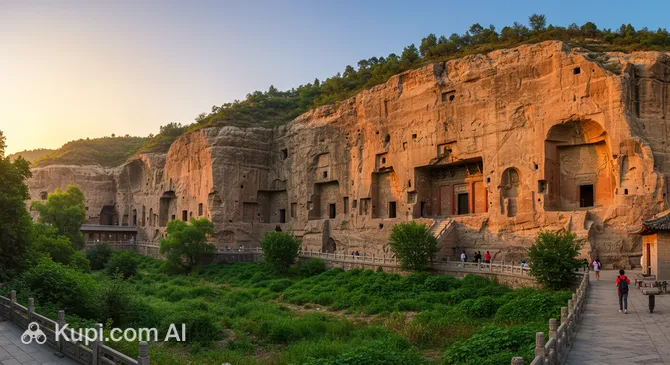
Tianshui. Illustration.
Source: Kupi.com AI

One of the main jewels of Tianshui is the famous Maijishan Grottoes — an impressive complex of Buddhist cave temples carved into a sheer cliff, housing thousands of clay sculptures and frescoes. No less significant is the Fuxi Temple, dedicated to the legendary ancestor of the Chinese nation. The city also takes pride in its past as an important ancient trade and cultural center that flourished thanks to its strategic position.

A visit to Tianshui is an opportunity to touch a thousand-year-old history, see amazing works of art, and feel the spirit of ancient civilizations. This city will undoubtedly leave a vivid impression on everyone interested in the culture and history of the East.

You can find more interesting facts on the Tianshui history page.

Weather Overview

When planning a trip to Tianshui, it is worth considering its continental climate with clearly defined seasons. Summer, especially in July, is warm: the average temperature stays around 22.0°C, while maximum values can reach 26.6°C. The summer months (July-August) see the highest amount of precipitation for the year (about 4 mm), with roughly 13 rainy days per month. Winters in Tianshui, by contrast, are cold and dry. In January, the average temperature drops to -2.2°C, and night frosts can reach -6.5°C, with almost no precipitation (0 mm).

Spring and autumn are comfortable transitional periods with moderate temperatures and light rainfall. Overall, expect warm summers with occasional rain and cold, dry winters. To better plan your trip according to weather conditions, we recommend checking the detailed information on the Tianshui Climate page.

Average monthly temperature

Average monthly precipitation

Interesting Facts

Beyond its majestic temples and caves, Tianshui hides many amazing stories and features that make it truly unique. Here are just a few lesser-known facts about this ancient city:

  • The name of the city, Tianshui, literally translates as "Heavenly Water." According to legend, it appeared during the Han Dynasty after a miraculous rain that ended a long drought and filled a spring that still exists today, known as Tianjingquan (Heavenly Well Spring).

  • Many know about the Terracotta Army of the first emperor Qin Shi Huang, but not everyone is aware that the lands of modern-day Tianshui were the heart of the ancient Qin State — the state that eventually unified China and began the first empire. It is believed that one of the early capitals of Qin was located in this very region.

  • The famous sculptures in the Maijishan Grottoes, one of Tianshui's main attractions, are not carved entirely from stone, as is often the case in such complexes. Most of them are made of clay applied over wooden or stone frames — a unique ancient technique that allowed the masters to achieve incredible expressiveness and detail in the figures.

  • Although Gansu Province, where Tianshui is located, is known for its predominantly arid climate, the city itself is often called "Little Jiangnan" (Xiao Jiangnan). Tianshui earned this flattering nickname due to its relatively mild and humid microclimate and fertile lands, reminiscent of the lush nature and bountiful harvests of the southern region of China known as Jiangnan.

How to Get There

There are several ways to get to Tianshui, but it is worth noting that the city does not have its own major international airport. Travelers from abroad will most likely need to fly into one of China's main transport hubs first, such as Beijing, Shanghai, or Xi'an, and then use domestic flights or rail connections to the cities nearest to Tianshui. After arriving at one of the regional transport hubs, you can reach Tianshui by bus or taxi.

By Air:

While Tianshui does not have its own airport, several regional airports are located some distance away. The nearest is Longnan Chengxian (LNL), located in the city of Longnan, approximately 88 km from Tianshui. This is a small airport, and a taxi ride from it to the center of Tianshui will take roughly 2 hours 30 minutes. Another option is Guyuan Liupanshan Airport (GYU) in Guyuan, which is about 172 km away. This is a medium-sized airport, and the journey to Tianshui from here takes about 4 hours 40 minutes by car. You can also consider Qingyang Airport (IQN), located in Qingyang, approximately 218 km from Tianshui. This is a fairly busy regional airport, and the trip to Tianshui will take about 5 hours 45 minutes.

For convenience, here is summary information for the main airports serving the Tianshui area:

AirportPassenger trafficDistance
Longnan Chengxian338 65888 km
Guyuan Liupanshan Airport144 785172 km
Hanzhong Airport409 731211 km
Qingyang Airport570 000218 km
Guangyuan Airport573 302243 km

By Rail:

Tianshui has its own railway stations, but for some routes, larger hub stations in neighboring cities may be more convenient. For example, you can consider arriving at the railway stations in Lanzhou. Lanzhou West Station (LZX) is located about 244 km from Tianshui, and Lanzhou Railway Station (LZD) is about 235 km away. Both stations are very large transport hubs. A car journey from these stations to Tianshui takes over 6 hours, but other local transport options are also available. It is recommended to check for direct trains to Tianshui itself, as this will be the most convenient option.

Summary information for some regional railway stations:

StationPassenger trafficDistance
Longnan Railway Station1151 km
Nianlipu Railway Station1159 km
Yuzhong railway station4200 km
Hanzhong Railway Station3204 km
Qingyang railway station3213 km

Additionally, Tianshui is connected to other cities in Gansu Province and China by a network of highways. Traveling by bus or car is also a viable option, especially for moving within the region.

Main Attractions

Tianshui, a city with a wealth of history, opens up an amazing world of ancient Chinese culture to travelers. Among its numerous treasures, several iconic sites stand out and should definitely be included in your itinerary to truly experience the spirit of this ancient city.

The main pearl of Tianshui is undoubtedly the Maijishan Grottoes. This majestic complex of Buddhist cave temples, carved into a rock shaped like a wheat stack (hence the name "Wheat Stack Mountain"), houses thousands of exquisite clay sculptures and wall paintings. Created over many centuries, these works of art are striking in their craftsmanship. As one of the four great cave complexes in China, Maijishan leaves a deep impression due to its unique location and the talent of ancient masters.

Another landmark site is the Fuxi Temple, dedicated to Fuxi, the legendary ancestor of the Chinese nation and a cultural hero. Tradition has it that it was in the vicinity of Tianshui that Fuxi developed the famous Eight Trigrams (Bagua), which became the foundation of Chinese philosophy. This vast ancient temple complex, with its traditional architecture, centuries-old trees, and atmosphere of peace, is an important pilgrimage center. Visiting the temple allows for a deeper dive into the origins of Chinese civilization.

For those who appreciate tranquility and picturesque landscapes, Yuquan Temple (Jade Spring Temple) is an excellent choice. This charming Taoist temple complex, nestled on a hillside, is known for its elegant pavilions, ancient cypresses, and, of course, the spring with crystal-clear water that gave it its name. It is an ideal place for leisurely walks, contemplating nature, and learning about Taoist culture.

To gain a more complete understanding of the region's rich historical heritage, it is worth visiting the Tianshui Museum. Its halls contain numerous artifacts telling the story of the city from the Neolithic era, its significant role on the Great Silk Road, and its unique cultural traditions. The museum's exhibits will help organize your impressions from visiting historical monuments and better understand Tianshui's place in the history of China.

Local Cuisine

The cuisine of Tianshui is a vivid reflection of the culinary traditions of Gansu Province, historically enriched by the influence of the Great Silk Road. Local dishes are characterized by their heartiness, use of fresh ingredients, and often spicy notes. Wheat noodles, mutton, and beef, along with a variety of vegetables, form the basis of many recipes. The city's gastronomic scene offers an authentic experience, far from standardized tourist menus.

Be sure to try several iconic dishes in Tianshui. First, there is Tianshui Guagua (天水呱呱) — a unique local snack made from buckwheat or wheat flour, resembling a jelly, served with spicy sauce, sesame paste, vinegar, and garlic. This dish is truly unusual and loved by locals. Another popular dish is Nianpi (酿皮), cold wheat or rice noodles seasoned with various sauces, vegetables, and often gluten. Although the famous Lanzhou Beef Noodles (兰州牛肉面) originate from the provincial capital, excellent variations can also be found in Tianshui, featuring fragrant broth and freshly made noodles.

Regarding drinks in Tianshui, as in all of China, tea is widespread. Sanpaotai (三泡台) tea is particularly popular in Gansu Province — it is a blend of green tea with dates, goji berries, raisins, chrysanthemum, and rock sugar, possessing a pleasant taste and healthy properties. For alcoholic beverages, you can find local beer and, of course, traditional Chinese baijiu (白酒) of various strengths. Non-alcoholic drinks are represented by a variety of fruit juices and carbonated water.

The dining culture in Tianshui is very democratic. Locals and tourists alike enjoy eating at small family-run eateries and bustling street stalls, where you can try the freshest local delicacies at affordable prices, as well as at more respectable restaurants offering a wide selection of regional cuisine. Markets are also excellent places to discover local products and simple but tasty food. It is in such authentic places that you can truly experience the gastronomic flavor of Tianshui.

Travel Tips

Planning a trip to Tianshui, an amazing city with a rich history in China? To ensure your journey goes smoothly and leaves only pleasant memories, we have prepared some practical tips. They will help you better navigate and enjoy every moment in this unique place!

  1. Clothing and Essentials by Season:

    The climate in Tianshui is moderate continental. In summer (June-August), it is quite hot, so choose light clothing and don't forget sunscreen and a hat. Winters (December-February) are cold and dry — stock up on warm clothes, including a hat, gloves, and a scarf. Spring (April-May) and autumn (September-October) are perhaps the best times to visit, with comfortable temperatures; layered clothing will be useful here. Be sure to bring comfortable shoes, as you will be doing a lot of walking, especially if you plan to visit the famous Maijishan Grottoes. Don't forget a universal adapter for electronics (China uses plug types A, C, and I). When visiting temples and the Maijishan Grottoes, choose modest clothing that covers your shoulders and knees.

  2. Getting Around the City:

    The main form of public transport in Tianshui is buses — they are an affordable way to reach most areas. Routes may be listed in Chinese, so it's helpful to have a translation app or ask hotel staff for the required bus number in advance. Taxis are also widely available and relatively inexpensive. Ensure the driver turns on the meter or agree on a price in advance for long trips. Popular Chinese ride-hailing apps like DiDi may require a local SIM card and a Chinese bank account to work fully. Car rental is generally not recommended for tourists due to the requirement for a Chinese driver's license and the complexities of local traffic rules.

  3. Financial Matters:

    The local currency is the Chinese Yuan (CNY), also known as Renminbi. You can exchange currency at bank branches (passport required) or at some large hotels. UnionPay cards are accepted almost everywhere. Visa, Mastercard, and other international systems may be accepted in major hotels and some tourist-oriented shops, but do not rely on them entirely, especially in smaller establishments. Mobile payments (Alipay, WeChat Pay) are the dominant payment method in China. If you can set up one of these services (sometimes possible by linking international cards), it will greatly simplify transactions. ATMs exist, but not all accept international cards; look for those with your payment system's logos. Tipping in China, including Tianshui, is not a common practice and is not expected.

  4. Health and Safety:

    Pharmacies (药店 - yàodiàn) are easy to find and are usually marked with a green cross. Basic medicines are available, but if you require specific medications, it's better to bring a sufficient supply and a doctor's prescription. Not all pharmacies are open 24/7. There are hospitals in the city providing medical care. It is highly recommended to take out comprehensive travel medical insurance before your trip. Tianshui is considered a fairly safe city. However, as in any tourist destination, follow standard precautions: watch your belongings in crowded places and on public transport, and do not leave valuables unattended. Drinking tap water is not recommended; buy bottled water.

  5. Language and Communication:

    The official language is Chinese (Mandarin). In Tianshui, as in many cities in China outside the largest metropolises, the level of English proficiency among the local population is low. Staff in tourist-class hotels may speak English, but this is rare in shops, restaurants, and on the street. Learn a few basic phrases: "你好" (Nǐ hǎo – Hello), "谢谢" (Xièxiè – Thank you), "多少钱?" (Duōshao qián? – How much?). You can buy a local SIM card at mobile carrier stores (passport required) for mobile internet. Wi-Fi is available in most hotels and many cafes. Note that some Western websites and services may be inaccessible without a VPN. Download an offline translator and maps (e.g., Amap/Gaode Maps or Baidu Maps, which work better in China than Google Maps).

  6. Local Etiquette and Traditions:

    A slight nod of the head is sufficient for a greeting; handshakes are also common, especially in business settings. Try not to speak too loudly in public places. When visiting temples or local homes, be prepared to remove your shoes if required. The concept of "saving face" (面子 - miànzi) is very important in Chinese culture; avoid direct confrontation or actions that might embarrass someone. Receive and give business cards, gifts, or other items with two hands — it's a sign of respect.

  7. What to Avoid:

    It is strictly not recommended to initiate or actively participate in discussions on sensitive political topics. Do not leave chopsticks sticking vertically into a bowl of rice, as this is associated with funeral rituals and is considered a bad omen. Try not to point at people or objects with one finger; instead, use an open palm.

  8. Special Tip for Tianshui:

    Tianshui is, above all, the gateway to the amazing Maijishan Grottoes (麦积山石窟). Be sure to set aside enough time for your visit — it is truly an unforgettable experience and one of the main jewels of the Silk Road. Keep in mind that exploring the complex requires physical effort. Also, don't miss the chance to try the local cuisine of Gansu Province. In Tianshui, look out for authentic snacks like "guagua" (呱呱) — a spicy jelly made from bean or grain flour — and various types of local noodles.

We hope these tips make your stay in Tianshui even more comfortable and fulfilling. This city is full of discoveries, and we are sure it will charm you with its ancient culture, picturesque landscapes, and the hospitality of its residents. Have an unforgettable trip!

Entertainment & Nightlife

When the sun sets over the historic city of Tianshui, life here does not stand still. Although this city in Gansu Province is better known for its ancient landmarks, it also offers various opportunities for evening and night leisure, allowing tourists to relax and have fun after a busy day of sightseeing.

The nightlife in Tianshui may not be as bustling as in China's megacities, but it has its own cozy local flavor. The main focus here is on more relaxed and socially-oriented entertainment. A popular choice is karaoke bars (KTV) — a favorite pastime for both locals and visitors. You can drop by one of the many establishments, such as a local club like "Yinzuo KTV" (银座KTV), where you can rent a private room and have fun with friends. For a more laid-back evening, local bars are suitable; for instance, a place in the style of "Qinchuan Pijiuwu" (秦川啤酒屋 / Qinchuan Brewpub) might offer a good selection of local beers and traditional snacks in a casual atmosphere. The city also has restaurants open late, ideal for a leisurely dinner. While large nightclubs with international DJs are rare here, you can find venues with dance music oriented toward young people. In the evening, some streets also come alive, turning into night markets, especially in the pedestrian street areas like Jiefang Lu (解放路) or near shopping malls, where you can try aromatic "chuan'er" (串儿) skewers and other street delicacies.

Most evening activity is usually concentrated in Tianshui's central commercial districts, for example, along busy shopping streets like Qinzhou Lu (秦州路) or the aforementioned Jiefang Lu (解放路), as well as near major hotels. The atmosphere in most places is quite casual and friendly. There is usually no specific dress code — neat casual style is quite appropriate. Most bars and KTVs start coming to life towards the evening, around 20:00-21:00, and operate until late at night, with some staying open until early morning, especially on weekends.

In terms of practical advice, the optimal time to visit nightlife venues is after 21:00. Prices in bars and KTVs in Tianshui are generally more moderate compared to larger cities in China. To get around the city at night, taxis are the most convenient option. It is recommended to ensure the driver has turned on the meter or to agree on the fare in advance, especially for longer distances. You can also use popular ride-hailing apps if you have access to them. Tianshui is generally considered a safe city, but it is always worth taking standard precautions: keep an eye on your belongings and avoid poorly lit or deserted areas late at night.

During the day, Tianshui also offers various cultural activities. You can visit local museums to dive deeper into the region's rich history or stroll through city parks, enjoying nature and observing the daily lives of residents. There may also be theaters in the city offering productions that reflect local culture, though these will likely be oriented primarily toward a Chinese-speaking audience.

Overall, evening in Tianshui offers a pleasant conclusion to a day filled with exploring ancient sites. It is a wonderful opportunity to see another, more modern and relaxed side of the city and to interact with locals in an informal setting.

Parks & Museums

Tianshui, an ancient city on the Silk Road, offers its guests not only a deep dive into history but also the opportunity to enjoy the peaceful beauty of nature and engage with a rich cultural heritage through its parks and museums. Here, everyone will find something for the soul: from the shady alleys of city gardens to priceless artifacts that preserve the memory of centuries.

For those seeking outdoor recreation, Tianshui offers several wonderful green zones. One of the main natural assets is the area around the famous Maijishan Grottoes, often part of the Maijishan National Forest Park (麦积山国家森林公园). This is not just a gateway to a great monument of Buddhist art, but also a beautiful place for hiking among picturesque mountains covered in dense forests. Here, you can enjoy clean air and magnificent views. In the city itself, for more relaxed leisure and observing the daily life of local residents, Tianshui People's Park (天水人民公园) or similar public gardens are excellent. These are typically oases of greenery with well-maintained paths, pavilions, and often small lakes where citizens practice tai chi or simply rest. A walk along the embankment of the Wei River (Weihe / 渭河), which flows through the city, can also be a pleasant addition to exploring Tianshui.

The cultural heritage of Tianshui is impressive in its diversity, and city museums play a key role in its preservation and display. The primary repository of the region's history is the Tianshui City Museum (天水市博物馆). Here, visitors can see archaeological finds, works of art, and ethnographic exhibits telling the centuries-old history of this land, starting from ancient civilizations. Special attention should be paid to the exhibitions dedicated to the Qin culture and the Silk Road period.

One cannot overlook such iconic sites as the Fuxi Temple (伏羲庙) — a majestic complex dedicated to Fuxi, the legendary ancestor of the Chinese nation. This is not just a temple, but a real open-air museum where you can see ancient steles, carved wooden structures, and learn about the mythology and early history of China. Another important historical and architectural monument is the Yuquan Taoist Temple Complex (玉泉观), located on a picturesque hill. It is famous for its refined architecture, ancient trees, and peaceful atmosphere. Visiting these sites allows for a deeper understanding of Tianshui's spiritual and cultural traditions.

Of course, the crown jewel is the Maijishan Grottoes (麦积山石窟). Although primarily a rock monastery, its significance as an open-air artistic and historical museum cannot be overstated. Thousands of clay sculptures and frescoes created over many centuries represent an invaluable heritage of Buddhist art. Often near such large sites, there are information centers or small exhibition halls that complement the experience.

For more authentic experiences, try visiting local markets, which are often located near parks or temple complexes — there you can not only buy souvenirs but also observe the colorful life of the city. Also, while exploring the surroundings of Tianshui, look for lesser-known but equally charming small temples or historical ruins that can offer unexpected discoveries and quiet moments for reflection.

Getting Around

Getting around Tianshui is quite convenient, and the backbone of the urban transport system is the bus network. Buses cover most areas of the city and are the most economical way to travel. Like many cities in China, Tianshui does not yet have a subway system, so the bus network plays a key role in the daily travel of both locals and tourists.

The fare payment system on Tianshui buses is quite simple. Most often, you can pay with cash directly upon boarding — there is usually a special box next to the driver for this. It is recommended to have small change with you, as drivers generally do not provide change. Mobile payments through popular Chinese apps like Alipay or WeChat Pay are becoming an increasingly common way to pay, if you have access to them. The cost of a single bus trip is usually very low, making this mode of transport very affordable. Specialized tourist passes or cards may not be as common as in large metropolises.

Here are some practical tips for tourists planning to use public transport in Tianshui. Route information and stop names are most often found in Chinese, so it is helpful to have a translation app handy or to plan your route in advance using online maps that support data for China (such as Amap or Baidu Maps). Tickets, when paying with cash, are bought right on the bus. Buses typically start running early in the morning and finish in the evening; it is better to check the exact schedule for specific routes, especially if you plan to travel to more remote areas or tourist sites outside the city.

In addition to buses, other ways of getting around are certainly available in Tianshui. Taxis are a convenient and relatively inexpensive alternative, especially for traveling with luggage, at night, or to places that are not easily reached by bus. Ensure the driver has turned on the meter or agree on the fare in advance if it is a suburban route. Popular Chinese ride-hailing apps (like DiDi) can also be useful, but they often require a local SIM card and a connection to Chinese payment systems to function fully. For short distances and a leisurely exploration of the city, bike rentals can be a great option. Bike-sharing systems are widespread in many Chinese cities and are easy to find and rent using a mobile app.

If you plan to visit iconic sites like the famous Maijishan Grottoes, which are located some distance from the center of Tianshui, you will likely need to use special tourist buses (if available), regular commuter buses going in that direction, or take a taxi for a more comfortable trip.

Accommodation

When planning a trip to Tianshui, you will easily find accommodation to suit every taste and budget. The city offers a wide range of options: from cozy and budget-friendly guesthouses or hostels, which are great choices for economical travelers, to comfortable mid-range hotels that offer a good balance of price and quality. If you prefer higher comfort, Tianshui also has high-level hotels with an expanded range of services, ready to make your stay especially pleasant.

To make your stay in Tianshui as comfortable as possible, pay attention to the location when choosing a hotel. It is optimal to stay near key attractions or convenient transport links — this will save you time getting around the city. Central areas of Tianshui usually offer the greatest variety of hotels, as well as easy access to restaurants, cafes, and shops. Current offers and specific hotel options can always be found on popular travel portals and booking sites.

When planning a trip to Tianshui, especially if it coincides with peak tourist season or major local festivals, we highly recommend booking your accommodation in advance. This approach not only ensures you have a room in your preferred hotel but also often allows you to find better price offers. Most hotels in Tianshui can be easily booked through well-known online platforms or directly on the hotels' official websites. The price range is quite broad — from budget options to luxury offers — so every traveler can find the optimal variant for an unforgettable trip to Tianshui.

Nearby Cities

For those looking to explore the surrounding area, Tianshui serves as an excellent starting point for day trips to several interesting nearby locations:

CityPopulationDistance
Huchuan14 99354 km
Fenggeling10 25067 km
Longtaixiang11 06375 km
Zhipingxiang13 92980 km
Shuangxianxiang12 32283 km

These nearby destinations provide insight into the region's diverse culture and landscapes, complementing your visit to Tianshui. Each trip promises new discoveries and interesting encounters with the rich heritage of Gansu Province.

Shopping & Souvenirs

Shopping in Tianshui is more of an immersion into local flavor than a hunt for global brands. The city offers interesting opportunities for those looking for authentic goods and souvenirs reflecting the culture of Gansu Province and China as a whole. Here, you will find both traditional markets and modern stores offering a variety of goods.

The main shopping areas of Tianshui are concentrated on the city's central streets, especially in the Qinzhou District. Stroll along the busy avenues where many shops are located, from small stalls to department stores. Here you can find clothing, shoes, electronics, and daily necessities. Another popular shopping artery is Jiefang Road (Jiefanglu).

There are several shopping centers in Tianshui where you can find a wider range of goods, including well-known Chinese brands. While they may not compare in scale to the mega-malls of Beijing or Shanghai, they offer comfortable shopping conditions, food courts, and entertainment areas. Look for such centers in the city's busy districts.

Special attention should be paid to Tianshui's local markets. They are a great place to feel the city's atmosphere, observe the life of local residents, and find unique products. Food markets will delight you with an abundance of fresh fruits, vegetables, local delicacies, and spices. Some markets also carry souvenirs and handmade items.

As souvenirs from Tianshui, consider products made by local artisans. These could be items related to the region's rich history, such as replicas of artifacts or images inspired by the famous Maijishan Grottoes. Also popular are high-quality Chinese teas, especially local varieties, silk products, calligraphy, and traditional Chinese painting. Don't forget the local sweets and dried fruits that Gansu Province is famous for.

Most shops in Tianshui are open daily, usually from 9:00-10:00 AM to 20:00-21:00 PM. Large shopping centers may have longer working hours. The main methods of payment are cash (Chinese Yuan) and mobile payment systems popular in China, such as Alipay and WeChat Pay. International credit cards may be accepted in major hotels and some tourist-oriented shops, but for daily purchases, it's better to have cash or set up mobile payments.

While a Tax-Free refund system for foreign tourists exists in China, in cities like Tianshui, it may not be as widespread as in large metropolises. If you make major purchases in large department stores or specialized shops, it's worth asking the staff if they provide VAT refund documentation services.
Have you reached the end of the page?

So the route has been studied inside and out