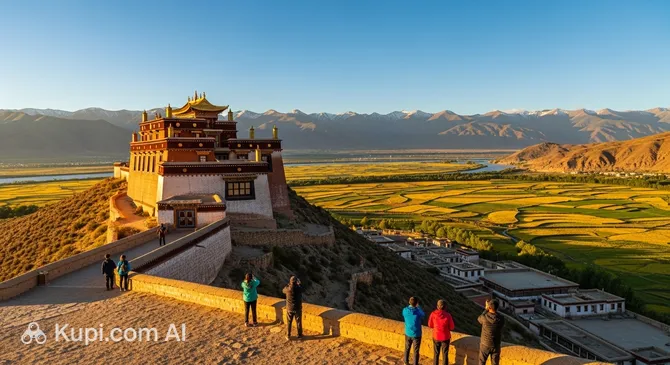
Located in the heart of the legendary Yarlung Valley, Tsetang (also known as Tsedang) is rightfully considered the cradle of Tibetan civilization. This city in China is the administrative center of Shannan Prefecture and serves as an important link between Tibet's past and present. Despite its official status as a small urban settlement, Tsetang possesses a special, tranquil atmosphere where the daily life of locals is closely intertwined with centuries-old traditions.
The city sits at an altitude of approximately 3,100 meters above sea level, which defines its unique landscape and climatic conditions. With a population of about 52,000, it is the fourth largest city in the region, while remaining a cozy and provincial place. Zetang. Illustration.
Source: Kupi.com AI
Its geographical location in the Yarlung River valley makes it a strategic point for anyone wishing to touch the origins of the ancient history of the city and its surrounding lands.
While there is no prominent industrial shine here, Tsetang attracts travelers with its historical roots and authentic way of life. It serves as an ideal base for exploring nearby monasteries and sacred sites where, according to legend, the first Tibetan dynasty was born. A visit to this city is an invitation to slow contemplation and an introduction to the true spirit of the highlands, far from the bustle of metropolises.
Weather Overview
The climate in Tsetang is characterized by distinct high-altitude specifics: it features cold, dry winters and moderately warm but rainy summers. The average annual temperature is about 9.2°C; however, due to the thin air and the altitude of 3,100 meters, temperature fluctuations between day and night can be quite significant.
In winter, especially in January, the temperature often drops to -6°C and below, but thanks to the abundance of sunny days, the cold is easier to bear. Summer months, such as July and August, bring the bulk of the precipitation—up to 205 mm in July, while the average temperature stays around 16°C. Expect a cool summer with frequent evening rains and dry, frosty winter months.
An important feature of the local atmosphere is the high intensity of ultraviolet radiation and periodic dusty winds characteristic of the Yarlung Valley terrain. When planning your trip, be sure to check the current weather in Tsetang to choose the right wardrobe and skin protection. The clean mountain air and lack of heavy industry make this place ecologically attractive despite the harsh natural conditions.
Average monthly temperature
Average monthly precipitation
Interesting Facts
Cradle of civilization: Tsetang is located in the Yarlung Valley, which is officially recognized as the birthplace of the first Tibetan dynasty, the Yarlung Dynasty.
High-altitude status: The city is located at an impressive altitude of 3,100 meters above sea level, which requires mandatory acclimatization for all guests.
Administrative paradox: Despite its role as the center of Shannan Prefecture, according to PRC classification, Tsetang is an urban township (zhen), highlighting its compactness.
Fourth in the region: In terms of size, Tsetang ranks fourth among the cities of Tibet, even though its population is only about 52,000 people.
Transit hub: The distance to the regional capital is 183 km, making the city an important stopover on the way to the attractions of the southeast.
How to Get There
Transport accessibility to Tsetang depends largely on weather conditions and the characteristics of the mountainous terrain. The main way to get here remains ground transport, connecting the city with other important centers in the region. When planning a trip, it's worth considering that mountain switchbacks may increase travel time, but they offer stunning views of the landscapes of China.
There is no direct air service to the city itself. The nearest airport is located in Nyingchi (LXZ), approximately 40 kilometers from the center. From there, the settlement can be reached by taxi or regular buses, with the journey taking 30 to 60 minutes. Travelers also frequently use the Lhasa airport, from where regular buses depart for Tsetang. The entire journey from the regional capital takes about 4–6 hours along the G318 highway.
There is currently no railway service in Tsetang, so tourists rely on the bus network or renting private transport with a driver to move between cities. Within the city, the most convenient and affordable way to get around is by taxi. You can find more detailed information about routes in the section on how to get to Tsetang.
Station
Passenger traffic
Distance
Lhasa railway station
19
81 km
Xigazê railway station
6
277 km
Dekargaon railway station
5
299 km
Main Attractions
The primary value of Tsetang lies not in modern architectural refinements, but in its status as a key point in the Yarlung Valley. The city serves as a starting point for exploring the cradle of Tibetan culture, where every stone is steeped in the history of the region's first rulers. Main life here is concentrated around the central square and administrative buildings, which reflect the modern stage of development in Shannan Prefecture.
Tourists should take time to wander through the local markets, where life pulses at its natural rhythm. Here, you can witness the daily life of Tibetans, unadapted for a mass audience. This is an excellent opportunity to feel the flavor of a high-altitude settlement, where traditions of farming and trade have remained virtually unchanged for decades.
For those seeking more significant cultural sites, Tsetang becomes a comfortable hub for day trips. Ancient monasteries and historical monuments of global significance are located in the immediate vicinity. The stay in the city itself allows you to settle into the right mood before visiting the shrines, while enjoying the silence and views of the harsh but majestic mountain landscapes.
Local Cuisine
The gastronomy of Tsetang is an honest and hearty reflection of Tibetan traditions, where every dish is meant to warm and provide strength in high-altitude conditions. The basis of the diet is tsampa—roasted barley flour mixed with yak butter and tea. It is a versatile staple that locals consume almost daily.
You must try the famous momo—Tibetan dumplings with a juicy filling of yak meat or vegetables, prepared by steaming. Another important item on the menu is thukpa—a fragrant, thick noodle soup that is perfect for cool evenings. Yak meat is served here in many forms, from fried to dried, and it features a unique, rich flavor.
The drink culture in Tsetang is equally interesting. Traditional butter tea with salt may seem unusual at first taste, but it is excellent for helping to cope with altitude sickness. For those who prefer something lighter, barley drinks or local beer are available. It is best to eat in local tea houses and small family restaurants, where the authenticity of the dishes is guaranteed by the very atmosphere of the establishment.
Travel Tips
A journey to Tsetang requires preparation, but the tips below will help you make your stay in this sacred place as comfortable and safe as possible.
Acclimatization: An altitude of 3,100 m is serious. During the first two days, it is strictly recommended to avoid physical exertion, drink more water, and monitor your well-being to avoid symptoms of altitude sickness.
Clothing: Weather in the mountains is changeable. Bring clothes for the "layering" principle: light clothing for the day and a warm down jacket or fleece for the evening. Don't forget sunscreen and sunglasses—UV radiation is very active here.
Finances: ATMs are rare in Tsetang and may not accept foreign cards. Always have a sufficient supply of cash Yuan (RMB) to pay for food, transport, and souvenirs.
Connectivity: Buy a local SIM card in advance in large cities (for example, in Lhasa). Wi-Fi in guesthouses can be slow or unstable, so mobile internet will be more reliable.
Etiquette: Treat local traditions with respect. Always walk around religious sites (stupas, monasteries) clockwise. Always ask for permission before photographing locals.
Health: Keep a first-aid kit with basic medications. In case of malaise due to altitude, it is better to immediately seek help at the city center, where administrative medical posts are located.
What to avoid: Do not discuss political topics or attempt to photograph military or administrative facilities—this could lead to unwanted issues with local authorities.
Water: Drink only bottled or boiled water, as tap water in high-altitude regions is not always suitable for drinking.
By following these simple rules, you can fully immerse yourself in the atmosphere of Tibetan culture and get only positive emotions from your trip.
Entertainment & Nightlife
Entertainment in Tsetang is predominantly quiet and contemplative. Since it is a small provincial center, there is virtually no nightlife in the classical sense—you won't find noisy clubs or bars with loud music. Locals prefer to spend their evenings with family or in traditional tea houses, where leisurely conversations take place over a cup of tea.
The city's atmosphere lends itself to evening strolls along the central streets, which fill with soft light and tranquility at dusk. Safety in the center is high, allowing tourists to feel comfortable when returning late to their hotels. For those craving cultural events, rare folk festivals held in the main square during holidays can be an alternative.
Daytime leisure in Tsetang is primarily about discovering the nature of the valley and walking through the surroundings. The lack of large entertainment centers is more than compensated for by the opportunity to see the real life of Tibet without the tourist gloss. If you desire more active recreation or social life, it is worth planning a trip to Lhasa, where the leisure infrastructure is much more developed.
Parks & Museums
The cultural environment of Tsetang is specific: you won't find the classic museums or art galleries that residents of metropolises are used to. The role of the main museum here is performed by the Yarlung Valley itself, where historical monuments and ancient ruins are scattered under the open sky. Residents and visitors alike perceive the surrounding space as a living testimony to history.
Park areas within the city limits are small and concentrated mainly in the central part near administrative buildings. Due to the harsh climate and mountain relief, natural greenery is limited, but small squares serve as popular meeting spots for locals. These are quiet islands of green where one can rest from the city's hustle and watch the leisurely flow of life.
For more large-scale walks in nature, it is worth going beyond the dense urban areas. The river valley offers natural open spaces and meadows, which in the warm season become ideal places for contemplating the landscapes. The absence of formal museum walls is compensated for by the depth of traditions preserved in the architecture of the houses and the lifestyle of the local communities.
Getting Around
The public transport system in Tsetang is simple and adapted to the needs of a small high-altitude city. The main means of transport for locals and tourists are buses and minibuses. They connect the central districts with the outskirts and nearby villages of Shannan Prefecture. Given the city's compactness, many key points in the center are easily accessible on foot.
Fares are usually paid in cash directly to the driver or conductor. Prices for trips are very low, making this the most economical type of transport. It should be noted that bus schedules can be unstable and depend on the time of day and passenger flow, so it is better to plan trips with extra time during peak hours.
Taxis serve as an alternative to public transport and are quite easy to find on the main streets. This is a more comfortable and faster way to move around, especially if you need to reach remote areas or a hotel with luggage. Bicycles are also popular among local residents; however, tourists should consider the altitude and thin air before deciding on a long bike ride.
Accommodation
Accommodation options in Tsetang are primarily geared towards transit travelers and pilgrims, so mid-range hotels and cozy guesthouses predominate. You should not expect ultra-modern luxury resorts here, but local hotels provide a decent level of comfort necessary for resting after long excursions in the highlands.
The city center, located near the Shannan prefecture administrative buildings, is considered the most convenient area to stay. Staying here provides easy access to local cafes, markets, and main transport points. Accommodation prices remain very democratic, making the city attractive for budget tourists and those who prefer long trips through Tibet.
When choosing accommodation, it is recommended to check for the presence of a heating system, as nights in the mountains can be cold even in summer. It is better to book rooms in advance, especially if your visit coincides with major local holidays. You might also consider renting apartments in residential areas if you plan to stay in the city for a longer term.
Nearby Cities
Tsetang serves as an excellent starting point for exploring the surroundings and discovering other cities and settlements in Tibet. Thanks to its location in the Yarlung Valley, it is convenient to plan trips from here to places of deep historical and spiritual significance for the entire region.
The most important destination for a day trip is Lhasa. The capital of Tibet is within reach, although the journey along mountain roads may take several hours. It is a city with incredible energy, majestic palaces, and monasteries that every traveler should see. You can also head towards smaller settlements such as Trashi Yangtse or Lhuntse to see life in the Tibetan hinterland.
Exploring the outskirts of Tsetang allows you to see a variety of landscapes—from arid mountain slopes to picturesque river valleys. Each direction reveals new facets of the culture and nature of this amazing part of the world, making your journey truly rich and full of discoveries.
Shopping & Souvenirs
Shopping in Tsetang is primarily about visiting local markets where you can find goods reflecting authentic Tibetan life. There are no large shopping malls with international brands here, but there is an abundance of folk crafts and everyday goods that are difficult to find in other regions.
The city's central market is the heart of local trade. Here, it is worth paying attention to products made from yak wool—blankets, scarves, and traditional clothing, which are famous for their warmth and durability. Also of interest are souvenirs made of wood and barley, created by local craftsmen. Many tourists bring back Tibetan incense and tea blends gathered in the highlands.
Shops and stalls usually operate from morning until early evening. Payment is mostly made in cash, as international cards are rarely accepted. Shopping here requires a certain amount of patience and a willingness to communicate with the sellers, but in reward, you will receive unique items that hold the warmth of the masters' hands and the spirit of the Yarlung Valley.