Support

Karnak

About

Karnak is a true gem of Upper Egypt, nestled on the east bank of the majestic Nile, just a few kilometers north of the famous Luxor. This city seems dissolved in time: here, antiquity meets modernity, and every stone holds mysteries of millennia. The name Karnak is known worldwide, primarily thanks to its unique temple complex, which captivates the imagination of even the most seasoned travelers.

Despite its relatively modest size and population of about 26,000 people, Karnak has its own, very special atmosphere. Officially considered part of the Luxor district, it is far from the bustle of the metropolis. The city breathes slowly, inviting guests to leisurely stroll along ancient alleys, admire majestic columns, and inhale the scents of history. When you come to Karnak, you find yourself at the very heart of ancient Egyptian culture, where the powerful energy of past eras is palpable.
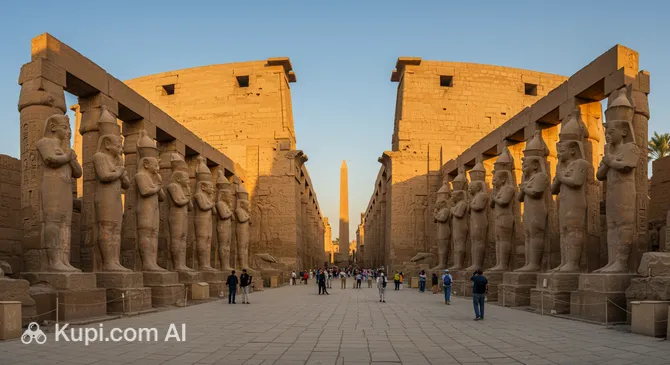
Karnak. Illustration.
Source: Kupi.com AI

The main reason thousands of tourists are drawn here is, of course, the legendary Karnak Temple Complex. It is the largest religious structure of Ancient Egypt and one of the most impressive in the world. The scale of the complex is astounding: it occupies more than 100 hectares, and its numerous halls, colonnades, statues, and reliefs tell stories of gods, pharaohs, and great events of antiquity. A walk by its "sacred lake" or among the giant columns of the Great Hypostyle Hall leaves unforgettable impressions.

But Karnak is not just about ancient stones and majestic columns. It is also a place where you can feel the authentic atmosphere of the Egyptian province, where every morning begins with the smiles of locals and evenings are filled with the magic of sunset over the Nile. Visiting Karnak is a unique opportunity to touch a great civilization and feel the breath of eternity.

You can find more interesting facts on the history of the city of Karnak page.
Weather Overview

The weather in Karnak is characterized by a hot desert climate. Summers here are very hot and dry, with average maximum temperatures in June-August reaching 40°C and above. Winters are mild and also dry, with average daytime temperatures around 20-23°C in December-February, while nighttime temperatures can drop to 7-10°C. Precipitation in Karnak is practically non-existent throughout the year.

For more detailed information about the weather, including monthly forecasts, you can visit the Climate of Karnak page.

Average monthly temperature

Average monthly precipitation

Interesting Facts

Beyond its world-famous temples, Karnak hides many amazing stories and little-known details that make it even more mysterious and attractive to travelers. Here are just a few of them:

Precinct of Amun-Re. Illustration.
Source: Kupi.com AI

Traveler photos:

  • The Karnak Temple Complex is the largest religious structure ever built by man. Its construction continued for more than two millennia, and practically every pharaoh sought to leave their mark here, adding new halls, chapels, obelisks, or colossal statues.

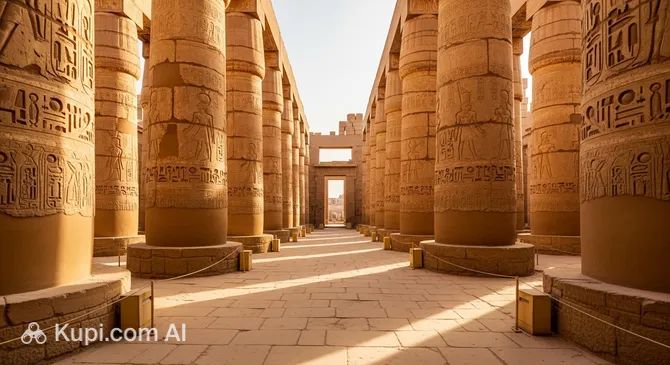
  • The temple's famous Hypostyle Hall, one of the most impressive structures of antiquity, features 134 giant columns arranged over an area of about 5,000 square meters. These columns, reaching heights of up to 21 meters, create the feeling of a true forest of stone.

  • Karnak was not only the primary religious center of Ancient Egypt but also an important administrative and economic hub. Key state decisions were made here, archives were kept, and annual festivals and ceremonies, such as those held at the Precinct of Amun-Re, gathered thousands of people.

  • Among the many legends surrounding Karnak, there is a tale of the "singing column." It is said that one of the columns in the Hypostyle Hall, under certain conditions such as strong wind, emits mysterious sounds resembling singing. This phenomenon attracts curious tourists and researchers.

How to Get There

Getting to the famous Karnak, located in the Luxor Governorate of Egypt, is possible in several ways, but air travel is the most common and convenient for most international tourists. Several airports serve this region, providing various options for travelers.

The main and closest air hub is Luxor International Airport (IATA: LXR). It is located directly in the city of Luxor, only about 7.2 km from the Karnak Temple Complex. A taxi ride from the airport to Karnak takes about 30-35 minutes. This large international airport accepts flights from many countries around the world, as well as domestic flights from Cairo and other Egyptian cities.

Another popular option, especially for tourists combining a Red Sea holiday with a cultural program, is Hurghada International Airport (IATA: HRG). It is located in the city of Hurghada, approximately 199 km east of Karnak. This is a very large international airport with a high volume of flights. The road from Hurghada to Karnak (Luxor) by taxi or bus takes about 5 hours and 20 minutes but allows you to enjoy the desert landscapes.

You can also consider flying into Aswan International Airport (IATA: ASW), located in the city of Aswan, about 194 km south of Karnak. This airport serves the southern part of Egypt and may be convenient if your trip includes a visit to Aswan. The drive from here to Karnak takes about 5 hours and 10 minutes by car.

For clarity, here is a summary of the main airports through which you can reach Karnak:

AirportPassenger trafficDistance
Luxor International Airport1.2 mln7 km
Mubarak International Airport706 423115 km
Aswan Airport758 668194 km
Marsa Alam International Airport1.5 mln196 km
Hurghada International Airport8.7 mln199 km

In addition to air travel, Karnak can be reached by rail. Although Karnak itself does not have its own train station (as it is an ancient complex within modern Luxor), the city of Luxor has a major railway station. Trains from Cairo, Alexandria, Aswan, and other Egyptian cities arrive here regularly. Traveling by train, especially in a sleeper car from Cairo, can be a comfortable and interesting way to travel. From the Luxor railway station, Karnak can be easily reached by taxi in 10-15 minutes.

There is also bus service between Luxor and other major Egyptian cities. Buses are a more budget-friendly option, but the journey may take longer. For those who prefer to travel by car, the roads in Egypt are fairly well-developed, and cars can be rented. Finally, one should not forget about Nile cruises, many of which include a stop in Luxor with visits to the Karnak and Luxor temples.

Main Attractions

Karnak is a true treasure trove of ancient Egyptian civilization, where every stone breathes history. The city invites travelers on an unforgettable journey through time, offering the chance to explore its majestic temple complexes and mysterious necropolises.

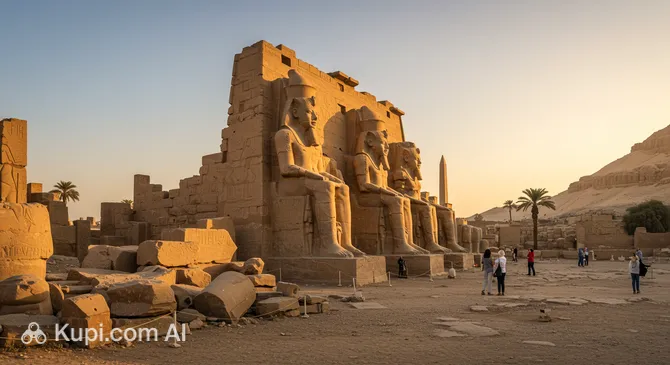
One of the main gems of Karnak is undoubtedly the Precinct of Amun-Re. This is a massive complex of temples, chapels, and other buildings dedicated to the supreme god Amun-Re, his consort Mut, and their son Khonsu. Visitors are struck by the giant columns of the Hypostyle Hall, majestic statues, and obelisks covered in ancient hieroglyphs. A walk through this sanctuary is a real immersion into the atmosphere of ancient Egyptian rituals and beliefs.

The Sun Temple of Amenhotep III is equally interesting. Although less of it remains compared to the main complex of Amun-Re, this site holds immense historical significance. The temple was dedicated to the cult of the solar deity and Pharaoh Amenhotep III, who was considered his earthly embodiment. Exploring the ruins of this temple allows for a better understanding of the religious concepts and architectural achievements of that period.

Temple of the Sun of Amenhotep III. Illustration.
Source: Kupi.com AI

Traveler photos:

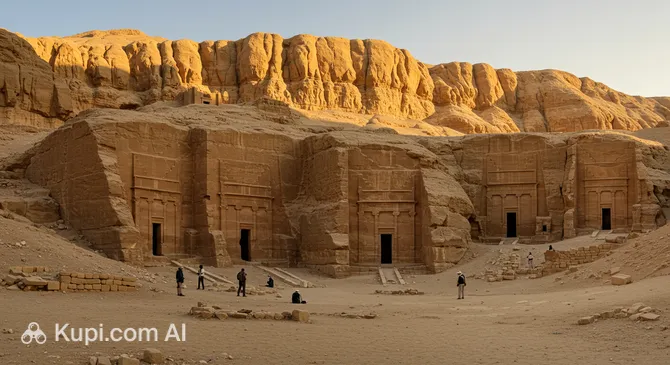
For those interested in the funerary traditions of Ancient Egypt, the Dra' Abu el-Naga' Necropolis is a must-visit. This ancient necropolis served as a burial site for nobility and high-ranking officials for many centuries, starting from the Middle Kingdom period. Numerous tombs with unique paintings and artifacts have been discovered here, shedding light on the life and death of the ancient Egyptians. A visit to the necropolis provides an opportunity to touch the secrets of the underworld as envisioned by the inhabitants of the ancient Theban region.

Dra' Abu el-Naga' Necropolis. Illustration.
Source: Kupi.com AI

Traveler photos:

Local Cuisine

The gastronomic scene in Karnak is a fascinating journey into the world of authentic Egyptian cuisine. Dishes with rich flavors, prepared according to recipes passed down through generations on the banks of the Nile, are highly valued here. Thanks to the fertile lands in the vicinity, local chefs always use the freshest vegetables, fruits, and aromatic herbs, making every dish truly special.

Be sure to try ful medames – a thick fava bean stew traditionally served with hot flatbread and fresh greens. This hearty and aromatic dish is one of the pillars of Egyptian cuisine. Equally popular is couscous with vegetables and spices, as well as taameya – the Egyptian version of falafel made from fava beans, which often serves as an excellent snack or light lunch. Fish lovers should taste fresh-caught Nile fish, fried to a golden crust and drizzled with lemon juice.

To refresh yourself on a hot day, there is nothing better than traditional Egyptian drinks. Try karkade – a bright red, tart tea made from hibiscus petals that perfectly quenches thirst. Fragrant mint tea is also offered everywhere; it is a symbol of hospitality and often accompanies a meal or a friendly conversation.

The food culture in Karnak is closely tied to street food and bustling markets. This is where you can feel the true spirit of the city and sample many delicacies: from freshly baked flatbread with tahini to sweet date cakes. Locals often have breakfast in small cafes serving simple but delicious dishes. A special atmosphere is created by gastronomic holidays and festivals, when the streets are filled with the aromas of cooking food, and tourists have a unique opportunity to learn about culinary traditions and the secrets of local cooks.

Travel Tips

Welcome to Karnak, a jewel of ancient Egyptian civilization! To make your journey to the majestic temples as comfortable and memorable as possible, we have prepared a few practical tips.

  1. Clothing and Essentials: For the hot climate of Egypt, choose light, breathable clothing made of natural fabrics like cotton or linen. When visiting the Karnak Temple Complex, women are recommended to cover their shoulders and knees, and men should cover their shoulders. Be sure to bring high-SPF sunscreen, a hat, sunglasses, and, especially important, comfortable closed-toe shoes for long walks on sand and uneven stone slabs. Don't forget an adapter for electrical appliances if it differs from the one used in Egypt (types C and F).
  2. Transport: The Karnak Temple Complex itself is explored on foot. To get there from Luxor, where tourists usually stay, you can use a taxi (always agree on the price of the ride in advance or ensure the driver turns on the meter) or more budget-friendly shared taxis (microbuses). For a colorful way to travel on the Nile or between Luxor attractions, feluccas (traditional sailing boats) and horse-drawn carriages (calèches) are popular. Renting a car is generally not recommended for tourists due to the specific nature of local traffic.
  3. Finances: The local currency is the Egyptian Pound (EGP). You can exchange money at banks, official exchange offices in Luxor, or some hotels. Credit cards (Visa, Mastercard) are accepted in large hotels, some restaurants, and shops; however, for purchases at markets, paying small vendors, and taxis, you must have cash with you. ATMs are quite common in Luxor. The tipping culture ("baksheesh") is very important – it is customary to leave small amounts for various services.
  4. Health and Safety: Drink only bottled water to avoid stomach issues. Always have a hat and use sunscreen. Pharmacies (marked as "Farmacia" or with a greenish cross) are available in Luxor; some may operate 24/7. In case you need serious medical assistance, contact hospitals or clinics recommended by your hotel or insurance company. The tourist zones of Karnak and Luxor are generally safe, but as anywhere, keep an eye on your personal belongings, especially in crowded places. Avoid walking alone in poorly lit areas after dark.
  5. Communication: The official language is Arabic. In the tourism sector, including Karnak and Luxor, many workers (guides, hotel staff, vendors) speak English. Knowing a few basic Arabic phrases, such as "Salam Alaikum" (hello), "Shukran" (thank you), or "La, shukran" (no, thank you – useful when dealing with persistent vendors), will be very helpful and will elicit a positive reaction from locals. A local SIM card with internet access can be purchased at the airport or at mobile phone shops in Luxor. Wi-Fi is usually available in hotels and some cafes.
  6. Local Etiquette: Show respect when visiting Karnak Temple and other ancient monuments: do not climb on the ruins and do not leave trash. Greetings usually involve a handshake (most common between people of the same gender). If you want to take photos of locals, be sure to ask their permission. Bargaining is standard practice at markets and in souvenir shops; do so politely and with a smile.
  7. What to Avoid: It is strictly recommended not to drink tap water. Try to avoid overly revealing clothing outside of the hotel grounds, especially when visiting religious and historical sites. Do not photograph military installations or people in uniform without permission.
  8. Additional Tip: To fully enjoy the grandeur of Karnak Temple and avoid the exhausting heat and large crowds of tourists, plan your visit for the early morning right after opening, or closer to evening. Consider hiring a licensed guide – their stories and explanations will make your visit much more informative and engaging.

We hope these tips help you better prepare for your trip to Karnak and enjoy every moment of your stay in this amazing corner of Egypt. We wish you unforgettable impressions!

Entertainment & Nightlife

Karnak, known worldwide for its majestic temples, offers guests unique evening experiences that differ from the noisy nightlife of large cities. You won't find districts with numerous modern bars and nightclubs here, but you can enjoy a special atmosphere of antiquity under Egypt's starry sky.

The main evening entertainment in Karnak is undoubtedly the famous Sound and Light Show at Karnak Temple. As darkness falls, the ancient walls come to life thanks to colorful lighting and an engaging narration about the history of this grandiose structure. It is a truly mesmerizing sight that transports spectators thousands of years back. The atmosphere here is solemn and somewhat mystical; the show is usually conducted in several languages. Tickets for the Sound and Light Show have a fixed cost, which can vary but is usually within a reasonable range for such an impressive performance; it is recommended to check current prices before visiting.

After the show or for a more relaxed evening, you can head to one of the local restaurants or cafes. Many of them offer Egyptian and international cuisine. It is especially pleasant to dine on an open terrace, enjoying the warm evening. Although Karnak does not have designated "nightlife streets," some establishments are located near tourist areas. The crowd here usually consists of tourists and locals who prefer a quiet rest. Most restaurants operate until late evening. Dinner at a mid-range local restaurant can cost the equivalent of approximately $15-30 USD per person, depending on the choice of dishes and drinks.

For evening walks and restaurant visits, it is recommended to dress modestly, respecting local traditions. The most comfortable time for evening activities is after sunset, when the daytime heat subsides. The most convenient way to move around the city in the evening is by taxi. It is recommended to use official taxis or book a car through your hotel. The tourist areas of Karnak are generally safe, but you should always take standard precautions and avoid poorly lit and deserted places.

During the day, Karnak reveals its main treasures — the grandiose temple complexes. It is certainly worth dedicating time to see iconic sites such as the majestic Precinct of Amun-Re, the mysterious Sun Temple of Amenhotep III, or the ancient Dra' Abu el-Naga' Necropolis. These monuments of ancient Egyptian civilization leave an indelible impression with their monumentality and rich history.

Thus, nightlife in Karnak is not about noisy discos, but about immersion in history and enjoying the magical atmosphere of ancient Egypt. Quiet dinners, stargazing, and, of course, the impressive Sound and Light Show at the temple will leave you with memories just as bright as your daytime excursions.

Parks & Museums

Karnak, famous for its ancient temples, offers a unique immersion into the history and culture of Ancient Egypt. Although the city does not abound with traditional parks in the modern sense, its extensive archaeological zones are themselves impressive open spaces, and its cultural heritage is represented by grandiose temple complexes that function as open-air museums.

Instead of typical city parks, Karnak offers the majestic spaces of the temple complexes themselves. The territory of the Karnak Temple is enormous, allowing for long walks among ancient columns and sanctuaries. The banks of the Nile flowing nearby also offer picturesque views and the chance to feel the ancient city's connection to the great river, which was the lifeblood of the civilization.

The main "museum" attraction of Karnak is, of course, the Karnak Temple Complex itself—the largest religious complex of the ancient world. It is a true labyrinth of temples, chapels, pylons, and sacred lakes dedicated to the Theban triad of gods—Amun, Mut, and Khonsu. Every corner here breathes history and captivates the imagination.

Precinct of Amun-Re. Illustration.
Source: Kupi.com AI

Traveler photos:

One of the key parts of the complex is the Precinct of Amun-Re, the heart of Karnak, where the most important religious ceremonies took place. Its Hypostyle Hall with massive columns is one of the most recognizable symbols of Egypt. It is also worth noting the Sun Temple of Amenhotep III, which, though in ruins, still impresses with the remains of colossal statues and bas-reliefs.

Temple of the Sun of Amenhotep III. Illustration.
Source: Kupi.com AI

Traveler photos:

To gain a deeper understanding of the funerary traditions of Ancient Egypt, you can visit the Dra' Abu el-Naga' Necropolis, located on the west bank of the Nile across from Karnak (though technically part of Luxor, it is often viewed in the context of Theban antiquities). Here you will find the tombs of nobles and officials of the New Kingdom, many of which are decorated with vibrant paintings.

Dra' Abu el-Naga' Necropolis. Illustration.
Source: Kupi.com AI

Traveler photos:

To get a more complete impression of Karnak, try to visit the temple complex early in the morning when there are fewer tourists and it is not as hot. Also explore the lesser-known parts of the complex, such as the Temple of Ptah or the Sacred Lake, to experience the atmosphere of antiquity in solitude.

Getting Around

Moving around Karnak, known primarily for its grandiose temple complex, has its own peculiarities due to its historical significance and relatively small size. There is no extensive network of subways or trams like in metropolises, but reaching necessary points is quite possible using available modes of transport.

The foundation of local "public" transport, so to speak, consists of microbuses and, to a lesser extent, small local buses. They connect Karnak with Luxor and run along the main roads. They do not have a strict schedule or fixed stops – they can usually be stopped with a wave of the hand. Fares are paid in cash directly to the driver, and the amount is usually small. This is a good option for budget travel and experiencing local flavor, but be prepared that transport may be crowded, and information about routes is mostly in Arabic.

The most convenient and frequently used transport for tourists in Karnak is taxis. They can be found at the entrance to the Karnak Temple, near hotels, or simply hailed on the street. It is crucial to agree on the price of the trip before it begins, as meters are rarely used. The price will depend on the distance and your bargaining skills. A taxi is a fast way to reach any point in the vicinity.

For short distances and to create a special atmosphere, especially for trips from the Nile to the temple or along the waterfront, horse-drawn carriages (calèches) are popular. These are more of a tourist attraction than a regular mode of transport, but they add color to the journey. As with taxis, the price for a calèche ride must be agreed upon in advance.

Don't forget that the Karnak Temple Complex itself is massive, and its detailed exploration involves long walks. This is the main way to "move" within the attraction itself. For travel between your hotel, the temple, and other sites within Karnak, if they are not within walking distance, taxis or calèches are the best fit.

Here are some practical tips: always have small cash with you for microbus fares and for paying taxi or calèche drivers. If you decide to use a microbus, don't hesitate to check the route with the driver or locals. In the hot months, try to plan your travel for early morning or later evening. Taxi apps common in large cities may be less popular in Karnak, so the traditional method of "hailing a car" is still relevant here.

Accommodation

In Karnak and its surroundings, travelers can find various accommodation options to suit different budgets and preferences. The range of housing includes more modest guesthouses and small hotels as well as more comfortable hotels geared towards tourists coming to explore Egypt's ancient monuments. It is also worth considering options in neighboring Luxor, which offers an even wider selection, including apartments for short-term rent.

For tourists, the most attractive areas may be those in the immediate vicinity of the famous Karnak Temple Complex, providing easy access to this main attraction. Locations along the Nile waterfront are also popular, offering picturesque views and convenient departure points for river trips. Choosing accommodation in these zones will allow for maximum immersion in the atmosphere of the ancient city and save time on travel.

The price range for accommodation in Karnak varies: you can find both budget options and mid-range hotels. During the peak tourist season, which usually falls in the autumn-winter period, it is recommended to book accommodation in advance to ensure the best choice and prices. The most common booking methods are popular international online platforms and direct contact with hotels.

Nearby Cities

For those looking to explore the surroundings, Karnak serves as an excellent starting point for day trips to several interesting nearby locations. For example, Luxor, located just 3 km away, is world-famous for its grandiose temple complexes, such as the Luxor Temple, and its proximity to the Valley of the Kings. A bit further, in Qena (about 50 km away), the main attraction is the magnificently preserved Temple of Hathor at Dendera, which is striking for its architecture and detailed reliefs. For a more complete overview of available destinations, see the table below:

CityPopulationDistance
Luxor202 2323 km
Armant76 45714 km
Shanhur9 31421 km
Naqada21 53022 km
Qift22 06336 km

These nearby destinations provide an insight into the region's diverse culture and landscapes, complementing the experience of visiting Karnak itself.

Shopping & Souvenirs

Shopping in Karnak is primarily an immersion into the atmosphere of an oriental bazaar and an opportunity to purchase unique souvenirs reminiscent of the ancient history of Egypt. The city is not known for large modern shopping centers; the main focus here is on small shops and street vendors offering handmade crafts and traditional goods.

Main shopping points in Karnak are concentrated near major tourist sites, such as the Karnak Temple. Here you will find rows of souvenir shops and stalls where you can buy commemorative items. There are no specialized shopping streets in the European sense; trade is more spontaneous around places popular with tourists.

There are no large shopping malls in Karnak itself. For a more diverse shopping experience, including modern clothing stores, electronics, and large supermarkets, tourists usually head to the neighboring, larger city of Luxor.

Markets in Karnak are generally small bazaars and clusters of street vendors. Here you can find traditional Egyptian goods: spices, teas, aromatic oils, textiles, and, of course, many souvenirs. The atmosphere at such markets is very lively, and bargaining is an integral part of the buying process.

Typical souvenirs worth bringing back from Karnak include: alabaster products (vases, figurines), papyrus scrolls with images of ancient Egyptian gods and pharaohs, scarab figurines (a symbol of luck), cartouches with your name written in hieroglyphs, as well as high-quality cotton products, incense, and natural perfume oils.

Shop and souvenir stall hours in Karnak are quite flexible, especially in tourist zones. Many are open from morning until late evening, catering to the flow of tourists. Payment is most often accepted in cash – Egyptian pounds. Some larger shops may accept card payments, but it's better to always have local currency with you. Don't forget to bargain, especially at markets and in small shops – it is expected and part of the culture.

Tax Free refund opportunities in Karnak are limited and usually available only in some large, officially registered stores for purchases over a certain amount. If you are counting on a tax refund, check this information directly with the seller before making a purchase and keep all receipts.

Reached the end of the page?

That means the route is fully explored