Support

Bordeaux Cathedral

About

Bordeaux Cathedral, officially known as the Cathedral of Saint Andrew (Cathédrale Saint-André de Bordeaux), is a majestic cathedral located in the city of Bordeaux, France. This monumental structure is one of the most striking examples of Gothic architecture and a key landmark of the city, attracting travelers from all over the world.
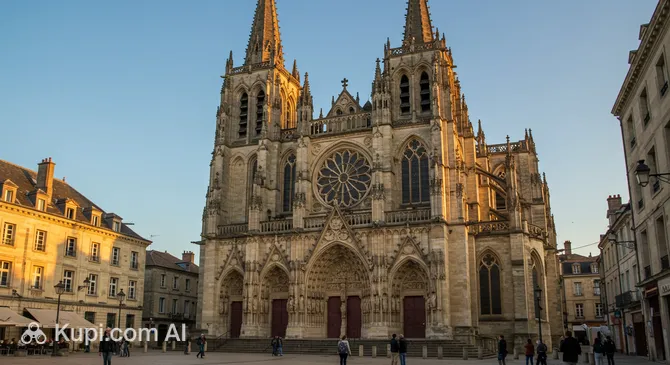
Bordeaux Cathedral. Illustration.
Source: Kupi.com AI

Traveler photos:

The cathedral is striking in its scale: the nave is 124 meters long, and the vaults reach a height of 18 meters. Its architecture clearly features classic Gothic traits: pointed arches, ribbed vaults, and powerful buttresses that create a sense of upward movement and fill the space with light. Interestingly, its bell tower, the Pey-Berland Tower, was built separately so that vibrations from the bells would not damage the main building, which stands on soft soil.

Special attention should be paid to the details that make the cathedral truly unique. Intricate stone carvings decorate the facades and interiors, and soft colored light filters through ancient stained glass windows—some of which date back to the 14th century—creating a unique atmosphere. Since 1998, the cathedral has been listed as a UNESCO World Heritage Site as part of the Way of St. James pilgrimage route.

Contacts

To plan your visit, check current service times, or find other information, it is recommended to use the cathedral's official contact details. This will help you get the most accurate and up-to-date information.

How to contactContact
AddressPl. Pey Berland, 33000 Bordeaux, France
Phone number+33 5 56 44 67 29
Websitewww.cathedrale-bordeaux.fr

What to Do

A visit to Bordeaux Cathedral is an immersion into the splendor of Gothic architecture and centuries of history. Inside, visitors can explore the rich interior and appreciate the numerous historical details. The cathedral's famous organ attracts particular attention; back in 1535, the English traveler Andrew Boorde called it "the fairest and greatest pair of organs in all Christendom".

While walking through the cathedral, look out for its architectural treasures. Tourists can see the north portal with its double-pointed windows, the south transept facade, and other decorative elements restored during various reconstructions. The ancient stained glass windows, some of which have survived since the 14th century, are equally admirable, as are the intricate stone carvings decorating various parts of the cathedral.

Getting There

Getting to Bordeaux Cathedral is easy, as it is located in the heart of the city on Place Pey-Berland. Thanks to this central location, the cathedral is one of the most accessible landmarks in Bordeaux. If you are staying in or walking through the historic center, the most pleasant way to reach the cathedral is on foot, enjoying the architecture of the ancient streets.

The most convenient way to reach the cathedral is by using the city's well-developed public transport system. The Hôtel de Ville tram stop is right at the cathedral entrance, served by tram lines A and B. Also nearby, about a five-minute walk away, is the Pey-Berland stop on tram line C. Additionally, you can take bus routes 1, 4, 15, and 16 to the Hôtel de Ville or Musée d'Aquitaine stops.

For those who prefer comfort, you can always use taxi services or order a ride through a mobile app, which will take you directly to the square. If you are traveling by car, keep in mind that the city center is mostly pedestrianized, and parking is paid and limited. The nearest underground parking garages to the cathedral are Pey-Berland and Victor Hugo, where you can leave your car and continue on foot.

Nearest city: Bordeaux

History & Facts

The history of Bordeaux Cathedral dates back to ancient times, with the first mentions of a church on this site going back as far as the 3rd century. However, the history of the current building began much later. A new, more majestic cathedral was erected here in the 11th century and was solemnly consecrated in 1096 by Pope Urban II himself. This original Romanesque temple became the foundation for the architectural masterpiece we see today.

From the 1130s through the 13th century, the cathedral underwent significant reconstruction, gaining Gothic features. During this period, the nave was heightened, elegant double-pointed windows were added, and the north portal was created. Interestingly, the interior and exterior decoration of the nave was executed in a restrained and austere style. This was due to the influence of Bishop Geoffroy de Loury, who held views close to the ascetic ideals of the Augustinian order. During the following 13th and 14th centuries, the Romanesque structure was almost entirely replaced by High Gothic elements.

One of the most dramatic periods in the cathedral's history occurred during the French Revolution. In March 1793, the building was nationalized and, stripped of its sacred status, turned into a barn for military horse fodder. Much of its rich decoration and decorative elements were removed or lost forever, and the tower was even threatened with demolition. In 1797, the nave was even used for political meetings. It was only in 1798 that the cathedral was returned to the church, but its condition required massive restoration.

A long process of restoration began in 1803 and continued throughout the 19th century. The most ambitious recovery work was led by Paul Abadie, an architect widely known for his masterpiece, the Sacré-Cœur Basilica in Paris. Thanks to these efforts, the cathedral was not only saved from ruin but also acquired many of the features admired by millions of visitors today.

Time Needed

You should set aside approximately 1-2 hours to see Bordeaux Cathedral itself. This is enough time to walk through the main nave without rushing, admire the grandeur of the Gothic vaults, examine the details of the ancient stained glass windows, and peek into the side chapels. During this time, you will be able to feel the atmosphere of this historic place, appreciate its impressive scale, and take memorable photos.

If you want to dive deeper into the history and architecture or plan to visit all parts of the complex, allow for more time. The climb up the Pey-Berland bell tower, standing next to the cathedral, deserves special attention. It takes an additional 45–60 minutes to climb the 233 steps and enjoy the panoramic view of Bordeaux from a height of 50 meters. Therefore, for a full and unhurried exploration of the cathedral and the tower, it is best to allocate up to 3 hours.

Working Hours

Bordeaux Cathedral is open to visitors year-round, though opening hours may vary. Generally, entry to the cathedral itself is free and does not require advance booking. From Tuesday to Saturday, the cathedral is usually open from 10:00 to 13:00 and from 15:00 to 19:30. On Mondays, it is only open in the afternoon, from 14:00 to 19:00. On Sundays, morning hours may vary slightly, so it is highly recommended to check the current schedule on the cathedral's official website before your visit, as it may change due to religious services or events.

No tickets are needed to visit the main part of the cathedral. However, if you plan to climb the freestanding Pey-Berland bell tower for a panoramic view of the city, you will need a ticket. The number of visitors to the tower is limited, so, especially during the peak tourist season, it is better to purchase tickets in advance online to avoid queues and guarantee your spot.

DayOpening hours
Monday2:00 – 19:00
Tuesday10:00 – 12:00, 2:00 – 19:00
Wednesday10:00 – 12:00, 2:00 – 19:00
Thursday10:00 – 12:00, 2:00 – 19:00
Friday10:00 – 12:00, 2:00 – 19:00
Saturday10:00 – 12:00, 2:00 – 19:00
Sunday9:30 – 12:00, 2:00 – 18:00

Nearby

Visiting Bordeaux Cathedral is just the starting point for exploring the rich history and culture of central Bordeaux. Exploring its surroundings will allow you to immerse yourself deeper in the city's atmosphere, as other iconic landmarks, each with its own unique history, are located just a few steps from this Gothic masterpiece.

A stroll through the neighborhood around the cathedral will enrich your experience and show how multifaceted this historic quarter is. Nearby, you will find both important cultural sites and cozy places for relaxation and shopping, making this part of the city ideal for leisurely exploration on foot.

NameDistance
Pey Berland Tower0.1 km
Museum of Aquitaine0.3 km
Porte Dijeaux0.4 km
French House0.4 km
ECLIPSO Bordeaux0.4 km
Palatino0.4 km
Promenade Sainte-Catherine0.4 km

Have you reached the end of the page?

So the route has been studied inside and out