Support

VESUNNA, Gallo-Roman Museum

About

Imagine an ultra-modern glass pavilion that, like a transparent protective case, carefully covers the ruins of an ancient Roman mansion. This is what the Vesunna Gallo-Roman Museum in the city of Périgueux looks like. This unique archaeological complex in France was designed by the famous architect Jean Nouvel and opened to the public in 2003.
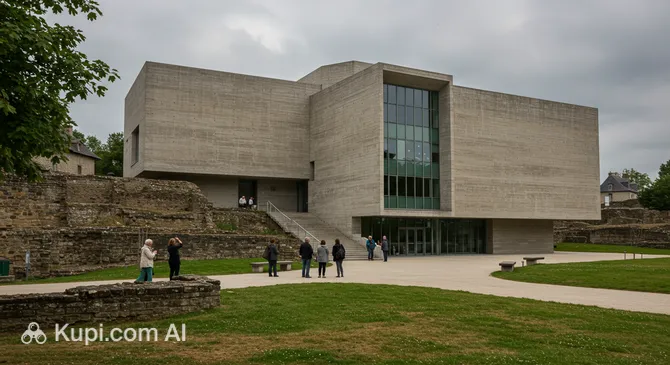
VESUNNA Gallo-Roman Museum
VESUNNA Gallo-Roman Museum. Иллюстрация. Источник: Kupi.com AI

The heart of the museum is the remains of the Domus de Vésone — a wealthy villa from the 1st century AD, covering about 2400 square meters. Thanks to a bold architectural solution, the ancient walls, columns, and even fragments of original frescoes are protected by a huge glass and steel roof that seems to float above the ground, letting in soft natural light.

In addition to the architectural ruins, the museum's exhibition tells the fascinating story of the Petrocorii — a Gallic tribe that inhabited these lands. It houses collections of ancient jewelry, ceramics, and sculptures that offer a literal glimpse into the daily lives of people who lived here two thousand years ago. The museum is located in a picturesque park, where the mysterious Vesunna Tower — the ruins of an ancient temple — stands nearby.

Contacts

For information about visiting, special exhibitions, or booking group tours, you can use the museum's official contact channels.

How to contactContact
AddressParc de Vésone, 20 Rue 26ème Régiment d'Infanterie, 24000 Périgueux, France
Phone+33 5 53 53 00 92
Websitewww.perigueux-vesunna.fr

What to Do

The main highlight of the museum is the opportunity to literally float above history. Visitors move along specially designed glass walkways and platforms suspended over the ruins of the ancient villa. From above, you can clearly see the layout of the rooms, the remains of the garden pool with its peristyle (colonnade), and even the complex heating systems used by the Romans.

Be sure to notice the preserved wall paintings. These frescoes once decorated the triclinium (dining room) and the private quarters of the home's owners. Looking at them, you can imagine how bright and luxurious the interior of the domus once was. The galleries also feature models that reconstruct the appearance of ancient Vesunna during its heyday in detail, helping you compare the ruins with the actual look of the ancient city.

For a deeper immersion, explore the collection of everyday artifacts: you will see exquisite ceramics, theatrical masks, jewelry, and even ancient wooden pumps found in wells. After exploring the indoor galleries, be sure to take a stroll through the adjacent Parc de Vésone to see the massive Vesunna Tower up close and the remains of the 4th-century city walls that complement the historical landscape.

Getting There

The museum is located in the southern part of the city of Périgueux, situated in the picturesque region of France. The attraction is found at: Parc de Vésone, 20 Rue 26ème Régiment d'Infanterie. If you are already walking through the historical center, the walk from Saint-Front Cathedral will take only about 15–20 minutes at a leisurely pace.

For those who prefer public transport, city buses going to the Vésone stop are suitable. These lines connect the park with the central station and other districts of the city. If you are traveling by car, you can leave your vehicle in the parking lot within Parc de Vésone itself or on nearby streets, following the signs for Rue 26ème Régiment d'Infanterie.

Tourists arriving from other regions can conveniently reach Périgueux by train or bus from the airports in Bergerac or Bordeaux. The journey takes 1 to 2 hours, after which the museum can be reached by taxi or local bus in just 10 minutes.

Ближайший город: Périgueux

History & Facts

The ancient city of Vesunna was founded around 16 BC by the Romans following the conquest of Gaul by Julius Caesar. Located in the province of Aquitania, in the territory of modern-day France, the city flourished quickly: by 40 AD, a forum stood here, and later, construction began on a massive amphitheater and a temple to the goddess Vesunna.

The museum itself is built over the remains of a luxurious domus (urban villa) from the 1st century AD, which belonged to a wealthy aristocratic family. Archaeologists have established that the house was rebuilt and expanded several times until it was filled in during the middle of the 2nd century. The ruins of this villa were discovered entirely by chance only in 1959 during construction work, which became a real sensation for historians.

From the 1960s, large-scale excavations were carried out under the leadership of archaeologist Claude Barrière, uncovering a kitchen, a triclinium, and private baths. The unique preservation of the finds led to the site being classified as a historical monument in 1963. To preserve the fragile frescoes and masonry, it was decided to create a modern museum right on the excavation site.

The architectural design of the museum was developed by the famous Jean Nouvel, who won the competition in 1993. His "umbrella museum" concept allowed for the harmonious integration of ancient heritage with high-tech aesthetics. The complex officially opened in 2003 and has since been the primary repository for Gallo-Roman artifacts in the entire Périgord region.

Time Needed

To leisurely explore all levels of the museum, admire the ancient frescoes, and study the model of the ancient city in detail, an average visitor will need about 1.5–2 hours. This is enough time to walk along the glass galleries and see the Vesunna Tower, located in the park next to the museum.

If you decide to use an audio guide or plan to carefully read the descriptions for each archaeological find, you should set aside up to 2.5 hours for the visit. The museum is very conveniently designed, so even a long stay does not feel tiring thanks to the open spaces and panoramic views.

Working Hours

When planning your visit to one of the most interesting archaeological centers in France, please note the opening hours, which vary slightly between weekdays and weekends.

  • Monday: Closed
  • Tuesday — Friday: 09:30 – 17:30
  • Saturday — Sunday: 10:00 – 12:30, 14:30 – 18:00

Please note that there is a break in the middle of the day on weekends. It is also recommended to check the current schedule on the official website before your trip, as opening hours may change on holidays or depending on the tourist season.

DayWorking hours
ПонедельникЗакрыто
Вторник9:30 – 17:30
Среда9:30 – 17:30
Четверг9:30 – 17:30
Пятница9:30 – 17:30
Суббота10:00 – 12:30, 2:30 – 18:00
Воскресенье10:00 – 12:30, 2:30 – 18:00

Nearby

Exploring the surroundings of the Vesunna Gallo-Roman Museum allows you to fully immerse yourself in the atmosphere of the city's ancient and medieval past. Very close to the modern pavilion, majestic monuments have been preserved that literally complete the overall picture of the ancient city.

A walk through Parc de Vésone and the adjacent streets will offer views of the ruins of Roman fortifications and unique architectural objects from different eras.

NameDistance
Vésone Tower0.1 km
Square of the Arenas0.3 km
Hercule Poireau0.9 km
Périgueux Cathedral0.9 km
Le Troquet1 km
L'Epicurien1 km
Périgord Museum of Art and Archaeology1.1 km

Reached the end of the page?

That means the route is fully explored