Support

Vesoul-Frotey

About the Airport

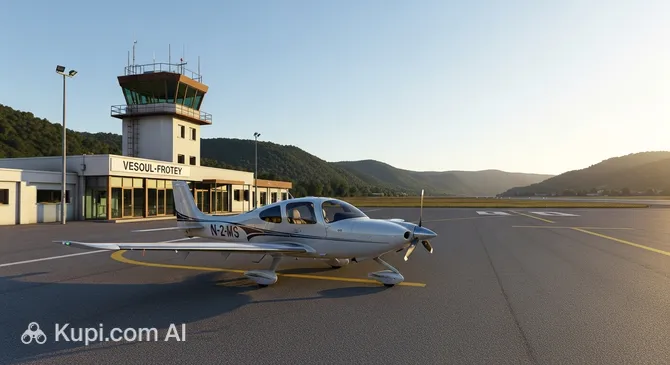
Vesoul-Frotey. Source: Kupi.com Binoculars

Vesoul-Frotey Airport (Vesoul-Frotey), also known as Sabot Airfield, is a cozy air haven situated on a picturesque plateau in the Bourgogne-Franche-Comté region. This small aerodrome serves not so much for mass tourism, but for connoisseurs of private aviation, parachuting, and breathtaking flights over the French countryside. Its runway offers stunning views of the Sabot de Frotey Nature Reserve and the Durgeon Valley, turning every takeoff and landing into a small aesthetic adventure.

AirportVesoul-Frotey
IATAXVO
ICAOLFQW
CityVesoul
TimezoneEurope/Paris
ScheduleOnline board

Features and Advantages of the Airport

Vesoul-Frotey is a perfect example of a local French aerodrome, where the atmosphere of club aviation reigns rather than the hustle of international terminals. The main feature of the facility is its location on high ground, next to the Sabot de Frotey National Nature Reserve, making it attractive for amateur pilots and photographers.

The airfield is the base for the local flying club (Aéroclub de la Haute-Saône), which offers piloting lessons, introductory flights, and parachute jumps. Due to its compactness and the absence of regular commercial flights, all procedures here are completed as quickly and comfortably as possible. For owners of private planes and business jets, this is a convenient access point to the Haute-Saône department, allowing you to reach the city of Vesoul in just a few minutes by car.

Contact Information

Since Vesoul-Frotey Airport is a general aviation aerodrome managed by the local flying club (Aéroclub de la Haute-Saône), there are no classic services for commercial passengers here. To contact the administration, please use the following details:

  • Official Website: aeroclub70.free.fr (Haute-Saône Flying Club web resource)
  • Information Desk Phone: +33 3 84 76 43 66
  • Airport Address: 2500 Route de l'Aérodrome, 70000 Frotey-lès-Vesoul, France
  • Email: aeroclub70@wanadoo.fr
  • Social Media: Official Aéroclub de la Haute-Saône Facebook page
  • Lost and Found Information: There is no centralized service (no commercial flights); for forgotten items, please contact the flying club administration directly.
  • Support Contacts: All inquiries are handled by the airfield secretariat via the main phone number or email.

How to Get to the Airport

Since Vesoul-Frotey Airport (Vesoul-Frotey) is located just a few kilometers from the city center of Vesoul, getting there is quick and without unnecessary hassle. However, it is worth noting that this is a small aviation airfield, so there are no regular shuttles or express trains. The main modes of transport remain cars and taxis.

Car and Taxi

Traveling by car is the most convenient option. The airfield is located in the commune of Frotey-lès-Vesoul. From the center of Vesoul, the route usually runs through Rue de Saint-Claude or Avenue du Durgeon, transitioning into the road leading to the Sabot plateau. The travel time from the city center is only 5–10 minutes if there is no traffic.

Taxis can be ordered by phone or through local apps. The cost of a trip from the center of Vesoul to the airfield varies between 10–15 Euros during the day. It is recommended to arrange a transfer in advance, especially if you are arriving by private plane and need a car waiting for you upon landing.

Public Transport

There is no direct rail or metro connection to the airfield. The nearest major railway station, Gare de Vesoul, is located in the city center. Trains from Paris, Mulhouse, and Belfort arrive here.

The VBus city bus network serves the surrounding areas, including Frotey-lès-Vesoul. You can use routes (e.g., Line 1) going towards the Frotey Town Hall (Mairie de Frotey). From the stop in the village to the airfield itself, you will have to walk about 15–20 minutes uphill. This option is suitable only for travelers without heavy luggage who are ready for a walk in the fresh air.

Car Rental and Parking

There are no rental company counters directly in the flying club building. It is recommended to rent a car in advance in the center of Vesoul, near the railway station, where well-known agencies (such as Hertz, Europcar, or Avis) are represented.

For those arriving at the airfield in their own transport, free parking is provided next to the hangars and the administrative building. There are usually enough spaces, as traffic here is moderate.

Nearest International Airports

Since Vesoul-Frotey does not accept regular commercial flights, tourists most often fly to major airports in neighboring regions and then travel to Vesoul by train or rental car. Here is a list of the main air hubs nearby:

  • Dole-Jura Airport (DLE) — located approximately 90 km from Vesoul. This is the closest airport accepting some European flights.
  • EuroAirport Basel-Mulhouse-Freiburg (MLH/BSL/EAP) — located 100 km away. This is a major international hub, convenient for travelers from many countries.
  • Strasbourg Airport (SXB) — located 145 km away. An excellent option for those who want to combine a trip to Vesoul with a visit to Alsace.

For the trip from these airports to Vesoul, count on a 1.5–2 hour drive by car or slightly more when using rail transport with transfers.

Terminals and Layout

Terminal Structure

Given the status of Vesoul-Frotey (XVO) as a general aviation aerodrome, the system familiar to large airports with multiple passenger terminals, gates, and jet bridges is absent here. The facility's infrastructure represents a single functional complex centered around the flying club building and technical hangars. It is a compact space where all necessary services are within walking distance of each other.

The main building serves as a terminal, administrative center, and relaxation spot simultaneously. It services:

  • Private aviation pilots and their passengers.
  • Parachuting participants.
  • Flight school students.
  • Visitors arriving for introductory flights.

Layout and Navigation

Navigation around the territory is extremely simple and intuitive. The entire complex can be roughly divided into three zones:

  1. Public Zone (Landside): Includes the parking lot and the entrance to the main flying club building. The reception, waiting area, and briefing rooms are located here.
  2. Hangar Zone: Technical facilities for storing and servicing aircraft, located in immediate proximity to the main building.
  3. Flight Zone (Airside): The apron, taxiways, and runway. Access here is strictly regulated and permitted only when accompanied by an instructor or pilot.

There are no complicated passageways, underground tunnels, or shuttles here — moving between the parking lot and the plane takes no more than 2–3 minutes on foot.

Departure and Arrival Zones

Since there are no regular commercial flights, the classic separation into "Departure Zone" and "Arrival Zone" with passport control and baggage claim does not exist here. All operations pass through the main hall of the flying club.

  • Departure: Passengers and pilots meet in the club building, undergo the necessary briefing (or pre-flight preparation), and then walk directly onto the apron to the aircraft.
  • Arrival: After landing and taxiing, the plane stops at the parking area in front of the building, and arrivals immediately enter the public zone or exit to the parking lot.

Service Features and Processing Time

The main feature of Vesoul-Frotey is the absence of bureaucracy and queues typical of large airports. Registration and security screening procedures in the usual sense (scanners, metal detector frames) are not conducted here, unless specific events are involved. However, flight safety remains a priority.

The time for completing formalities is minimal:

  • For private pilots: Pre-flight briefing, checking weather reports and flight plans take about 20–30 minutes.
  • For private flight passengers: It is recommended to arrive 15–20 minutes before departure. This time is sufficient to meet the pilot and board.
  • For parachutists: It is required to arrive in advance (usually 30–60 minutes) for medical checks, briefing, and equipment fitting.

Navigation Recommendations

Upon arriving at the airfield, follow signs to the main entrance marked Aéroclub. If you have arrived for a meeting or excursion, speak to the administrator at the counter or any staff member in club uniform — the atmosphere here is friendly, and they will quickly direct you. Entering the flight field without an escort is strictly prohibited for safety reasons.

Airport History

The history of Vesoul-Frotey Airport (XVO) is not a chronicle of building giant terminals, but an inspiring tale of passion for the skies and the development of private aviation in France. It all began in the interwar period, specifically in **1934**, when the Haute-Saône Flying Club (Aéro-club de la Haute-Saône) was founded. A group of local enthusiasts chose a unique location for flights — the Sabot plateau (Le Sabot), rising above the Durgeon Valley. This place was ideal due to its flat surface and lack of high obstacles.

In the early years of its existence, the airfield was a classic grass field where pilots trained on light piston aircraft. After World War II, interest in civil aviation in the region increased sharply, requiring an expansion of the site's capabilities. A key stage of modernization was the construction of a hard runway with asphalt paving 1,444 meters long. This strategic decision raised the airfield's status to a new level, opening Vesoul to twin-engine aircraft and small business jets connecting the city with European business centers.

Key Stages of Development

Over the decades, the infrastructure of Vesoul-Frotey has been carefully updated, preserving the authentic spirit of the flying club. In the late 20th and early 21st centuries, significant work was carried out to reconstruct the hangar complex, allowing for an increase in the fleet of based aircraft. The club building was also modernized, becoming a comfortable place for training flight school cadets. An important achievement was the installation of modern lighting equipment, ensuring flight safety.

Interesting Facts from History

  • The Legend of the Devil's Sabot: The name of the area "Sabot" translates from French as "wooden clog/shoe." According to an ancient local legend, the devil, flying over these lands with a heavy burden, dropped his clog, which turned to stone and became a hill. It is on this legendary "clog" that planes take off and land today.
  • Sporting Glory: The airfield is historically not just a transport hub, but an important sports arena. Vesoul-Frotey has established itself as one of the leading regional centers for parachuting, regularly hosting competitions and training camps that have raised many professional athletes.
  • Ecological Balance: The airport developed in close proximity to nature. In 1981, part of the plateau was declared a National Nature Reserve. The airfield administration managed to organize operations so that flights do not disturb the peace of the unique ecosystem, becoming an example of the harmonious coexistence of aviation and environmental protection.

Services and Amenities

Services at the airport:

Since Vesoul-Frotey Airport (XVO) is a small general aviation aerodrome, you will not find the wide range of services typical of large international hubs here. The infrastructure is focused on the basic needs of pilots and their passengers, providing comfort without excess.

Restaurants, Cafés, and Shops

There are no large chain restaurants, Duty-Free shops, or boutiques on the airfield grounds. The main place for rest and a snack is the Clubhouse of the flying club.

  • Dining: The flying club building usually has a bar or a small cafeteria area where you can have coffee, soft drinks, and a snack (snacks, sandwiches). This is a great place to socialize with local aviators in an informal setting.
  • Nearby Restaurants: For a full lunch or dinner, it is recommended to go to the city of Vesoul (5–10 minutes by taxi), where a wide selection of Burgundian and French cuisine establishments is presented.
  • Shops: There are no retail outlets at the airfield. If you need to buy souvenirs or travel items, it is better to do so in the city in advance.

Waiting Lounges and VIP Services

There are no specialized business lounges or closed VIP lounges with separate service here. The common hall of the flying club serves as the waiting area. Thanks to low traffic and the absence of outsiders, the atmosphere here is always quiet and practically private, which corresponds to the level of VIP service in terms of comfort and silence.

Communication and Electronics

For the convenience of visitors, basic communication capabilities are provided in the airfield building:

  • Wi-Fi: A free Wi-Fi network is usually active on the club grounds for pilots and guests. The password can be obtained from the administrator.
  • Charging Stations: There are no special stands for charging gadgets, but a sufficient number of standard electrical outlets are available in the waiting area.

Financial Services

Please note that there are no ATMs, currency exchange points, or bank branches at Vesoul-Frotey. It is recommended to carry a small amount of cash Euros for minor expenses (e.g., taxi). The nearest ATMs are located in the commune of Frotey-lès-Vesoul or in the center of Vesoul.

Medical Services

The airfield has a first aid kit, and staff are trained to act in emergencies. However, there is no full-fledged medical center or pharmacy on the premises. In case of serious health problems, assistance will be provided by the city ambulance service; the Vesoul hospital is just a few kilometers away.

Services for Passengers with Children

Specialized mother and child rooms or playgrounds are absent. The airfield is compact, so waiting for a flight with children does not cause difficulties, but parents should closely monitor children, as access to the flight field is open and located in immediate proximity.

Services for Passengers with Reduced Mobility

The flying club building is single-story, which facilitates access for passengers with reduced mobility. The absence of stairs and long corridors makes movement comfortable. If you require special assistance boarding a private plane, you must notify your pilot or the flying club administration in advance.

Hotels and Accommodation

There are no hotels on the airfield grounds themselves. Passengers and crews can stay in hotels located in the immediate vicinity:

  • In Frotey-lès-Vesoul: In the village adjacent to the plateau, small guesthouses (Gîtes) can be found.
  • In Vesoul: In the city center (3–4 km from the airfield), hotels of various categories are located, including the Grand Hôtel du Nord or chain hotels such as Ibis and F1.

Business Services

For business travelers arriving on private jets, the flying club can provide a room for a briefing or a short meeting upon prior request. Full-fledged conference rooms with equipment are available in hotels and business centers in the city of Vesoul.
Where to Eat

The gastronomic component of Vesoul-Frotey Airport (XVO) fully corresponds to its status as a small general aviation aerodrome. Passengers should not expect food courts, chain coffee shops, or gourmet establishments typical of large international hubs here. The dining system is intimate, functional, and primarily focused on a snack before a flight or a friendly chat after landing.

Cafés and Refreshments on Site

The only dining point on the territory is the Flying Club Bar (Clubhouse Area), located in the main administrative building. This is the heart of the airfield's social life, where pilots, instructors, and guests gather.

  • Assortment: Hot drinks (coffee, tea, hot chocolate), soft drinks, juices, and water are served here. Food options usually include light snacks: croissants and pastries (especially in the mornings), sandwiches, chocolate bars, and chips.
  • Location: The facility is located in the public area (landside), immediately upon entering the club building. Due to the compactness of the facility, it effectively serves the departure area as well, as the exit to the planes is just a few meters away.
  • Atmosphere: The venue features a cozy, almost home-like setting with a view of the flight field. It is an ideal place for "hangar flying" — discussing flights over a cup of coffee.

Full Meals and Local Cuisine

For a full lunch or dinner, passengers and crews are strongly advised to head to the city of Vesoul or the neighboring commune of Frotey-lès-Vesoul. Traditional French bistros and restaurants are located within a 5–10 minute drive.

If you are heading into the city, you might encounter the gastronomic symbols of the Franche-Comté region:

  • Cancoillotte: A famous runny processed cheese with low fat content, often served with potatoes.
  • Montbéliard Sausage (Saucisse de Montbéliard): Smoked sausages, a hallmark of local cuisine (Note: typically pork-based).
  • Griottines: Local cherries soaked in Kirsch (cherry brandy) — a popular dessert or souvenir (contains alcohol).

Dietary Options (Vegetarian, Vegan, Halal, Gluten-Free)

Given the limited assortment of the flying club, specialized dietary options are practically absent here.

  • Vegetarians: Cheese sandwiches or pastries may be available, but the choice is minimal.
  • Vegans and Gluten-Free: Finding suitable food at the airfield itself will be extremely difficult. It is recommended to bring snacks with you or plan a meal in city restaurants where the selection is much wider.
  • Halal and Kosher: Specialized products are not sold at the aerodrome.

Prices and Opening Hours

The pricing policy at the flying club is very reasonable and does not have the markups typical of large airports.

  • Average Check: Coffee or water will cost 1–2 Euros, a sandwich or snack — about 3–5 Euros. A quick snack rarely exceeds 5–7 Euros per person.
  • Opening Hours: The schedule coincides with the activity of the flying club. It is usually open from 09:00 to 18:00 (longer in summer), especially on weekends and holidays when flights take place. On weekdays in winter or during bad weather, service may be limited.

Recommendations for Passengers

If your departure is scheduled for early morning or late at night, take care of food in advance. Vesoul-Frotey Airport is a place to start a journey, not for gastronomic discoveries. The best strategy: enjoy a cup of coffee before departure, and plan your main meal at one of the cozy restaurants in Vesoul upon arrival or before leaving for the airfield.

Travel Tips

Traveling through a small airfield like Vesoul-Frotey differs radically from the experience in large international hubs. There are no endless queues or bustle, but there are specific rules of etiquette and logistics peculiar to small aviation. Here are a few recommendations to help make your flight comfortable and safe.

Optimal Arrival Time

Forget the standard rule of "arriving 2–3 hours early." At Vesoul-Frotey, everything happens much more dynamically. If you are flying on a private plane or have booked an air taxi, arriving at the airfield 20–30 minutes before the scheduled departure time is sufficient. This is enough time to meet the pilot, discuss the route, and load luggage. For those planning a parachute jump, it is better to check the meeting time with the instructor — usually, you need to arrive an hour early for equipment preparation.

Check-in and Screening: Simpler Than It Seems

There are no check-in counters, printed boarding passes, or scanners for removing shoes here. "Check-in" most often consists of a simple handshake with your pilot. However, a passport or ID card should still be kept handy, as their possession is mandatory for any flight. Security checks are conducted visually by the aircraft captain, who assesses the compliance of cargo and passengers with flight rules.

Luggage: Weight Matters

In light aviation, every kilogram counts.

  • Type of Bags: It is strongly recommended to use soft sports or travel bags rather than rigid plastic suitcases. The luggage compartments of light aircraft (such as Cessna or Piper) often have non-standard shapes, and a soft bag is much easier to stow.
  • Limitations: Strictly agree on the weight of luggage with the pilot in advance. Overloading in light aviation is unacceptable for safety reasons.
  • Liquids: The "100 ml" rule is usually not applied as strictly here as on commercial flights, but the transport of dangerous substances (flammable, explosive) is categorically prohibited.

Choosing a Seat on the Plane

In small planes, passenger seating is often dictated not by personal preference but by the center of gravity of the aircraft. The pilot will assign you a seat to ensure the correct balance of the plane. If weight allows for a choice, the best seat is next to the pilot (in front), offering a panoramic view of the instrument panel and the landscapes of Franche-Comté. Do not hesitate to politely ask about this in advance.

Connections and Transfers

Vesoul-Frotey is not a transit hub. There is no concept of a "connecting flight" with baggage transfer by an airline here. If your route involves a further flight from a major airport (for example, from Basel or Lyon), allow enough time for the ground transfer. The risk of a small plane's departure being delayed due to weather is higher, so leave a buffer of 3–4 hours before your next flight.

Customs and Documents

Since most flights here are domestic or within the Schengen zone, there is no permanent customs control at the airfield. However, if you are arriving from a country outside Schengen (for example, from the UK or Switzerland), the pilot is obliged to notify border services in advance. In this case, the Gendarmerie may arrive at the airfield to check documents. Always have valid visas and passports with you.

Tips for Saving Money

  • Transfer: A taxi to the airfield can be expensive if called from remote areas. It is cheaper to order a car in advance from the center of Vesoul or ask local flying club members to give you a lift to the city — the aviation community is very friendly.
  • Food: There are no shops with inflated prices at the airfield, but the food selection is limited. To avoid overpaying and going hungry, take water and light snacks with you from a supermarket in the city.

If the Flight is Delayed

Light aviation is highly dependent on weather conditions. Fog over the Durgeon Valley or strong crosswinds can delay departure for several hours. Unlike major airlines, vouchers for food or hotels are not provided here for weather delays.
What to do: Relax in the clubhouse, use the Wi-Fi, or chat with the pilots. If the weather is hopeless, have a "Plan B" — for example, the train schedule from Vesoul station (Gare de Vesoul) to reach your destination by ground transport.

Reached the end of the page?

That means the route is fully explored