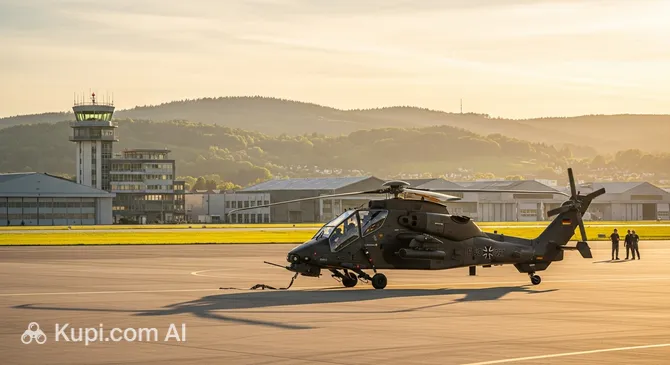
The history of Fritzlar Airfield is a fascinating journey through time, spanning nearly a century. For tourists interested in military history and technology, this facility represents a unique example of how an aviation base can evolve from a field aerodrome of the 1930s to an ultra-modern centre of helicopter aviation in the 21st century.
Foundation and Early Years (1938–1945)
The history of the airfield began in the spring of 1938, when construction of an airbase for the Luftwaffe started on the "Eckerich" field on the outskirts of Fritzlar. The opening took place quite quickly, and by the beginning of World War II, the facility was functioning as a base for bomber and fighter aviation. At that time, it was a classic airfield with a grass surface, typical of that era.
American Period (1945–1957)
After the end of the war, during Easter 1945, the airfield was occupied by American troops. For the next 12 years, it served as a base for US Army Aviation and was named Fritzlar Air Base. During this period, various units were based here, including cavalry regiments and artillery units using light aviation for reconnaissance. It was the American presence that saved the facility from complete dismantling, which befell many other German military facilities of that time.
Return to the Bundeswehr and the Helicopter Era
A key moment in history was 14 March 1957, when the base was officially handed over to the newly created German Armed Forces (Bundeswehr). From this moment, Fritzlar's establishment as the capital of army aviation began.
- 1960s and 70s: The airfield became home to various aviation units, but true specialisation was defined later. Active operation of Alouette II helicopters began here.
- 1979: A significant milestone — the formation of the Anti-Tank Helicopter Regiment (Panzerabwehrhubschrauber-Regiment 35), which was later reformed. For many years, the sky over Fritzlar was filled with the characteristic sound of the engines of light and manoeuvrable Bo-105 helicopters.
Massive Modernisation and the "Tiger" Era
The most significant reconstruction in the airfield's history began in the late 1990s and continued into the 2000s. This was linked to the decision to station the newest Eurocopter Tiger combat helicopters here.
To accommodate this complex machinery, the base underwent radical changes:
- New huge hangars were built, capable of housing modern equipment and maintenance facilities.
- Ultra-modern buildings with flight simulators were erected, allowing pilots to practice combat missions without taking off.
- The runway and taxiways were modernised, and navigation equipment was updated.
Investments in this modernisation amounted to hundreds of millions of Euros, making Fritzlar one of the most modern helicopter bases in Europe.
Interesting Facts and Achievements
Over its long history, Fritzlar Airfield has accumulated quite a few interesting features:
- Honorary Name: In 2008, the 36th Attack Helicopter Regiment based here was awarded the honorary name "Kurhessen", emphasising the deep connection of the military with the historic region of Hesse.
- Contrast of Eras: Fritzlar is one of the few places in the world where you can take a photo of a super-modern combat helicopter against the backdrop of fortress towers and cathedrals from the 12th century. This visual contrast attracts spotters from all over Europe.
- Long-standing: The airfield is one of the oldest continuously operating military airfields in Germany, retaining its significance despite all the geopolitical changes of the 20th century.