Support

Eugenides Planetarium

About

The Eugenides Planetarium, also known as the Eugenides Foundation, is an impressive science and education center in Greece. Although it is sometimes mentioned in the context of Piraeus, it is actually located in the Palaio Faliro district of southern Athens, near the shores of the Saronic Gulf. It is one of the largest and most technologically advanced planetariums in Europe, aiming to make science accessible and engaging for everyone.
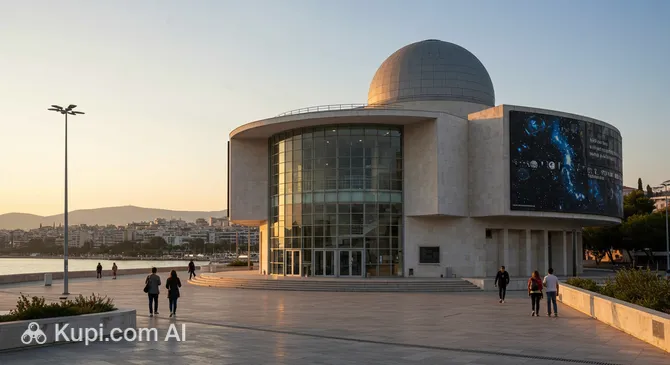
Eugenides Planetarium. Illustration.
Source: Kupi.com AI

Traveler photos:

The main pride of the Eugenides Planetarium is its enormous dome screen, 25 meters in diameter, onto which images are projected using a state-of-the-art high-resolution digital system. This creates a stunning effect of total immersion, allowing viewers to go on a virtual journey through the universe, exploring distant stars, planets, and galaxies, as well as learning about the latest astronomical discoveries.

In addition to breathtaking space shows, the Eugenides Foundation complex includes an interactive science and technology museum where visitors can experiment and learn. It also features an extensive science library, modern conference halls for lectures and events, and a cafe. The foundation's primary mission is the popularization of science and technology, especially among young people, and stimulating interest in knowledge and research.

Contacts

For the most up-to-date information regarding the Eugenides Planetarium, including visiting hours and ticket prices, it is recommended to visit the official website or contact them directly. Below are the main contact details.

You can also find the Eugenides Planetarium on social media, such as Facebook (Eugenides Foundation) and Instagram (@eugenidesfoundation), to stay updated on news and event announcements. Physical address: Λεωφ. Συγγρού 387, Παλαιό Φάληρο 175 64, Athens, Greece.

How to contactContact
Address387 Syggrou Ave. (entrance 11, Pentelis st, Athina 175 64, Greece
Phone number+30 21 0946 9600
Websitewww.eef.edu.gr

What to Do

At the Eugenides Planetarium, visitors can expect a thrilling immersion into the world of space. The main highlight is the spectacular shows demonstrated on the massive dome. You can embark on a virtual journey through the universe and learn about stars, planets, and amazing astronomical phenomena. Programs are updated regularly, combining educational content with entertainment elements. Popular sessions include "Journey into the Universe," "Dark Matter," and "Birth of the Solar System." While the narration is in Greek, English translations are provided via headphones for international guests, making the visit accessible and clear.

Beyond the planetarium itself, the complex houses an interactive science museum. It features exhibits dedicated to physics, astronomy, mathematics, and other sciences. Visitors, especially younger ones, enjoy participating in scientific experiments, exploring interactive stands, and visiting temporary exhibitions. It is a wonderful opportunity not only to see but also to touch science, making the learning process engaging and memorable.

For those wishing to deepen their knowledge, there is a science library on the premises. It boasts a rich collection of books and periodicals on natural sciences, technology, and mathematics. After a busy program full of discoveries and new experiences, you can relax in the local cafe. It offers a panoramic view of Athens, allowing you to enjoy a cup of coffee while reflecting on what you've seen.

Getting There

The Eugenides Planetarium, one of Athens' most fascinating attractions, is located in the Palaio Faliro district at 387 Syngrou Avenue. This modern science center can be reached in several convenient ways, making it easily accessible for both residents of the Greek capital and visitors arriving from, for example, Piraeus.

The most common way to reach the planetarium is by public transport. If you plan to use the metro, the nearest station is "Syngrou-Fix" (M2 red line). From this station, you will need to take a short tram ride toward Voula or catch one of the local buses. Another convenient option is to take a tram directly from the central Syntagma Square: routes T3 or T5 both stop right at the "Planetarium" station. Additionally, buses 550, A2, B2, and E2 serve the planetarium, as does the X96 express bus from Athens Airport.

If you prefer to travel by taxi, the trip from central Athens, such as Syntagma Square, usually takes about 15-20 minutes, though travel times can vary depending on traffic. A taxi ride from the port city of Piraeus takes approximately the same amount of time. For those traveling by private car, the Eugenides Planetarium is situated on Syngrou Avenue, one of the main thoroughfares in Athens. Visitor parking is available near the planetarium, but keep in mind that finding a spot can be challenging during peak hours.

Nearest city: Piraeus

History & Facts

The Eugenides Planetarium in Piraeus is not just a place for stargazing, but an institution with a rich and significant history. Its creation was made possible by the Eugenides Foundation, which was established in 1954 according to the will of the famous Greek shipowner and philanthropist Eugenios Eugenidis (1882-1954). Initially, the foundation's mission was to support and develop technical education in Greece and to publish up-to-date scientific and technical literature, which laid the foundation for its future educational activities.

The foundation's first building opened to the public in 1966, serving as a starting point for many educational initiatives. However, the true technological leap and transformation happened later. The modern planetarium building that delights visitors today was built in 2003 following a massive reconstruction. The new digital planetarium was officially opened on November 11, 2003. This event was significant not only for Piraeus but for all of Greece, as it was the country's first digital planetarium and one of the largest and most technologically advanced in the world at the time.

Striving to maintain high standards and offer visitors the most modern capabilities, the Eugenides Planetarium underwent another major equipment upgrade in 2017. This update significantly improved the quality of projections and expanded the repertoire of impressive shows, further immersing viewers in the mysteries of the universe. Over the years of its fruitful work, the Eugenides Planetarium has firmly established itself as one of the most important scientific and educational centers in Greece. Every year, its halls welcome thousands of schoolchildren, students, and curious visitors eager to touch the world of astronomy and science.

Time Needed

When planning a visit to the Eugenides Planetarium in Piraeus, you should expect that a full exploration will take approximately 2-3 hours. This time will be sufficient to see the main exhibits and immerse yourself in the world of astronomy.

The main part of the visit is, of course, a session in the planetarium itself. A standard show usually lasts about 40-50 minutes, taking viewers on an exciting journey through the starry sky. After that, it is recommended to set aside another 1-1.5 hours to explore the science museum and interactive exhibits that clearly demonstrate various physical phenomena and astronomical concepts. These exhibits are interesting for both adults and children.

If you want to delve deeper into scientific topics, visit the library, or participate in any additional educational programs or lectures that are periodically held at the planetarium, extra time will be required. Therefore, if your interest goes beyond a standard visit, it is better to check the event schedule in advance and add a little more time to your plan.

Working Hours

The Eugenides Planetarium in Piraeus warmly welcomes visitors from Tuesday to Sunday, providing a unique opportunity to dive into the world of stars and galaxies. On weekdays, from Tuesday to Friday, the planetarium is open from 9:00 AM to 8:00 PM. On weekends, Saturday and Sunday, the doors open a bit later—from 10:30 AM to 8:00 PM. The planetarium is closed on Mondays. Shows in the planetarium dome are held according to a schedule, typically every 1-2 hours, with the last session usually starting around 6:30 PM or 7:00 PM.

While the planetarium operates year-round, please note that during the summer months (July-August) and on Greek national holidays, the schedule may change. Therefore, it is strongly recommended to check the current session schedule and opening hours on the official Eugenides Planetarium website before your visit. This will help you plan your trip effectively and avoid any potential inconvenience. Booking tickets in advance, especially for popular sessions or group visits, is also a good idea to guarantee your spot.

DayOpening hours
MondayClosed
TuesdayClosed
Wednesday5:00 – 20:30
Thursday5:00 – 20:30
Friday5:00 – 20:30
Saturday10:00 – 20:30
Sunday10:00 – 20:30

Nearby

A visit to the Eugenides Planetarium is undoubtedly a memorable event, but exploring its surroundings can make your journey to Piraeus even more fulfilling and interesting. Exploring nearby locations will allow you to dive deeper into the city's atmosphere and discover something new.

Don't stop at just one attraction! A stroll through the neighborhood around the Eugenides Planetarium can lead to unexpected discoveries, whether it's a cozy cafe, a scenic park, or another point of interest. This is a great opportunity to get to know Piraeus and its multifaceted character better. Below is a list of some attractions located nearby.

NameDistance
Koutouki Kalypso0.4 km
Pikioni Park0.5 km
Warehouse Edge0.6 km
Water Square0.8 km
Museum Ship Averof1.3 km
Benaki Toy Museum1.4 km
Palaio Faliro1.6 km

Have you reached the end of the page?

So the route has been studied inside and out